Georeferenced Precision for Industrial As Built Documentation
Network RTK via NTRIP provides the georeferencing backbone for reality capture
workflows in refineries, power plants, and large scale manufacturing facilities


Network RTK via NTRIP provides the georeferencing backbone for reality capture
workflows in refineries, power plants, and large scale manufacturing facilities

Measuring the world around us has evolved from simple hand tools to sophisticated optical 3D technology. Whether it is documenting a delicate museum artifact or ensuring an engine component is built to within a few microns of its design, modern metrology relies on structural light scanners like those developed by SMARTTECH3D.
Read Article →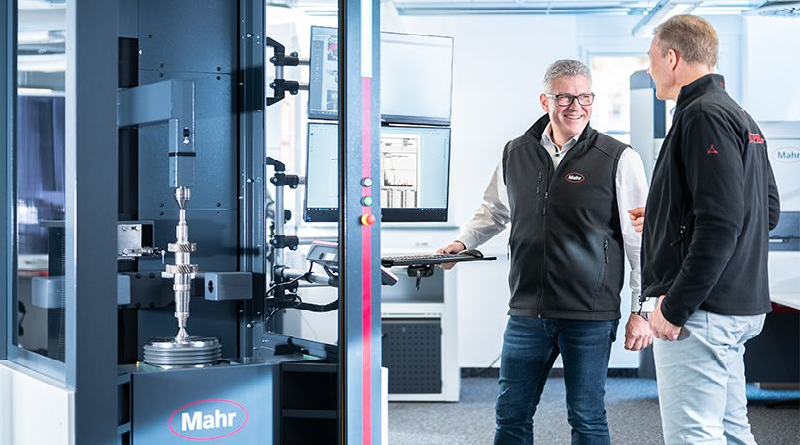
In order to detect such sources of error at an early stage and keep processes stable, measurement engineers use a method that at first glance has more to do with mathematics than with metal – Fourier Analysis.
Read Article →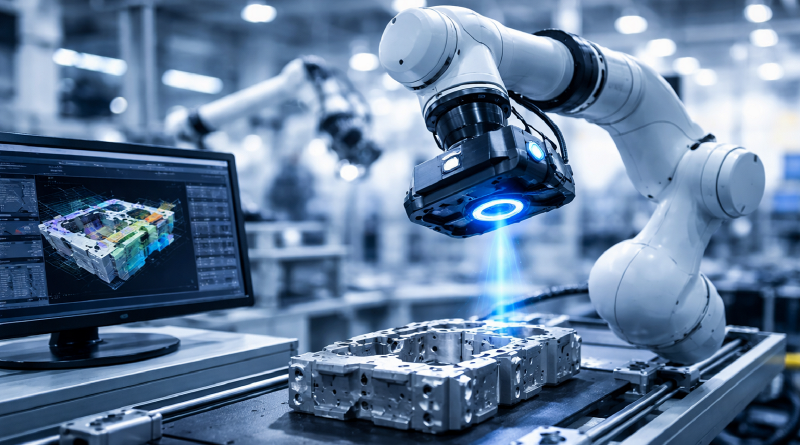
Machine vision has moved far beyond its early role as a digital replacement for human inspection. Today, it is becoming a core enabler of robotic intelligence, giving automated systems the contextual awareness, adaptability, and measurement capability required for high-mix, high-precision manufacturing.
Read Article →
Hexagon’s metrology technologies enable Oracle Red Bull Racing and Red Bull Ford Powertrains to achieve extreme precision in a remodelled chassis with new aerodynamics and highly ambitious new 1.6 litre powertrain.
Read Article →
Standing in a universal workstation, two articulated industrial robots outfitted with white light optical scanners move closely over the entire surface of the high-precision part — in this case, a turbine disk for a GE90 engine.
Read Article →
Zero-defect manufacturing has long stood as one of the most ambitious goals in industrial quality control. For decades, however, it remained more of a guiding philosophy than a practical reality, limited by sampling inspection, human oversight, and delayed feedback from production.
Read Article →
Fully automated, data-driven, precise: Artificial intelligence, sensor technology, and smart production control are turning grinding machines into intelligent manufacturing partners today. This results in productive, flexible, and self-optimizing systems.
Read Article →
A fluorescence laser scanner makes it possible to measure the application of release agents in die casting processes. The measurement data provides the basis for controlling the application of release agents in metal die casting processes.
Read Article →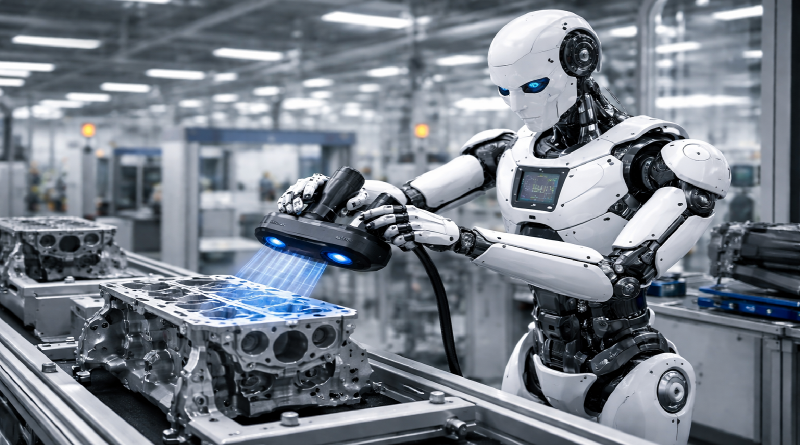
As the smart factory model matures, one of the most intriguing new participants entering the production floor is the humanoid robot. Far from being futuristic curiosities, these human-shaped, AI-enabled robotic systems are emerging as potential enablers of a more connected, adaptive approach to metrology.
Read Article →