AI-Powered Vision System Automates Industrial Battery Sorting
Redwood has developed an automated battery sorting system that combines computer vision, machine learning and multiple sensing technologies to identify and classify batteries before they enter the recycling process. Designed to replace manual sorting, the system is already processing operational feedstock at industrial scale, helping improve material recovery and the consistency of downstream recycling operations.
The system identifies individual batteries using high-resolution imaging, three-dimensional profiling and weight measurement. By combining these data sources, machine learning models determine battery chemistry and direct each unit to the appropriate sorting destination in real time.
The technology supports Redwood’s wider battery recycling operations, including a rotary calciner designed to process more than 40,000 metric tons of material annually, equivalent to approximately 15–20 GWh of battery capacity.
Preparing Mixed Battery Feedstock for Automated Inspection
Battery feedstock arriving from collection partners presents a significant handling challenge. Rather than being delivered in an orderly sequence, batteries typically arrive in drums, boxes and bins, mixed with insulating materials and covering a wide range of sizes, shapes and form factors.
Before individual batteries can be inspected and classified, the material must be separated and presented consistently to the sensing equipment.

Redwood has therefore developed a multi-stage infeed system that progressively breaks down the incoming material, separates insulation and reduces the flow to a single-file sequence. This ensures that batteries pass through the inspection system individually, providing consistent conditions for image capture and measurement.
Combining Computer Vision and 3D Measurement
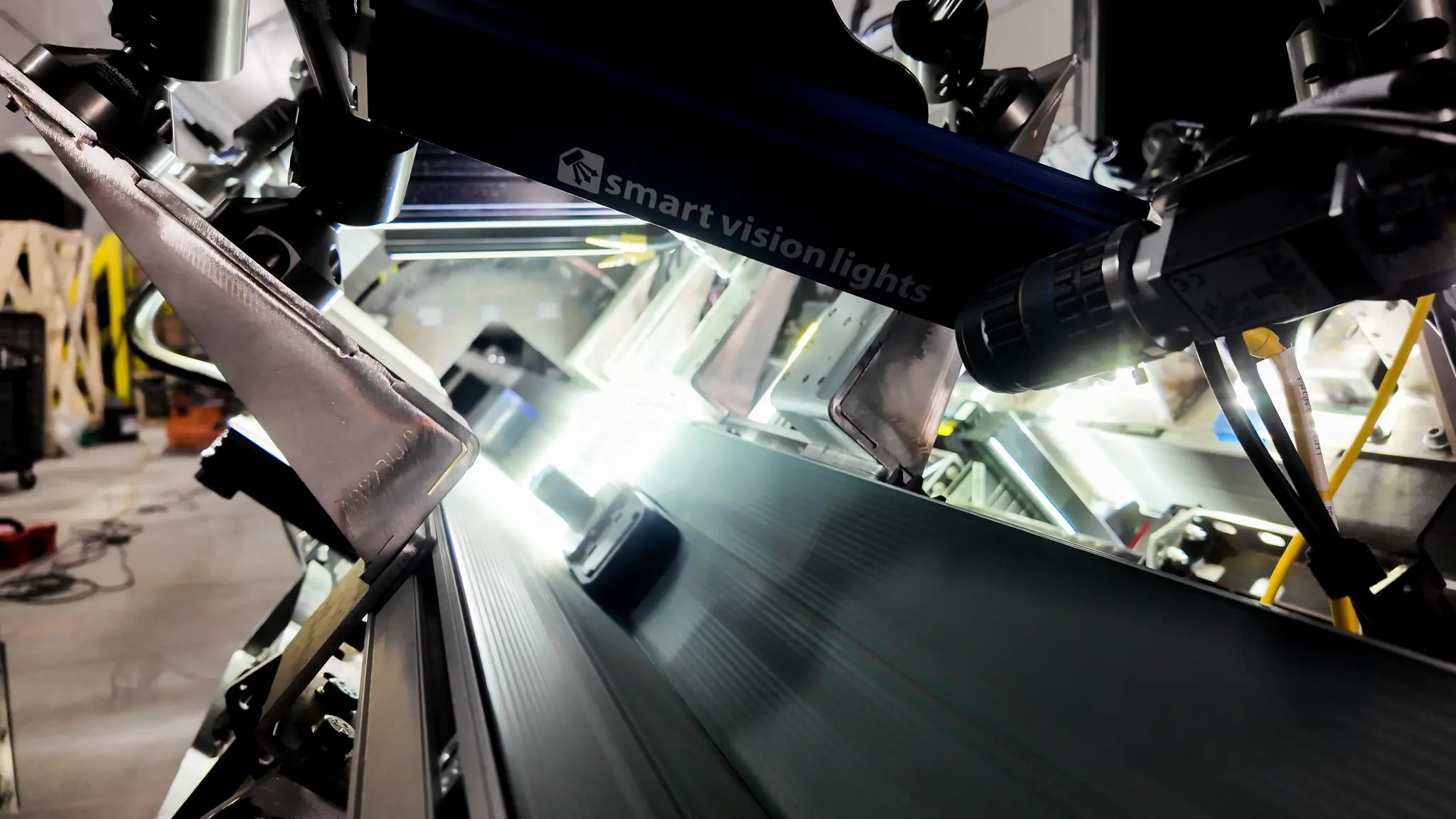
Each battery passes through a sensor tunnel where several measurement technologies capture complementary information.
High-resolution cameras acquire images of every side of the battery, including its underside, enabling the system to identify chemistry markings, printed text and label information. A laser profilometer measures the battery’s three-dimensional geometry, while a checkweigher records its mass.
The resulting sensor data are transmitted asynchronously to an on-premise GPU computing cluster, where machine learning models process multiple batteries in parallel. Developed using Redwood’s own battery datasets, the models combine printed text, physical geometry and weight to predict the chemistry of each battery.
Classification results are returned to the line’s control system in real time. The inference pipeline has been optimised to complete its assessment before each battery reaches the outfeed, even when the line is processing several metric tons of material per hour.
An earlier version of the system used X-ray inspection. However, Redwood found that most of the information required to identify battery chemistry could be obtained from external markings and physical characteristics. The transition to conventional cameras reduced system cost, simplified operation and provided a more scalable inspection architecture.
Real-Time Classification and Sorting
Once a battery has been classified, the control system determines its destination and coordinates the appropriate sorting mechanism.
Depending on the sorting station, batteries are diverted using mechanical diverters, pneumatic actuators or synchronised servo motion control. Each mechanism has been selected and configured to maintain accurate positioning at the required production speeds.
An integrated guide-by-light system provides operators with a visual indication of the classification decision. A strip of lights running alongside the conveyor changes colour according to the identified battery chemistry, allowing operators to monitor the system’s decisions and intervene if a classification appears incorrect.
Maintaining accurate visual positioning requires continuous tracking of each battery. The system combines measurements from the laser profilometer with conveyor belt encoder data to keep the guide-by-light indication aligned with the corresponding battery, including when belt speed varies.
Measuring Classification Accuracy
At the end of the inspection process, the machine learning model can assign one of three outcomes: accepted for recycling, rejected, or classified as unknown.
Developing reliable classification models presents particular challenges because battery designs, chemistries and battery-containing products continue to evolve. Redwood’s recycling process accepts a broad range of feedstock, making accurate identification essential.
Two types of classification error have different consequences. The first occurs when an unsuitable battery chemistry is incorrectly accepted. This can introduce contamination into the recycled material and create instability in downstream processing.
The second, less visible error occurs when a suitable battery is incorrectly rejected. Although this does not necessarily trigger an operational alarm, it reduces recovery yield because potentially valuable materials, including lithium, nickel and cobalt, are lost from the recycling stream.
These competing risks establish the operating limits for the classification system. Rather than relying on conventional machine learning performance scores that can obscure the relationship between false acceptances and false rejections, Redwood’s engineering team developed separate performance metrics to monitor each type of error.
Every classification decision is logged alongside its underlying sensor data. If downstream material quality falls outside specification, the relevant decisions can be retrieved and examined to establish what the model detected and how it reached its conclusion.
The company also operates a continuous data labelling and model improvement process. A custom automated labelling pipeline, developed by Redwood engineers, is supplemented by human review for more challenging cases. The resulting labelled datasets are fed back into model training, allowing performance benchmarks to be refined using examples of errors encountered in production.
According to Redwood, this iterative development process has increased classification accuracy from an initially untrained model to more than 98%.
Engineering For Industrial Throughput
The current automated sorting line was designed and commissioned within a matter of months by a relatively small, cross-functional engineering team covering mechanical, electrical, controls and software disciplines. It is now processing operational battery feedstock at production volumes.
By identifying battery chemistry at the individual-unit level before thermal processing, the system provides greater control over the composition of material entering the recycling process. Improved classification reduces contamination, supports more consistent calciner operation and increases the potential recovery of valuable metals.
The automated sorting line forms part of Redwood’s broader investment in the engineering infrastructure required to establish a domestic battery supply chain. As battery recycling volumes increase, the ability to combine automated handling, machine vision, dimensional measurement and machine learning will become increasingly important to achieving consistent material quality and economically viable recovery at industrial scale.
For more information: www.redwoodmaterials.com