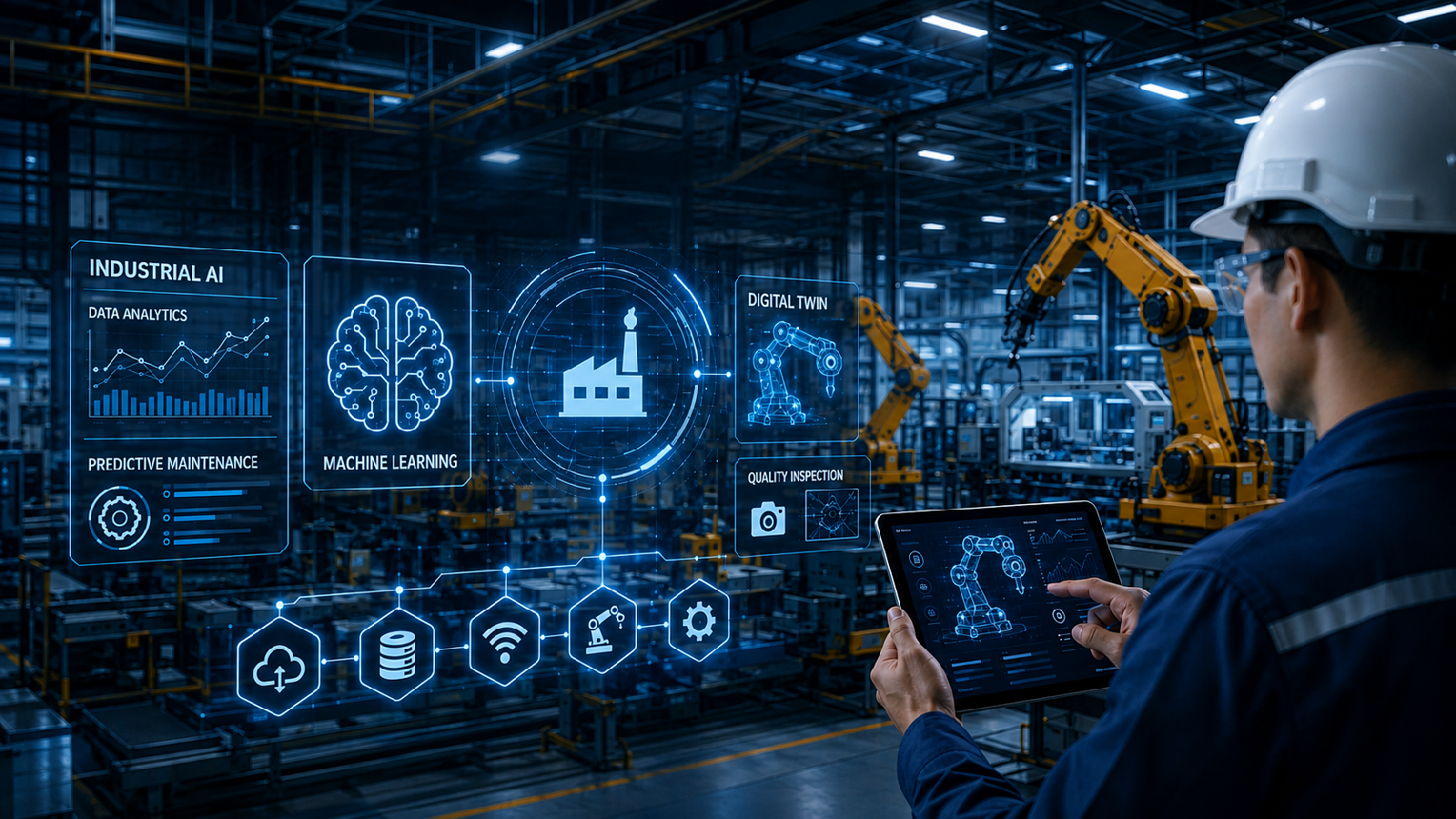
IMTS 2026: Big Tech Sets Out the Future of Industrial AI
Manufacturers looking to understand where artificial intelligence is headed and how to put it to work can hear directly from some of the world’s leading technology companies at IMTS 2026 – The International Manufacturing Technology Show, Sept. 14-19 at McCormick Place in Chicago. IMTS+ Main Stage presentations from Amazon Web Services (AWS), Google Cloud, Microsoft, and Siemens will discuss industrial AI from multiple perspectives, as well as share success stories in manufacturing applications.
“According to ABI Research, 85% of manufacturers remain stuck in AI pilots, unable to bridge the gap from isolated use cases to full-scale AI adoption,” said Ryan Kelly, vice president of technology at AMT – The Association For Manufacturing Technology, which owns and produces IMTS. “Bringing leaders from AWS, Google Cloud, Microsoft, and Siemens to the IMTS+ Main Stage gives the IMTS audience an opportunity to hear different perspectives on where AI is going, what is already working, and what manufacturers need to consider as they move from exploration to adoption.”
The IMTS+ Main Stage presentations offer manufacturers a broad view of industrial AI, from the cloud infrastructure and data foundations that support it to agentic systems, physical AI, and AI embedded directly into production technologies. IMTS 2026 also features AI-enabled technologies demonstrated across the show floor, including in the new Industrial AI Arena and in the IMTS Industrial AI Conference.
From AI Pilots to Industrial AI at Scale
AWS will address one of the biggest challenges facing manufacturers today: moving AI beyond isolated pilot projects and deploying it across industrial operations. In his presentation titled “Realizing Industrial AI at Scale with AWS,” Mike Choe, general manager of U.S. Automotive & Manufacturing at AWS, will discuss strategies for unlocking more value from manufacturing data, accelerating AI-related innovation, and deploying AI systems manufacturers can trust.
Joining the discussion to share lessons from applying AI in real-world environments are Brandon Hootman, vice president of physical AI platforms & construction autonomy at Caterpillar, and Rajesh Singh, director of Amazon Robotics Manufacturing at Amazon Robotics. The discussion will explore agentic AI systems that can help optimize complex operations and supply chains, physical AI operating in demanding environments, and unified data foundations that turn fragmented operations into more intelligent systems.
“Manufacturing is undergoing its most significant transformation since the introduction of robotics, and industrial AI is driving it,” said Choe. “Making change happen in manufacturing, however, requires a thoughtful approach. With AWS, manufacturers are deploying AI built on trusted foundations of data security and operational reliability, giving them the confidence to rethink how they design, build, and deliver products. The companies deploying these capabilities today are accelerating innovation cycles, reducing costs, and responding to market shifts with a speed and agility that weren’t achievable even a year ago.”
Building the Agentic Factory
Google Cloud’s Praveen Rao, global head of manufacturing industry, will deliver a presentation titled “The Agentic Factory: Where Human Ingenuity Meets Industrial AI.”
Google Cloud is helping manufacturers embrace Industry 5.0 and achieve excellence as they shift from automation to autonomy across the shop floor. By integrating intelligent AI agents, digital twins, and physical AI technologies across their operations, manufacturers can seamlessly bridge virtual simulation with real-world execution. Ford, ASML, Honeywell, GE Appliances, and Toyota are a few examples of successful implementations.
“As we transition beyond basic automation into the era of the autonomous agentic factory, the future of manufacturing focuses on empowering workforce talent alongside intelligent machinery,” said Rao. “Global manufacturers are creating smarter factory ecosystems by using AI to integrate IT, OT, and ET systems during early product design and production through the end-to-end customer experience.”
Moving Physical AI From Insight to Action
Microsoft will focus on the intersection of intelligence and the physical world in “Physical AI in Manufacturing: From Insight to Action.” Dayan Rodriguez, corporate vice president, global manufacturing and mobility at Microsoft Corp., will discuss how physical AI (systems that perceive, reason, and act in the physical environment) is beginning to reshape production, quality, and supply chain operations. Successes include those at Rolls-Royce, TK Elevator, and Krones.
“The opportunity for manufacturers is to move AI from insight to action, connecting intelligence directly with the physical operations where products are designed, built, and moved,” said Rodriguez. “When manufacturers bring together people, data, AI, and robotics, they can create more resilient operations while giving their workforce better tools to make decisions and solve problems.”
Ben Grimes, corporate vice president, U.S. manufacturing and mobility at Microsoft Corp., will focus on the new industrial frontier in “Industrial Intelligence Unlocked: The Next Frontier of Manufacturing.” Grimes will discuss how agentic AI drives an unprecedented convergence of automation, digitalization, and industrial software. The result is systems that create advantages across the entire value chain. He will explain how humans, machines, and agents are shaping a new frontier of industry together, unlocking unmatched performance, accelerated innovation, and new growth horizons.
AI on the Shop Floor
Siemens brings the AI conversation directly to manufacturing operations with “AI on the Shop Floor: Beyond Geometry.” Volker Wolff, head of SINUMERIK Product Lifecycle Management at Siemens, will join AMT’s Kelly for an IMTS+ Main Stage conversation on the growing role of AI in manufacturing technology as machine tool and CNC control providers use intelligent capabilities to reduce programming and setup time, shorten cycle times, stabilize machining accuracy, and diagnose operating conditions.
“AI on the shop floor has the potential to make increasingly complex manufacturing processes easier to manage and optimize,” said Wolff. “By putting intelligence closer to the machine and the people operating it, manufacturers can use data more effectively to improve productivity, consistency, and decision-making.”
For more information: www.imts.com