
ISO 9001:2026 Brings Evolution Rather Than Revolution
The publication of ISO 9001:2026 marks the latest evolution of the world’s most widely used quality management standard, with manufacturers being encouraged to build on existing quality systems rather than undertake wholesale revisions.
Published by the International Organization for Standardization (ISO) on September 16, 2026, ISO 9001:2026 replaces the 2015 edition and introduces targeted changes intended to improve clarity, usability and relevance to today’s business environment.
For manufacturers already operating an ISO 9001-based quality management system (QMS), the revision does not represent a fundamental change in the underlying approach. Customer focus, the process approach, risk-based thinking and continual improvement remain central to the standard. ISO describes the new edition as building on the established framework while placing greater emphasis on areas including leadership, quality culture, ethical behaviour, risks and opportunities.
One practical perspective comes from 8Dflow, which has reviewed the changes and their implications for existing QMS processes:
“The ISO9001:2026 revision is more of an evolution than a reset. Manufacturers should be looking closely at areas such as risks and opportunities, management of change, quality culture and how people communicate when operations are disrupted. But if an existing process already works, there is no value in rewriting it simply because a new edition has been published” commented Jason Westland Founder and CEO of 8DFlow.
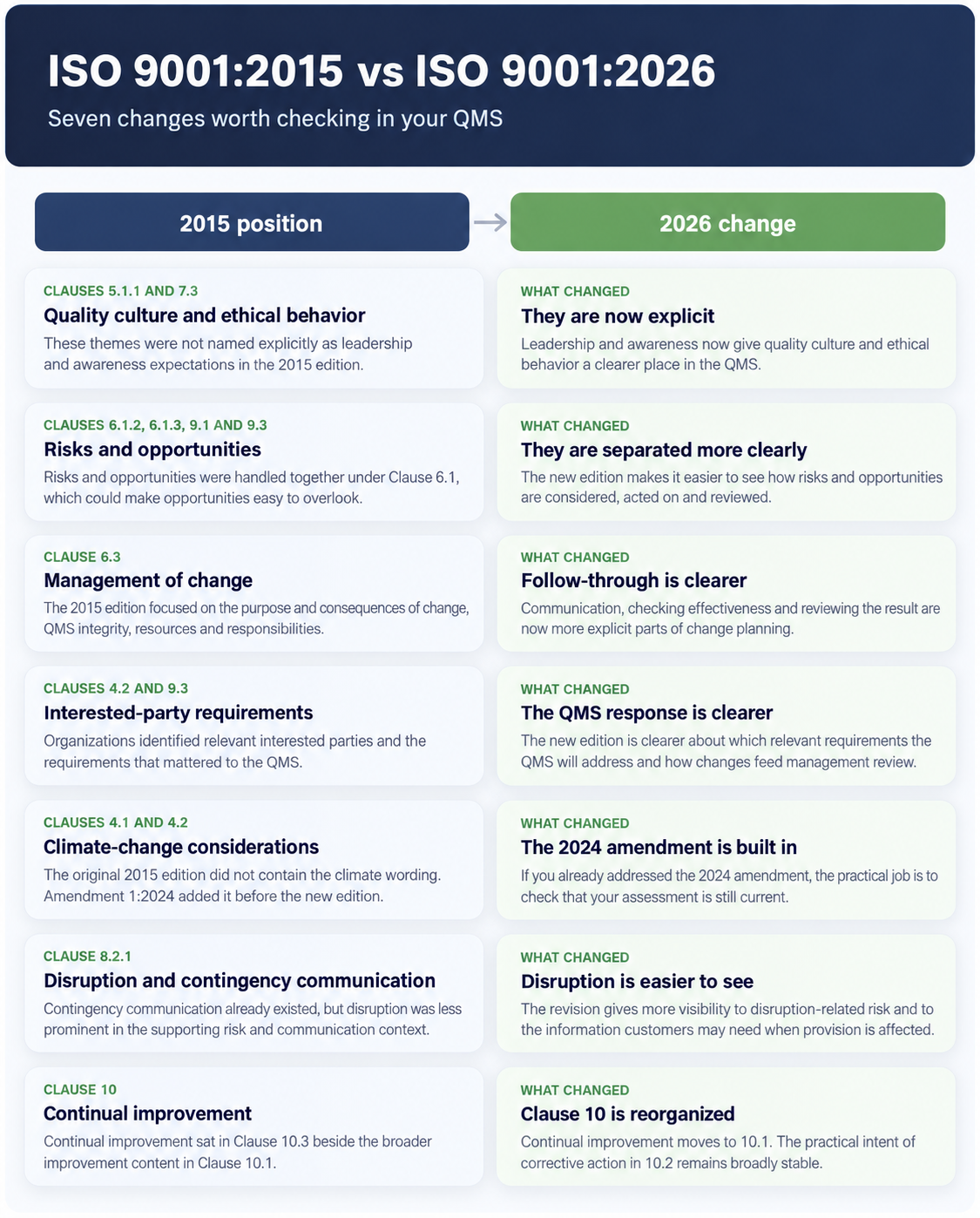
The 2026 revision makes several of these areas more explicit. Risk analysis and evaluation have been clarified, while opportunities are now addressed separately in a new subclause. ISO says this is intended to encourage organizations to consider both risks and opportunities as part of decision-making and continual improvement.
Management of Change
Management of change is another area receiving greater attention. The revised Clause 6.3 provides clearer emphasis on communication, checking the effectiveness of changes and reviewing their results. For manufacturers, this can be particularly relevant when introducing new equipment, modifying production processes, changing suppliers or implementing new digital and automation technologies.
Quality Culture and Leadership
The revision also strengthens the role of quality culture and leadership. Quality culture and ethical behaviour are now explicit themes within leadership and commitment requirements, while employee awareness also incorporates these areas. The intention is to move beyond documented procedures and consider how quality expectations are communicated and reinforced throughout an organization.
Customer Communication
Communication during operational disruption is another practical consideration. The revised standard provides greater clarity around customer communication when disruptions affect the provision of products or services. For manufacturers operating complex global supply chains, this places additional emphasis on ensuring that relevant information reaches customers and other affected parties when circumstances change.
The revision does not mean that every procedure, work instruction or quality document needs to be rewritten. ISO specifically states that organizations should build on their existing systems and processes, retaining what works and making targeted changes where necessary to meet the new edition.
For manufacturers, this makes the transition more of a gap-analysis exercise than a complete QMS redesign. Existing processes should be reviewed against the revised requirements, with particular attention paid to risk and opportunity management, change planning, leadership involvement, quality culture, organizational knowledge, communication and management review.
There are also a number of smaller changes and clarifications. The revised standard incorporates the 2024 climate-change amendment into the main edition, provides greater clarity around interested parties, reorganizes aspects of operational planning and strengthens guidance around organizational knowledge. Internal audit requirements remain broadly familiar, although each audit is now expected to have a clear objective.
For companies already certified to ISO 9001:2015, the transition does not have to happen immediately. ISO 9001:2015-certified organizations have until September 30, 2029 to complete the transition to ISO 9001:2026. From March 31, 2028, new and initial accredited certifications can only be issued to the 2026 edition.
The message for manufacturers is therefore relatively straightforward: understand what has changed, identify genuine gaps and improve those areas – but preserve processes that are already effective.
ISO 9001:2026 is intended to keep quality management relevant as manufacturing becomes more connected, automated and responsive to changing market and supply-chain conditions. For organizations with mature QMS processes, the transition provides an opportunity to examine whether those systems continue to support the business, rather than simply updating documents to reflect a new edition of the standard.
For more information: www.8dflow.com