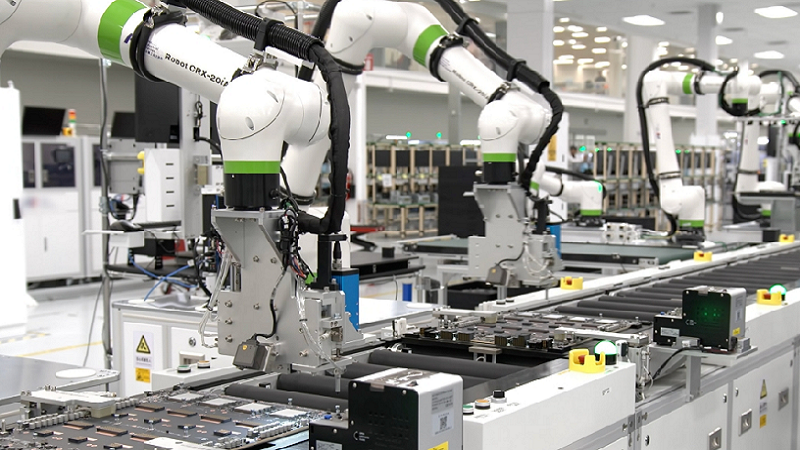
Foxconn Builds Self-Learning AI Factories to Transform Manufacturing
Foxconn is deploying large-scale AI infrastructure, industrial language models and digital twin technologies to create self-learning manufacturing environments, reporting significant improvements in production efficiency, engineering workloads and quality control.
Foxconn is accelerating its transition towards intelligent manufacturing through the development of an AI factory ecosystem designed to convert industrial data into actionable intelligence. Working with NVIDIA, the electronics manufacturing giant is combining advanced computing infrastructure, artificial intelligence (AI) models and simulation technologies to support real-time decision-making across manufacturing, electric vehicles and smart city applications.
At the centre of the initiative is FoxBrain, Foxconn’s proprietary large language model (LLM), developed by adapting open foundation models using industrial data. The model provides the intelligence behind a range of specialist platforms, including Genesis for manufacturing applications and CityGPT for urban services.
The objective is to establish a self-learning manufacturing ecosystem in which AI systems can analyse operational data, identify problems and support decisions across increasingly complex production environments.
AI Infrastructure Accelerates Industrial Intelligence
Foxconn has established NVIDIA DGX SuperPOD as the computational foundation of its AI factory, providing the processing capacity required to train and deploy large-scale AI models.
According to Foxconn, the new infrastructure delivers 2.48 times faster training performance for 120-billion-parameter models compared with its previous NVIDIA H100-based systems. The company reports processing one trillion tokens in just 12 days.
NVIDIA software is also being used to manage the AI infrastructure and deploy specialised AI agents across more than 200 manufacturing facilities. These agents are intended to support operational decisions using real-time production information, helping connect manufacturing processes with intelligent analysis and automated responses.
Measurable Improvements in Manufacturing
Foxconn reports that the integration of AI into manufacturing operations is already delivering measurable productivity and quality improvements.
Production scheduling has seen a 25 percent reduction in labour hours, while the engineering workload associated with injection-moulding process changeovers has been reduced by 50 percent.
Quality control is another significant application. On surface-mount technology (SMT) production lines, Foxconn reports that its AI systems have addressed more than 20 major defect root causes, achieving a correction rate exceeding 90 percent.
These applications illustrate how AI can extend beyond conventional automation and data analysis to support the identification of recurring manufacturing problems, root-cause investigation and corrective action.
For high-volume electronics production, where process stability and defect prevention are critical, the ability to analyse production information continuously offers opportunities to improve consistency and reduce the time required to resolve quality issues.
Digital Twins Support Global Factory Replication
Alongside AI model development, Foxconn is using NVIDIA RTX PRO servers, Omniverse and Isaac technologies to simulate manufacturing facilities and robotic operations before physical deployment.
Digital twin environments enable production lines, equipment and robotic systems to be modelled and evaluated virtually. This allows engineering teams to assess factory configurations, optimise workflows and validate automation concepts before committing to physical implementation.
The approach is particularly relevant to Foxconn’s global manufacturing operations, where replicating production processes across multiple facilities requires consistent engineering standards and reliable deployment procedures.
By combining industrial simulation with AI-driven analysis, the company aims to reduce implementation risks and accelerate the transfer of manufacturing capabilities between sites.
Extending AI Services Beyond Manufacturing
Foxconn is also extending its AI factory capabilities beyond its own operations. Through its subsidiary Visionbay.ai, an NVIDIA Cloud Partner, the company is leveraging NVIDIA-Certified Systems to provide AI-as-a-Service to enterprises and government organisations across Asia.
This creates an additional commercial opportunity, allowing Foxconn to offer AI infrastructure and specialised capabilities to external customers rather than limiting deployment to its internal manufacturing network.
The initiative reflects a broader shift towards industrial AI platforms that combine high-performance computing, domain-specific models, digital twins and intelligent automation.
For the metrology and manufacturing industries, Foxconn’s approach highlights the growing importance of integrating quality data, process monitoring and engineering intelligence within connected production environments.
While AI-driven defect analysis and root-cause identification can improve manufacturing quality, their effectiveness ultimately depends on reliable measurement data, consistent inspection processes and the ability to link detected deviations to corrective manufacturing actions.
The longer-term opportunity is to move towards manufacturing systems in which inspection and measurement data become an integral part of a continuously learning production environment, supporting decisions throughout the manufacturing lifecycle.
Foxconn’s AI factory programme demonstrates how large-scale AI infrastructure is beginning to move from experimental applications into industrial deployment, with the potential to reshape how factories are designed, operated and optimised.
For more information: www.foxconn.com