AI Inspection Needs A Disagreement Audit Before Quality Teams Scale It
Recent Metrology News coverage of AI-driven visual inspection shows a broader manufacturing trend: visual-inspection systems are moving directly into quality and traceability workflows instead of operating as isolated checks. As those systems become more tightly connected to disposition and process decisions, manufacturers can act faster, but a mistaken automated judgment can also travel farther through the workflow.
That creates a new requirement for quality leaders: measure disagreements between automated inspection and qualified human judgment before reducing human review.
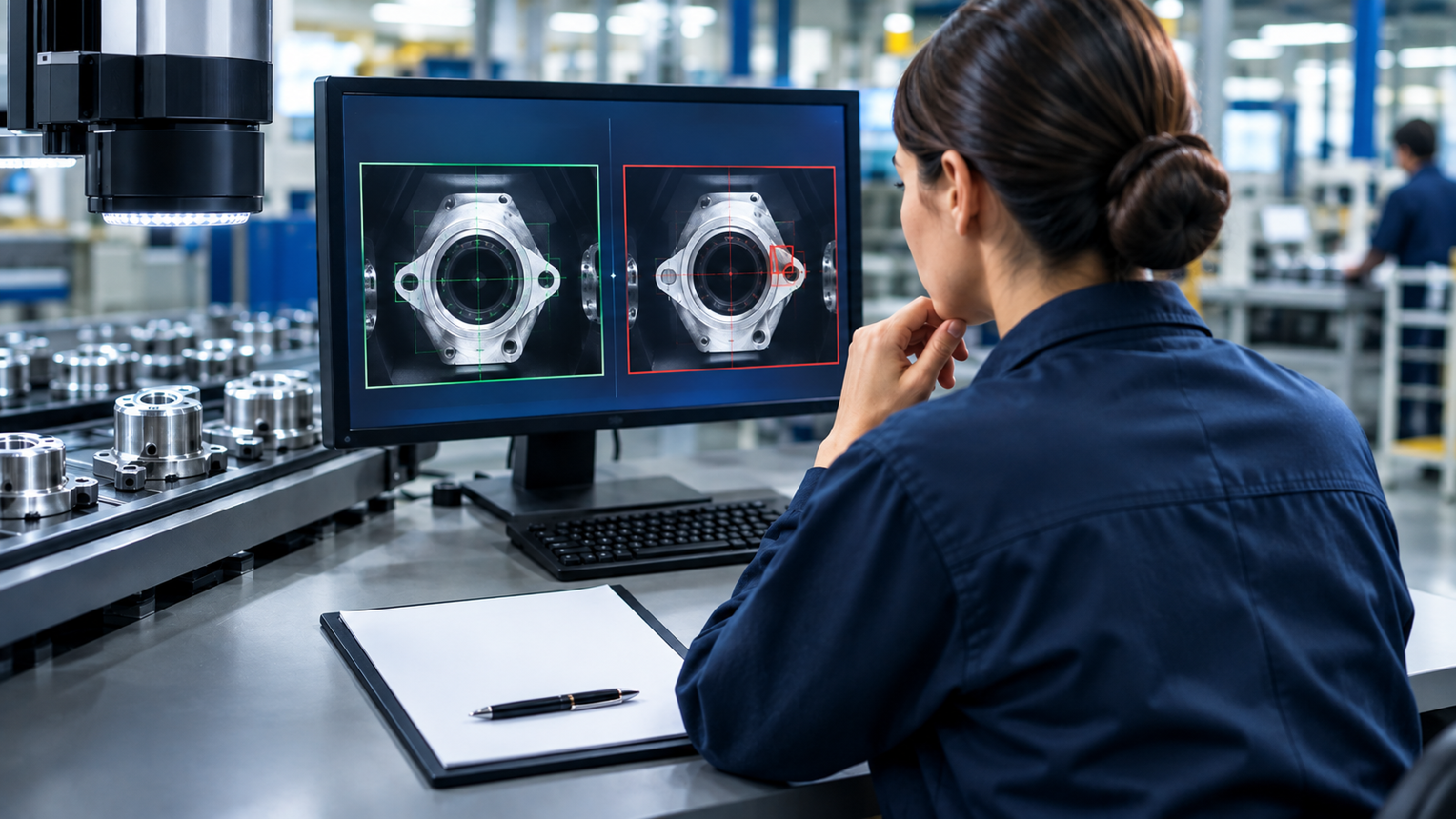
A disagreement audit is a structured sample of cases where the AI result and the human assessment differ. It records the automated finding, the reviewer finding, the final disposition, and the reason for the discrepancy once the case is resolved.
The idea fits naturally with quality practice. Manufacturers already use measurement system analysis, calibration, traceability, and corrective action because a result means little without confidence in how it was produced. AI-based inspection adds another decision layer. That layer should receive the same disciplined attention.
The first step is to define what counts as a meaningful disagreement. A difference that does not affect disposition may matter less than one that changes whether a part passes, requires rework, or triggers investigation. Quality teams should concentrate first on disagreements that alter a consequential decision.
The second step is to sample beyond obvious failures. If people review only cases the AI flags as suspicious, they cannot see false negatives. A useful audit includes some apparently normal cases, some borderline cases, and some cases drawn from known difficult conditions. The sample can shrink as evidence accumulates, but it should never disappear simply because the system has performed well recently.
The third step is to identify the source of the disagreement rather than assuming the person or the model must be wrong. The problem may come from lighting, fixturing, surface condition, sensor drift, a changed product mix, ambiguous standards, or inconsistent human interpretation. Each cause implies a different corrective action.
This becomes more important as AI moves deeper into measurement. Recent advances in AI-assisted optical measurement are designed to reduce programming effort and make sophisticated inspection easier to deploy. That trend can extend automated assistance across more operators and sites, increasing the number of quality decisions that depend on systems whose errors may be intermittent or context-specific.
Quality leaders should therefore track four measures alongside conventional speed and accuracy metrics.
First, measure consequential disagreement rate: how often does the AI-human difference change the disposition or next action?
Second, measure resolution accuracy: after the case is investigated, which judgment proved better supported by the evidence?
Third, measure exception handling time. Time saved during routine inspection can be offset by lengthy investigation, rework, or escalation when unusual cases occur.
Fourth, measure recurrence. If the same type of disagreement appears repeatedly, the organization has learned that the issue belongs in the standard process rather than in an informal exception.
These measures help avoid a common mistake in automation projects: celebrating average performance while overlooking the tails of the distribution. Quality failures often become expensive precisely because the unusual case matters more than the typical one.
The audit also preserves professional capability. When AI handles more routine inspection, junior quality staff may receive fewer opportunities to build pattern recognition through repetition. Deliberately reviewing disagreements gives them concentrated exposure to difficult cases. Senior specialists can explain why a result was accepted, rejected, or escalated, turning exceptions into a practical training library.
Managers should resist using the audit as a contest between employees and AI. If reviewers believe every disagreement will be interpreted as evidence that they failed or that the technology failed, people will become defensive. The purpose is process improvement. A human override may expose a model weakness, a training gap, a specification ambiguity, or a flawed local practice.
The best outcome is a shrinking set of unexplained disagreements, rather than a shrinking number of human interventions at any cost.
As manufacturers connect vision systems, QMS platforms, and AI-assisted metrology, they will gain faster flows of inspection data and increasingly automated decisions. The control system around those decisions needs to mature at the same pace.
Before reducing review because the AI appears reliable, quality leaders should be able to answer a simple question: when the machine and a qualified person disagree, do we know who was right, why, and what we changed afterward?
If the answer is consistently yes, the organization has evidence for scaling. If the answer is no, more automation will amplify uncertainty rather than remove it.
Author: Gleb Tsipursky, PhD, is a behavioral scientist called the “Office Whisperer” by The New York Times, and has written eight books, including most recently The Psychology of AI Adoption at Work: From Resistance to Results (Georgetown University Press, 2026).