
SHINING 3D Introduces Wireless 3D Scanning and Tracking System
SHINING 3D has introduced EinScan Trak, a 3D scanning and optical tracking system that combines large-area scanning with a detachable handheld laser scanner. The system is designed to allow users to capture medium and large-sized objects using optical tracking, while also providing a handheld configuration for smaller components and difficult-to-access features.
The system is aimed at applications including reverse engineering, automotive work, engineering measurement, industrial design, cultural heritage documentation and large-object digitisation.
Two Scanning Configurations
 In tracking mode, the spherical scanner operates wirelessly with an optical tracker. The tracker determines the position and orientation of the scanner using retroreflective markers mounted on the scanner itself, rather than requiring tracking markers to be attached to the surface being measured.
This configuration is intended for scanning larger objects, including automotive bodies, boats and other large structures. The optical tracking approach allows the scanner to be moved between different areas while maintaining its spatial position.
The spherical scanner incorporates a detachable handheld scanner. Once removed, it can be operated independently as a wireless laser scanner without the optical tracker. This configuration is intended for smaller components, deep cavities, narrow spaces and other areas that may be difficult to reach using the tracking configuration.
The two scanning modes can be used within the same project, allowing large areas to be captured using tracking before switching to handheld scanning for more localised features.
Three Blue-Laser Modes
EinScan Trak uses three laser configurations to address different scanning requirements.
The crossed-laser configuration uses 19+19 laser lines and is intended for faster acquisition over larger areas. A seven-parallel-line configuration is designed for capturing edges, contours and smaller surface features, while a single-line laser configuration is intended for deep holes, narrow channels and other difficult-to-access geometries.
The scanner contains two 2MP depth cameras and a 5MP texture camera for capturing geometric and colour information. The optical tracker incorporates two 5MP depth cameras.
SHINING 3D specifies a maximum scanning speed of 2.63 million points per second, with a scanning range of up to 4 m and resolution down to 0.05 mm.
Marker-Free Scanning
The system supports marker-free scanning in both its tracking and handheld configurations.
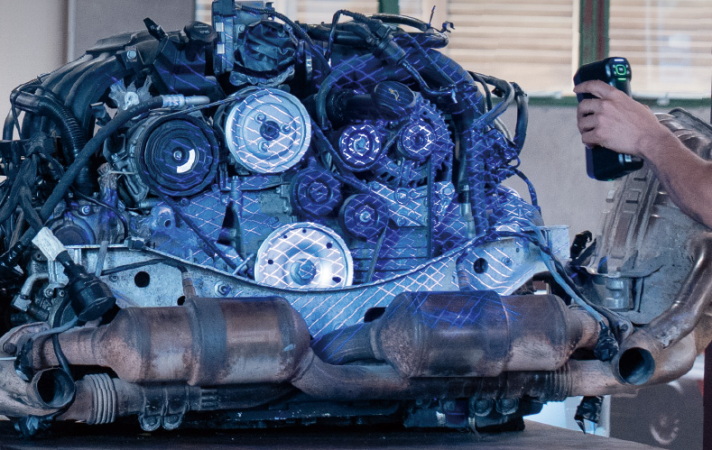 During tracking-mode operation, markers on the scanner are tracked by the optical tracking system, eliminating the requirement to place tracking markers across the surface of the object. In handheld mode, the scanner can use surface features for tracking and alignment when an object has sufficiently distinctive geometric characteristics.
Markers remain available as an option for applications where they are required.
For larger objects, datasets captured from different tracker positions can be aligned using features on the scanned object. SHINING 3D’s Hybrid Leapfrog function also allows the tracker to be repositioned during a scanning project while maintaining tracking. This function requires four markers at each tracker position.
Wireless Operation and Data Capture
EinScan Trak supports both wireless and wired operation, using Wi-Fi 6 for wireless communication. The specified wireless operating range is up to 4 m. The system can operate for up to 5.5 hours in tracking mode and up to 3.5 hours in handheld scanner mode, according to SHINING 3D. Hot-swappable batteries are supported.
The scanner can be used on a range of surface types, including black, reflective and metallic materials. The manufacturer specifies operation in outdoor lighting conditions of up to 110,000 lux.
The system also incorporates a 5MP texture camera, allowing colour information to be captured alongside geometric data. This capability is applicable where the visual appearance of an object needs to be documented as part of the digitisation process.
Combining Large and Detailed Scans
The scanning workflow allows users to change resolution during a project and apply higher local resolution to selected areas. Data captured using different laser modes and from the two scanner configurations can be combined within the same project.
This enables a large object to be scanned at an appropriate resolution for overall geometry, while individual areas can subsequently be captured at higher resolution where additional detail is required.
The system’s software can merge the resulting datasets to produce a combined 3D model.
Measurement and Reverse Engineering
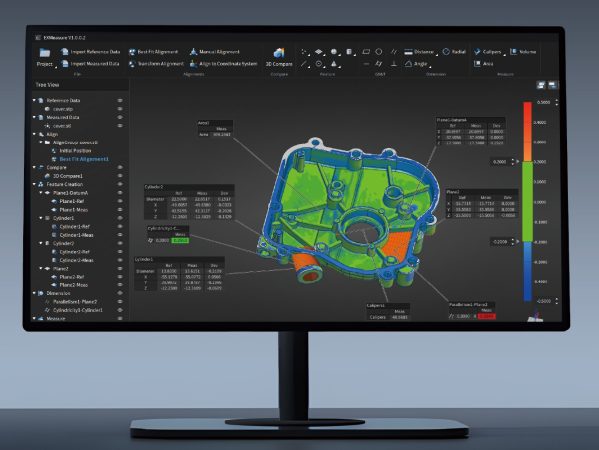 EinScan Trak can be used with SHINING 3D’s EXMeasure software for dimensional measurement and inspection. The software provides tools for creating and measuring geometric features including points, lines, planes, cylinders and spheres.
Inspection functions include colour-map comparison between reference and measured models, together with measurements for flatness, parallelism and cylindricity. The software also supports measurements of angles, areas, volumes, diameters and lengths.
For reverse engineering applications, the scanner can be used with SHINING 3D’s EXModel software. Its functions include mesh editing, coordinate alignment, primitive extraction, cross-section creation, 2D and 3D sketching, free-form modelling, auto-surfacing and feature-based reconstruction.
The resulting geometry can then be exported for downstream CAD applications.
Applications
The combination of optical tracking, handheld laser scanning and marker-free operation provides a single system for capturing both large surfaces and smaller or inaccessible features.
Potential applications include automotive inspection and customisation, reverse engineering, engineering measurement, industrial design and large-object digitisation. The texture-capture capability also supports applications such as cultural heritage documentation, museum collections, scientific research and digital archiving.
For more information: https://www.shining3d.com/