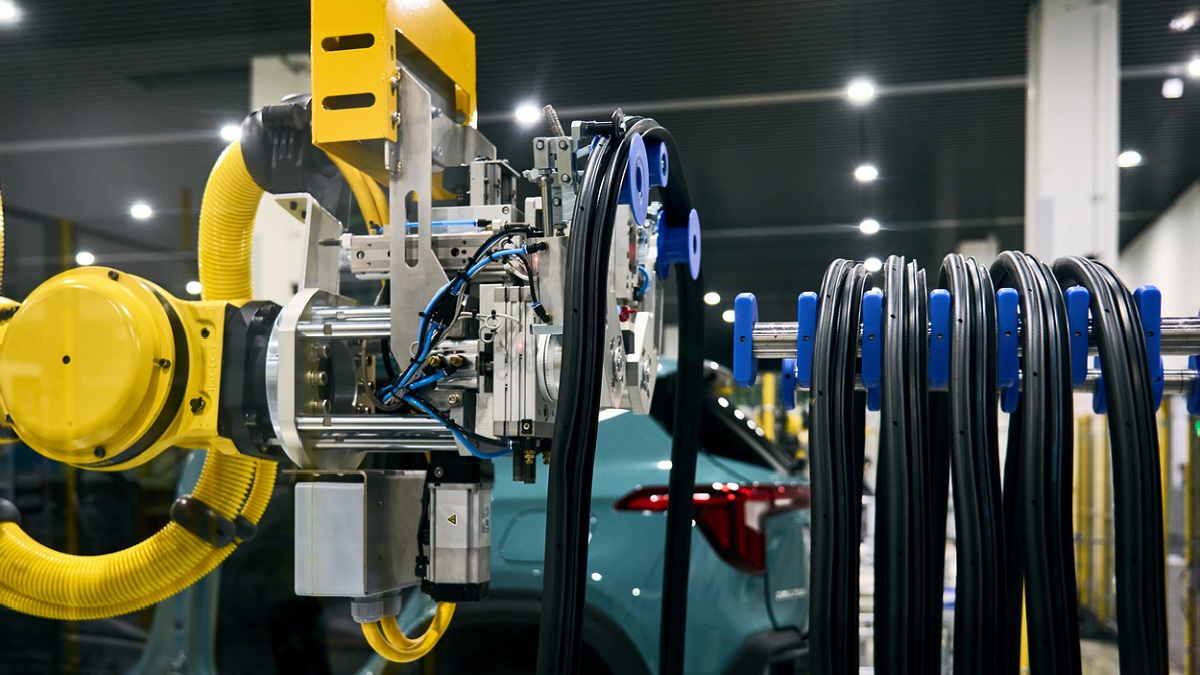
Hyundai Motor and Kia Advance Vision for Software-Defined Factories
Hyundai Motor Company and Kia Corporation are advancing their vision for software-defined factories (SDFs), in which integrated data, artificial intelligence (AI) and standardised software platforms will play an increasingly important role in how manufacturing operations are designed, managed and optimised.
The companies presented their latest developments at recent E-FOREST TECH DAY 2026, held at the Hyundai Motor and Kia Uiwang Research Institute in South Korea. Now in its seventh year, the event showcased approximately 200 manufacturing technologies spanning software-defined factories, automation, energy management and future mobility.
For the manufacturing industry, the significance of the initiative extends beyond factory automation. The transition towards software-defined production points to a future in which manufacturing processes, equipment performance and quality inspection are increasingly connected through common data infrastructures, enabling production systems to respond more rapidly to changing requirements.
Establishing The Foundations For Software-Defined Manufacturing
E-FOREST is Hyundai Motor and Kia’s smart factory initiative, focused on connecting production processes and technologies to improve manufacturing performance. Its latest development centres on establishing the common digital foundations needed to deploy software-driven manufacturing solutions across production facilities in Korea and international markets.
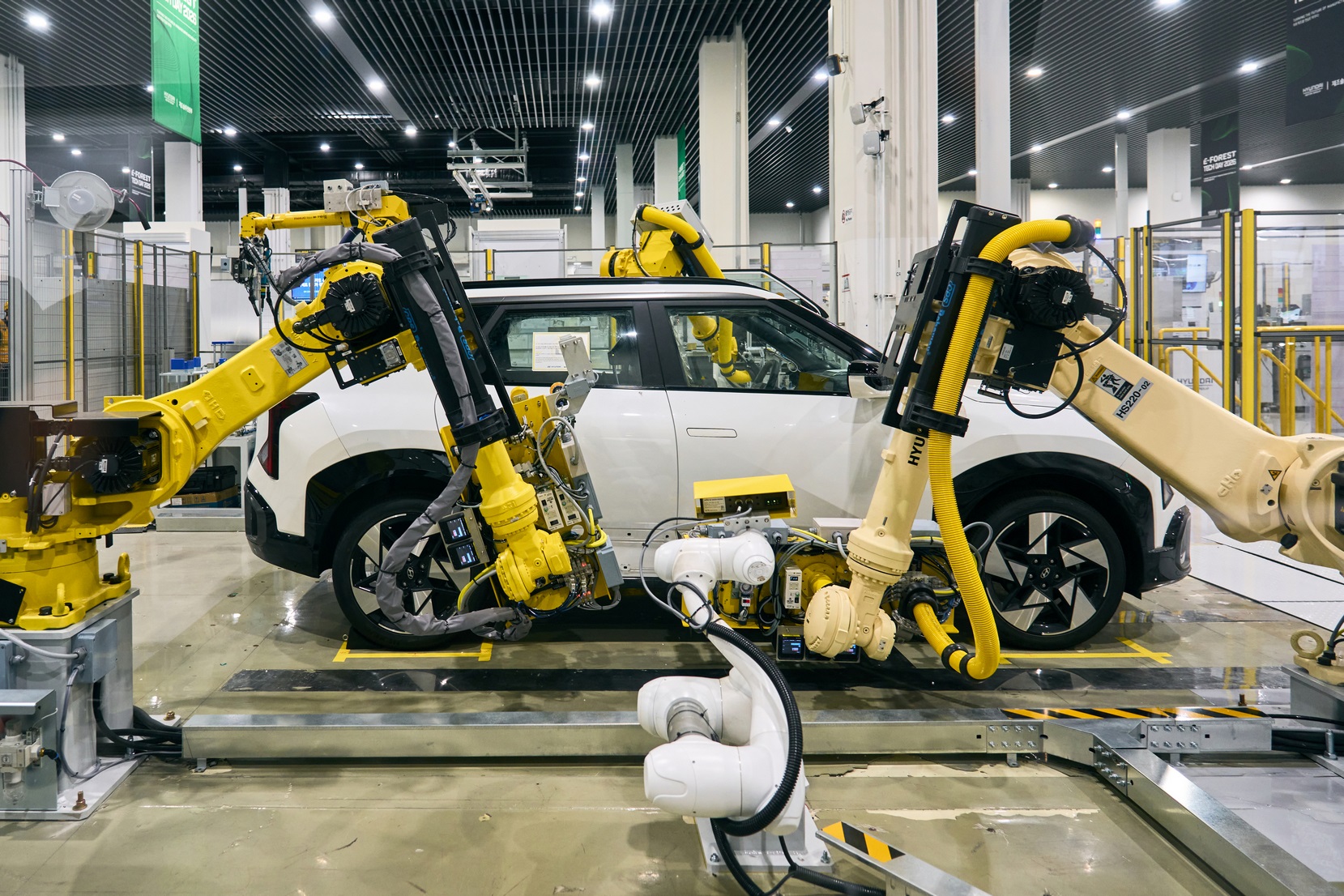
A key element of this approach is a unified framework for data collection and management, supported by a common development environment. Standardising these foundations is intended to simplify the development, deployment and scaling of manufacturing applications across different plants.
For manufacturers operating multiple production sites, this approach could help reduce the fragmentation that often arises when equipment, inspection systems and production-management software operate in separate environments. Common data structures and development frameworks can make it easier to transfer proven solutions between facilities while adapting them to local production requirements.
The strategy also reflects a broader shift in industrial automation. Rather than relying exclusively on fixed-function equipment and individually developed applications, software-defined manufacturing seeks to make production capabilities more configurable through software, connected data and intelligent systems.
Digital Twins Bring Virtual and Physical Production Closer Together
Digital twin technology is among the developments being highlighted by Hyundai Motor and Kia. By reproducing factory equipment and processes in a virtual environment, digital twins allow manufacturers to simulate operations and investigate potential problems before making changes to physical production systems.
The technology offers opportunities to assess production-line configurations, identify process constraints and evaluate proposed changes with less disruption to live operations. When supported by reliable data from physical equipment, digital twins can also provide a basis for comparing expected performance with actual manufacturing results.
For metrology and quality engineering, the connection between digital factory models and physical measurement data is particularly important. Dimensional inspection results, equipment status and process information can potentially be brought together to help engineers understand not only whether a component meets specification, but also how manufacturing conditions influence the outcome.
Realising these benefits depends on the quality, consistency and traceability of the underlying data. A digital representation of a factory is only as useful as the information connecting it to the physical environment.
AI Moves Into Manufacturing Operations
Hyundai Motor and Kia are also developing AI agents for factory-specific tasks, including retrieving and interpreting data, searching manufacturing know-how and creating equipment manuals.
These applications illustrate how AI is moving beyond isolated analytical tools towards systems intended to support everyday manufacturing activities. By making technical information more accessible, AI agents could help production personnel find relevant instructions, investigate equipment issues and draw on accumulated operational knowledge.
The wider opportunity lies in connecting AI with manufacturing systems and verified production data. Such integration could support faster troubleshooting, improve access to process knowledge and help engineers identify relationships between equipment behaviour, production conditions and product quality.
However, effective industrial AI requires more than access to large volumes of information. Reliable results depend on data integrity, appropriate context and the ability to distinguish verified technical information from uncertain conclusions. In quality-critical applications, AI-generated recommendations must also operate within clearly defined validation and decision-making processes.
Automated Inspection Becomes an Integral Part of The Smart Factory
Quality inspection is another important element of the SDF programme. Among the technologies showcased is a tunnel-type vision system for automated vehicle exterior inspection, using 3D simulation as part of its inspection approach.
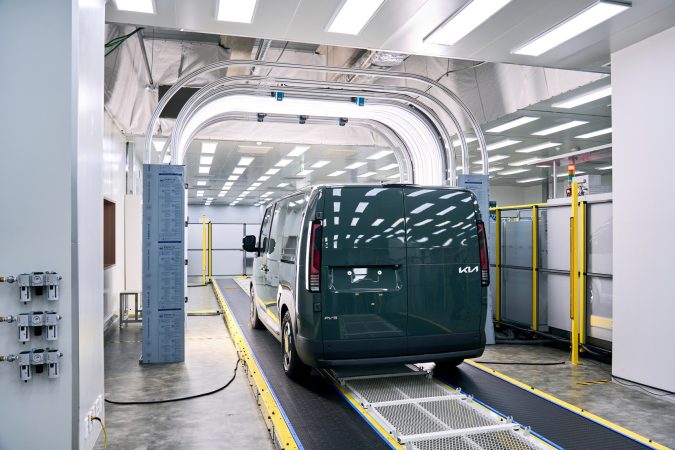 Developed by Hyundai Motor and Kia as an alternative to third-party systems, the technology is intended to improve finished-vehicle quality, with plans for deployment at production plants in Korea and overseas.
Automated exterior inspection illustrates the growing role of optical technologies in high-volume manufacturing. Vision systems can examine vehicle surfaces and identify potential defects at production speeds that would be difficult to achieve through manual inspection alone.
More broadly, the integration of inspection within a software-defined factory creates opportunities to connect quality results with production data and equipment information. Rather than treating inspection as a final checkpoint, manufacturers can work towards using measurement and inspection results to support process monitoring, defect analysis and continuous improvement.
The longer-term potential is particularly significant when inspection systems can communicate through standardised interfaces and contribute data to a common manufacturing environment. This could make it easier to compare quality performance across production lines and facilities, identify recurring problems and investigate the causes of defects.
For dimensional metrology, the same principles apply to coordinate measurement systems, optical measurement technologies and in-process inspection. Consistent data formats, reliable measurement results and integration with manufacturing systems are essential if measurement information is to support automated decisions rather than simply generate reports.
Automation, Energy and Future Production Technologies
Beyond foundational SDF technologies, the exhibition covered assembly and inspection automation, energy solutions and manufacturing technologies for future mobility.
The energy initiatives reflect the importance of optimising factory operations alongside product quality and productivity. Connected monitoring and data analysis can help manufacturers understand energy consumption, identify inefficiencies and support more sustainable production.
The programme also included new forming technologies and additive manufacturing, which creates components directly from design data without requiring conventional moulds. These approaches offer different routes to manufacturing flexibility, particularly where product complexity, tooling requirements or production volumes influence process selection.
As these technologies develop, inspection and verification will remain essential. New manufacturing processes can introduce different sources of dimensional variation and material inconsistency, increasing the need for measurement strategies that can verify components and provide feedback to production processes.
Collaboration to Accelerate Industrial AI
E-FOREST TECH DAY 2026 also included a manufacturing technology presentation conference and partner seminars focused on practical applications and future development strategies.
Topics included physical AI, data-driven manufacturing innovation and manufacturing AI, highlighting the importance of collaboration between manufacturers and technology partners.
Physical AI, which connects artificial intelligence with systems that interact with the physical world, is attracting growing interest in industrial applications involving robotics, automated handling and adaptive production. Its development will depend on the integration of perception, reliable data, control systems and the ability to respond safely to changing conditions.
For metrology, this convergence presents an important challenge and opportunity. Automated systems must be able to perceive their environment, determine relevant geometric or quality characteristics and act on measurement results with sufficient confidence. Measurement technologies therefore have a potentially important role in enabling intelligent manufacturing systems to move from data collection towards reliable, closed-loop process control.
A Shift Towards Connected, Adaptable Manufacturing
Hyundai Motor and Kia’s SDF initiative reflects a wider direction in industrial manufacturing: the move towards production environments in which software, AI, automation and connected data work together across the factory.
The practical value of this transition will depend on how effectively manufacturers integrate new technologies with existing equipment, establish consistent data standards and demonstrate measurable improvements in quality, productivity and operational flexibility.
For the metrology sector, the implications are clear. Measurement systems will increasingly need to function as connected elements of manufacturing infrastructure, providing reliable data that can be used by inspection applications, digital twins, AI systems and production-control platforms.
The future factory will require more than automated machines and sophisticated software. It will need dependable information about the physical products being made and the processes used to manufacture them. As software-defined manufacturing advances, metrology will be central to establishing that connection between the digital factory and the real-world quality of its output.
Editor