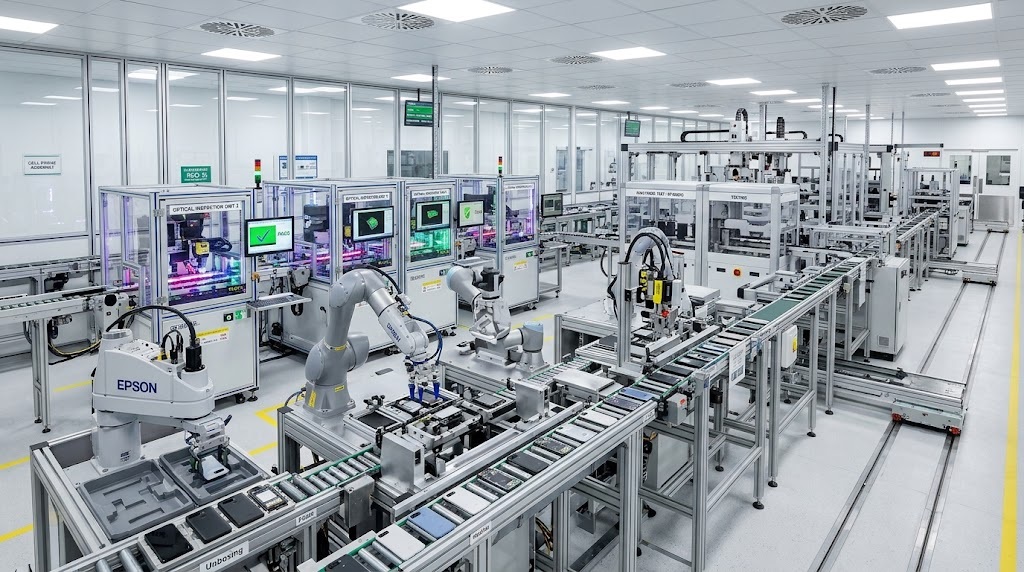
Smart Sensors Drive Process Optimization and Factory Connectivity
Smart sensors are becoming an increasingly important component of modern manufacturing, supporting the transition towards connected factories, data-driven process optimization and more integrated quality management. By combining sensing capabilities with embedded processing, communications and analytical functions, these technologies enable manufacturers to monitor production conditions, detect deviations and respond to changes with greater speed and precision.
Unlike conventional sensors that primarily provide raw measurements, smart sensors can process data locally, communicate with other systems and support automated decision-making. Their integration into production equipment, inspection systems and manufacturing infrastructure is helping bridge the gap between machine operation, process control and dimensional quality assurance.
From Data Collection to Process Intelligence
Manufacturing processes generate substantial quantities of data including temperature, vibration, position, force, dimensional characteristics and machine condition. Historically, much of this information has been collected through separate monitoring systems, limiting its value for broader production optimization.
Smart sensors can provide continuous access to this information, allowing manufacturers to identify trends, recognize abnormal operating conditions and adjust processes before problems affect product quality or production efficiency.
As an example, vibration and temperature sensors installed on machine tools can identify changes in spindle behaviour, bearing condition or thermal stability. Position and displacement sensors can monitor machine movements, while pressure and flow sensors can help maintain consistent conditions in hydraulic, pneumatic and fluid-based manufacturing processes.
When sensor data is combined with production information, machine status and inspection results, manufacturers gain a more comprehensive understanding of the factors influencing product quality.
This approach supports a shift from reactive troubleshooting towards predictive maintenance and proactive process control.
Connecting Sensors Across the Factory
The effectiveness of smart sensors depends not only on their measurement capabilities but also on their ability to exchange information with other manufacturing systems.
Industrial communication technologies, including IO-Link, industrial Ethernet, OPC UA and time-sensitive networking, are helping connect sensors with programmable logic controllers, machine control systems, manufacturing execution systems and industrial analytics platforms.
This connectivity enables sensor data to be used beyond the individual machine or production cell. Information can be shared across manufacturing operations, providing production engineers, maintenance teams and quality departments with a more consistent view of factory performance.
Edge computing is also playing an important role. By processing information close to the point of measurement, manufacturers can reduce communication delays, filter unnecessary data and identify significant events without transferring every measurement to a central server or cloud platform.
For applications requiring rapid responses, local processing can support immediate adjustments to machine settings or production parameters. At the same time, selected information can be transmitted to higher-level systems for longer-term analysis, traceability and production planning.
Improving Manufacturing Quality and Metrology
For the metrology sector, smart sensors offer opportunities to bring measurement information closer to the manufacturing process itself.
Traditional quality inspection often takes place after machining or assembly, with results used to determine whether a component meets its specification. While coordinate measuring machines, optical measurement systems and other inspection technologies remain essential for verifying dimensional accuracy, connected sensing can provide additional information about the conditions under which components are manufactured.
Machine tool thermal sensors, for example, can help identify temperature changes that influence dimensional accuracy. Tool condition monitoring can reveal wear that may affect feature geometry or surface finish, while force and vibration measurements can provide indications of changing cutting conditions.
When combined with dimensional inspection results, these data streams can help manufacturers establish relationships between process conditions and measured product characteristics.
This creates opportunities for closed-loop manufacturing, in which inspection data and process measurements are used to adjust machining parameters, compensate for drift or trigger corrective action before a production run generates significant quantities of non-conforming parts.
The integration of in-process measurement, machine monitoring and final inspection is therefore an important step towards a more connected approach to manufacturing quality.
However, process monitoring does not replace dimensional verification. Sensors must be appropriately selected, calibrated and validated for their intended application, while measurement uncertainty and traceability remain important considerations wherever data is used to demonstrate product conformity.
Supporting Predictive Maintenance and Production Efficiency
Smart sensors are also helping manufacturers improve equipment availability and reduce unplanned downtime.
Continuous monitoring of vibration, temperature, current consumption and other operating parameters can reveal early indications of mechanical wear, misalignment, overheating or abnormal loading. Analytics software can identify patterns associated with developing faults, enabling maintenance teams to intervene before equipment failure disrupts production.
The same information can support energy management and resource optimization. Monitoring electrical consumption, compressed air usage, coolant flow and process temperatures can reveal inefficiencies that might otherwise remain undetected.
For manufacturers operating complex production lines, combining information from multiple sensors can help distinguish between isolated equipment problems and wider process issues. This can improve troubleshooting and support more informed decisions about maintenance schedules, machine utilization and production planning.
The Role of AI and Advanced Analytics
The growing availability of connected sensor data is creating opportunities for artificial intelligence and machine learning in manufacturing.
AI-based analytical tools can examine relationships between multiple process variables, identify unusual operating patterns and help predict the consequences of changing production conditions. In quality applications, these techniques can support anomaly detection, process capability analysis and the identification of factors associated with dimensional variation.
The value of these systems depends on data quality, reliable sensor performance and the availability of suitable reference information. Inaccurate readings, inconsistent data formats or poorly understood process conditions can undermine analytical results.
Manufacturers therefore need to consider sensor selection, installation, calibration, data management and system integration as part of a coordinated strategy rather than treating connectivity as a standalone technology project.
Cybersecurity and access control are also important as increasing numbers of production devices become connected to factory networks. Industrial systems must be designed to protect operational data while maintaining the reliability and availability required for manufacturing.
Towards More Connected Manufacturing
Smart sensors are helping transform factory connectivity from a means of collecting machine data into a foundation for more intelligent production management.
Their integration with industrial networks, edge computing, analytics and metrology systems provides manufacturers with improved visibility of process conditions and creates opportunities to connect equipment performance with measurable product quality.
For manufacturers seeking greater productivity, reduced waste and more consistent dimensional accuracy, the next stage of development will depend on how effectively sensor information is integrated into production and quality workflows.
The long-term opportunity lies not simply in installing more sensors, but in connecting reliable measurements with meaningful analysis and timely action. As manufacturing systems become increasingly connected, smart sensors will play an important role in enabling factories to move towards predictive, adaptive and increasingly autonomous production.
Author: Guest Writer William Jones II