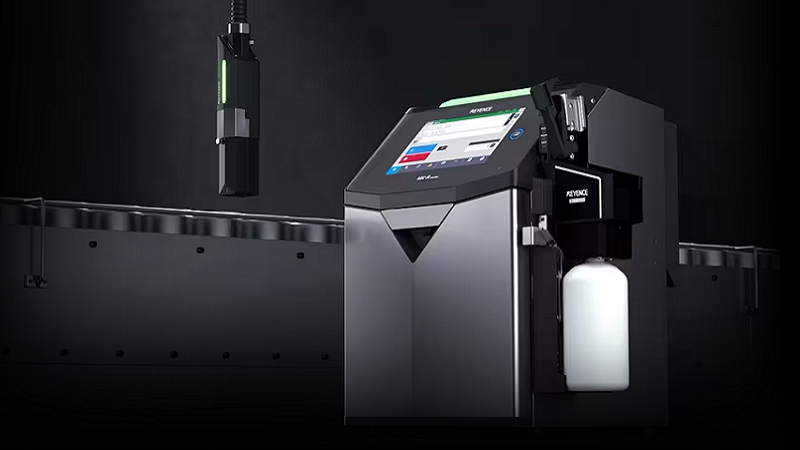
KEYENCE Introduces 6th-Generation CIJ Printer Designed to Minimise Production Downtime
KEYENCE Corporation has introduced its sixth-generation continuous inkjet (CIJ) printer, the MK-R1000 series, designed to reduce unplanned production downtime through automated print-head cleaning, self-diagnostics and rapid component replacement.
Built around the concept of “On the Line. By Design.”, the MK-R1000 incorporates several technologies intended to address common operational challenges associated with industrial coding and marking, including ink accumulation, print-head maintenance and lengthy recovery procedures following a fault.
A key feature is MK Clean In Place, which KEYENCE describes as the world’s first system to clean a CIJ print head without removing it from the production line. The printer also incorporates automated troubleshooting and what the company identifies as the industry’s first Head Core Module, allowing critical print-head components to be replaced within minutes.
Automated Cleaning and Maintenance
Ink accumulation on the print head is a common cause of declining print quality and printer faults in CIJ applications. Conventional maintenance procedures can require operators to remove the print head, clean it separately, reinstall it and carry out test printing before production can resume.
The MK-R1000 addresses this through MK Clean In Place, which uses high-pressure solvent jets to clean the print head while it remains installed on the production line, irrespective of its orientation.
Scheduled cleaning can be performed during production changeovers to remove ink deposits before they develop into operational problems.
The system also incorporates Inline Startup, an automated procedure designed to simplify daily start-up. At the press of a button, the printer performs a self-diagnosis, determines the appropriate start-up method based on its current condition and executes the necessary procedures.
By adapting the start-up process to the printer’s operating condition, KEYENCE aims to reduce unnecessary maintenance and bring the system into production within minutes.
Longer Printing Distance and Adaptive Inkjet Control
Print-head contamination can also result from ink splashing back from products passing close to the nozzle. While conventional CIJ printers typically operate at distances of 10–15 mm from the product, the MK-R1000 has a standard printing distance of 35 mm, approximately 2.3 times that of its predecessor.
The increased stand-off distance is intended to minimise ink splashback and reduce the accumulation of deposits around the print head.
Print quality is further supported by Adaptive Long Distance Printing, which uses machine-learning analysis of more than 10 million real-world print patterns collected from previous MK-series printers.
The technology applies individual voltage corrections to ink droplets during printing, controlling their trajectories and electrical charge to minimise interference between adjacent droplets. According to KEYENCE, this enables consistent printing across different production speeds, printing distances, character heights and message formats.
Rapid Fault Diagnosis and Recovery
The MK-R1000 has been designed to minimise the time required to recover from operational faults, with KEYENCE targeting a recovery time of 15 minutes or less.
When an issue occurs, operators place the print head in the MK Dock 2 and initiate Quick Recovery. The printer identifies the problem, carries out a series of automated troubleshooting procedures and attempts to restore normal operation without requiring specialist technical knowledge.
For more complex faults, the Head Core Module provides an alternative to replacing the complete printer. The module houses critical print-head components and can be exchanged within minutes, allowing production to resume without lengthy equipment changeover procedures.
This modular approach is intended to reduce dependence on specialist technicians and avoid the extended downtime that can result when a printer cannot be returned to service immediately.
Designed for Industrial Environments
Beyond its maintenance and recovery features, the MK-R1000 incorporates a stainless-steel controller and print head, both rated IP66 for protection against dust and water ingress.
An optional Backup Module provides additional protection against power interruptions. It maintains printer operation during momentary power failures of up to two seconds. For longer interruptions, the system performs an automatic cleaning and shutdown procedure designed to prevent ink lines from becoming clogged.
Operator interaction has also been simplified through on-screen instructional videos that provide step-by-step guidance for tasks ranging from initial installation to component replacement. KEYENCE says this enables operators without previous experience of the equipment to carry out routine procedures.
Commenting on the development, Chet Vonghiran, Strategic Product Specialist at KEYENCE Corporation of America, said manufacturers primarily want coding equipment that operates reliably without requiring constant attention. He noted that routine cleaning and fault-related stoppages can make printers a significant source of production disruption.
The MK-R1000 is designed to automate cleaning, preventative maintenance and troubleshooting, allowing operators to concentrate on other production responsibilities.
Jeff Johnson, Executive Director at KEYENCE Corporation of America, added that customer feedback highlighted the disproportionate cost of unplanned downtime compared with the initial cost of the printer. The MK-R1000 has therefore been developed around maintaining continuous operation, with automated maintenance, extended printing distance and modular component replacement intended to keep coding equipment on the production line and minimise interruptions.
For more information: www.keyence.com