Hesai Launches 3D Spatial Camera to Accelerate AI-Driven Robotics
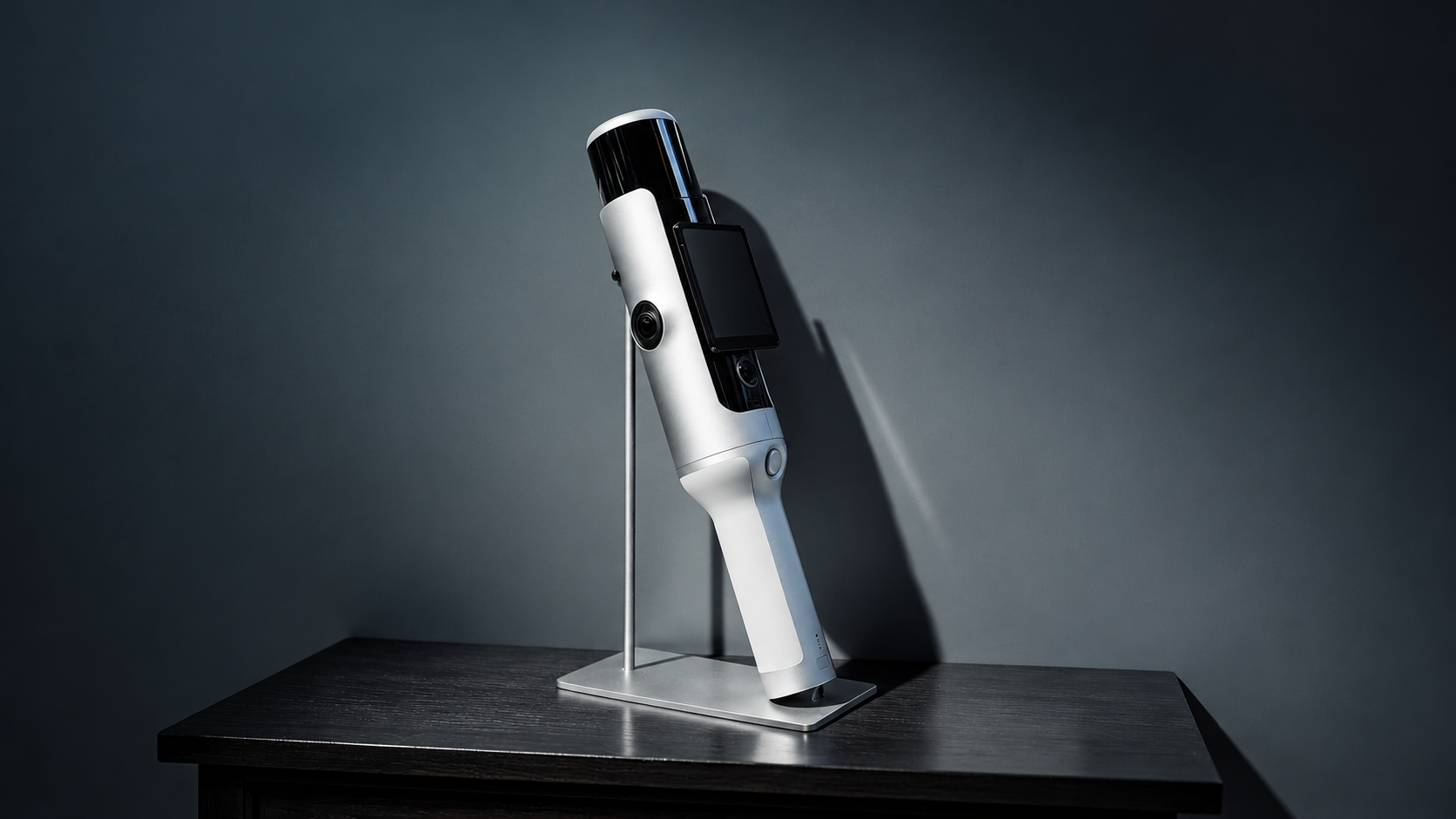
China’s Hesai Group has launched Kosmo, a 3D spatial data platform designed to convert real-world environments into detailed digital models for training artificial intelligence (AI) systems and developing intelligent robots. Kosmo combines lidar, high-resolution imaging and 3D reconstruction to create digital environments for robot training, with potential applications in automated inspection and smart manufacturing.
The platform combines Kosmo One, an AI spatial camera integrating lidar and high-resolution imaging, with Kosmo World, a cloud-based environment for reconstructing, processing and managing 3D spatial data. The system is intended to address a growing challenge in physical AI: obtaining accurate, realistic and scalable representations of the environments in which robots must operate.
Hesai, best known for its lidar technology for automotive sensing and autonomous driving, is extending its capabilities into the wider physical AI market, where robots must interpret and interact with complex real-world surroundings.
According to the company, Kosmo One combines high-resolution lidar, a one-inch image sensor and a high-precision inertial measurement unit (IMU). The system captures geometry, colour, texture and camera-position information, synchronising these data sources to support the reconstruction of detailed three-dimensional environments.
Hesai says its reconstruction technology uses 3D Gaussian Splatting to produce visually realistic digital representations with millimetre-level geometric accuracy. A typical indoor space of 100 square metres can be scanned by one operator in approximately 15 minutes, with the captured data subsequently processed by Kosmo World.
From Spatial Data to Robot Intelligence
The initial focus is on creating digital environments for training embodied AI systems, including robots that need to navigate, recognise objects and perform tasks in environments that change over time.
Conventional approaches to building training environments can require extensive manual modelling, while synthetic environments may not fully reproduce the geometry, textures, lighting and other characteristics encountered in actual operating conditions.
Kosmo is designed to narrow this gap by capturing real spaces and converting them into simulation-ready environments. Its software can generate 3D Gaussian Splatting representations, polygon meshes and depth data, alongside semantic segmentation that identifies individual objects within a scene.
The resulting digital environments can be integrated with platforms including NVIDIA Isaac Sim and Isaac Lab, allowing developers to use real-world spatial information in robot simulation and training workflows. Hesai has also announced partnerships with embodied AI companies Galbot and Dexmal to advance these applications.
Implications for Manufacturing Metrology
Although Kosmo is primarily positioned as a spatial data and robot-training platform rather than a dimensional inspection system, its underlying technologies are relevant to the development of more adaptable manufacturing automation.
Industrial robots increasingly need to work with components whose positions, orientations or surrounding conditions vary. Detailed 3D representations can help robotic systems understand their environment, locate objects and plan movements before carrying out an operation.
In automated inspection, this capability could support more flexible positioning of cameras and sensors, robot-guided scanning and the localisation of components presented in different orientations. Spatial models could also help engineers develop and test robotic inspection cells in simulation before deploying them on the factory floor.
The distinction between spatial perception and metrology remains important. A visually realistic digital reconstruction is not, by itself, evidence that a component conforms to its engineering drawing. Inspection for dimensional acceptance requires validated measurement performance, appropriate calibration, quantified uncertainty and traceable results.
However, the combination of spatial sensing, AI and measurement technology offers a route towards inspection systems that can adapt more readily to variations in component presentation and production conditions. By improving a robot’s understanding of its surroundings, spatial intelligence could complement the measurement systems responsible for determining dimensional accuracy.
For manufacturers, the longer-term opportunity is to connect these capabilities with production data, allowing automated systems to move beyond simply recognising a component towards selecting an appropriate inspection strategy and responding to measured deviations.
Extending the Physical AI Ecosystem
Kosmo forms part of Hesai’s wider strategy to expand beyond lidar hardware into the data and software infrastructure supporting physical AI.
The company is also developing robotic actuation technologies, including modules for dexterous robotic hands and other robot joints. Its broader proposition combines perception, spatial understanding and physical movement, with the aim of helping robots operate more effectively in real environments.
For smart manufacturing, the significance of this approach lies in the closer integration of sensing, simulation and robotic execution. More accessible methods of digitising production environments could reduce the effort required to develop robotic applications and allow changes to inspection or handling processes to be evaluated virtually.
The practical impact on industrial metrology will depend on how these spatial data capabilities are integrated with measurement hardware and validated inspection software. Nevertheless, as manufacturers seek more flexible automation, the ability to combine realistic 3D environmental data with robotic sensing and control is becoming an increasingly important part of the technology landscape.
For more information: www.hesaitech.com