Omron to Acquire OnLogic for $675 Million to Advance Industrial AI
Omron has agreed to acquire US industrial computer manufacturer OnLogic and its parent company, Interlogic, in a $675 million transaction designed to strengthen its industrial computing capabilities and accelerate the development of physical artificial intelligence (AI) solutions for manufacturing.
The announcement states that the acquisition brings together Omron’s expertise in sensing, control, motion, robotics and safety with OnLogic’s range of configurable industrial computers designed for demanding operating environments. Completion is expected in early 2027, subject to regulatory approval.
The companies aim to combine industrial automation with computing power at the network edge, enabling manufacturers to process larger volumes of machine and sensor data closer to where production takes place. This is increasingly important for applications requiring real-time responses, advanced analytics and AI-based decision-making.
OnLogic develops and manufactures rugged industrial PCs for industrial automation, edge computing and Internet of Things applications. Its configurable, build-to-order approach allows customers to specify computing platforms for particular operating environments and application requirements.
Omron expects the acquisition to accelerate the development of next-generation physical AI platforms by combining these computing systems with its own precision control technologies. The companies also intend to explore opportunities to integrate industrial computers with Omron’s sensing and robotics equipment, creating solutions that connect data processing with machine operation.
From machine Data to Manufacturing Decisions
For manufacturers, the growing importance of edge computing reflects the need to turn increasingly complex production data into actionable information without relying exclusively on centralised cloud infrastructure.
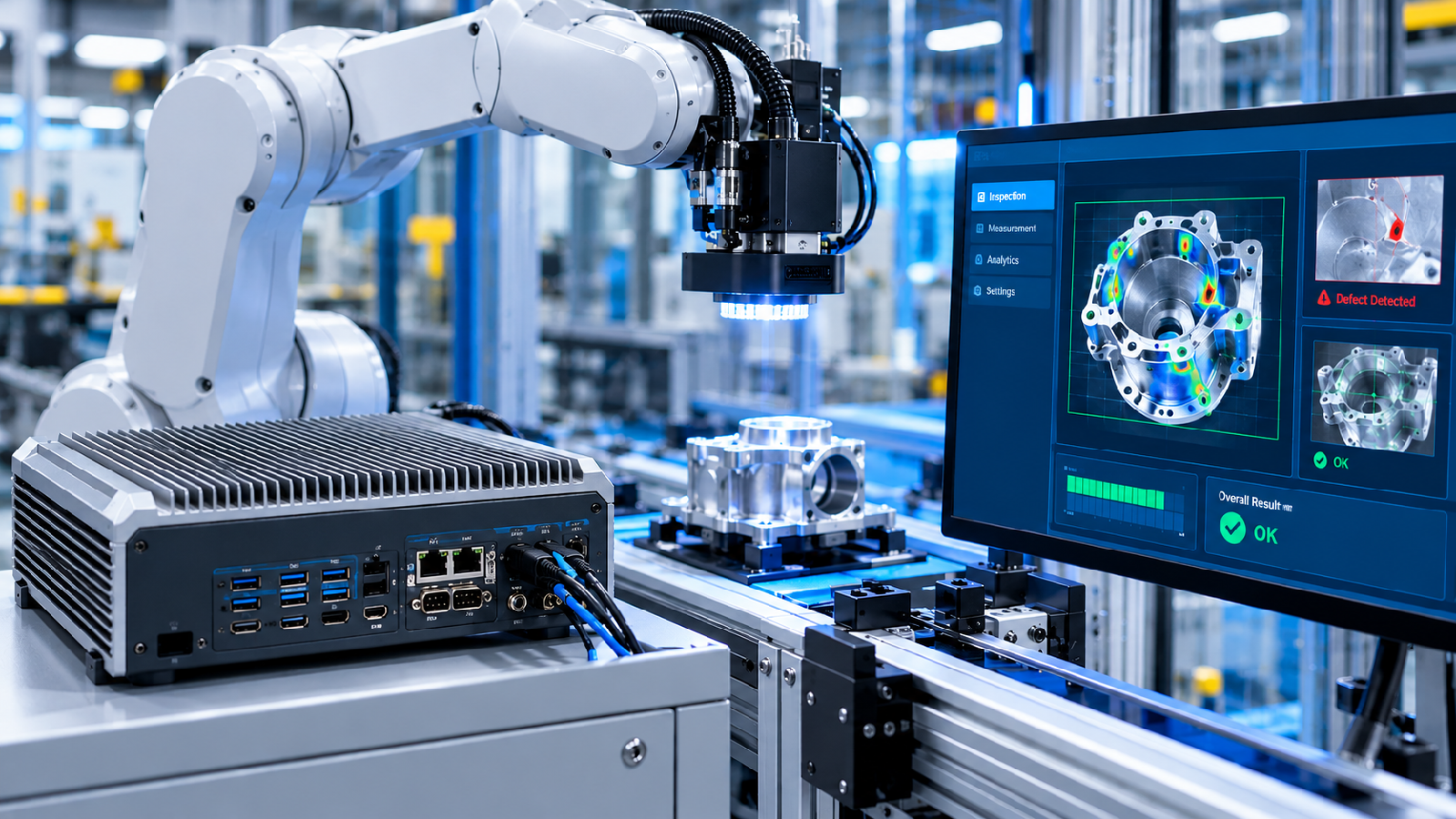
In automated inspection, for example, industrial computers can process data from cameras, optical measurement systems and other sensors, supporting the identification of defects and deviations during production. When integrated with machine controls and robotics, these capabilities can help manufacturers respond to quality issues more quickly.
The longer-term opportunity lies in connecting measurement results directly to manufacturing decisions. Dimensional inspection data could inform process adjustments, while AI-based systems could help identify patterns associated with emerging quality problems.
However, achieving reliable closed-loop manufacturing requires more than computing power alone. Measurement uncertainty, calibration, data integrity and traceability remain essential when inspection results are used to make decisions about product conformity or process correction.
Omron’s proposed acquisition reflects a wider industry movement towards integrating sensing, computing and control into more closely connected manufacturing systems. Rather than treating inspection, automation and data analysis as separate activities, manufacturers are increasingly looking to combine them within a unified production environment.
Maintaining OnLogic’s Independent Operation
Following completion, OnLogic will continue operating as an independent business within the Omron Group. Its headquarters will remain in South Burlington, Vermont, with its existing global offices, brand identity, direct-sales model and management team retained.
Omron President and CEO Junta Tsujinaga said the acquisition would strengthen the company’s position in North America while expanding the capabilities needed as manufacturing becomes more connected, data-driven and intelligent.
For OnLogic, joining Omron is expected to provide greater global reach, supply-chain resources and opportunities to expand its industrial computing products into additional markets.
The transaction represents a strategic investment in the computing infrastructure underpinning next-generation industrial automation. Its longer-term significance will depend on how effectively the combined technologies translate into practical manufacturing applications, including intelligent inspection, adaptive process control and data-driven quality management.
For more information: www.omron.com