Anthropic Develops Standard for AI Agents to Control Manufacturing Equipment
Anthropic has introduced a research preview of the Model Hardware Standard (MHS), a specification designed to allow AI agents to communicate with and control physical equipment including robotic arms, microscopes and other laboratory and manufacturing systems.
The company says MHS addresses a longstanding problem in automated environments: equipment from different manufacturers typically uses its own programming interfaces, making integration dependent on bespoke software and engineering work. MHS provides a common interface through which an AI agent can discover connected equipment, understand its capabilities and issue commands.
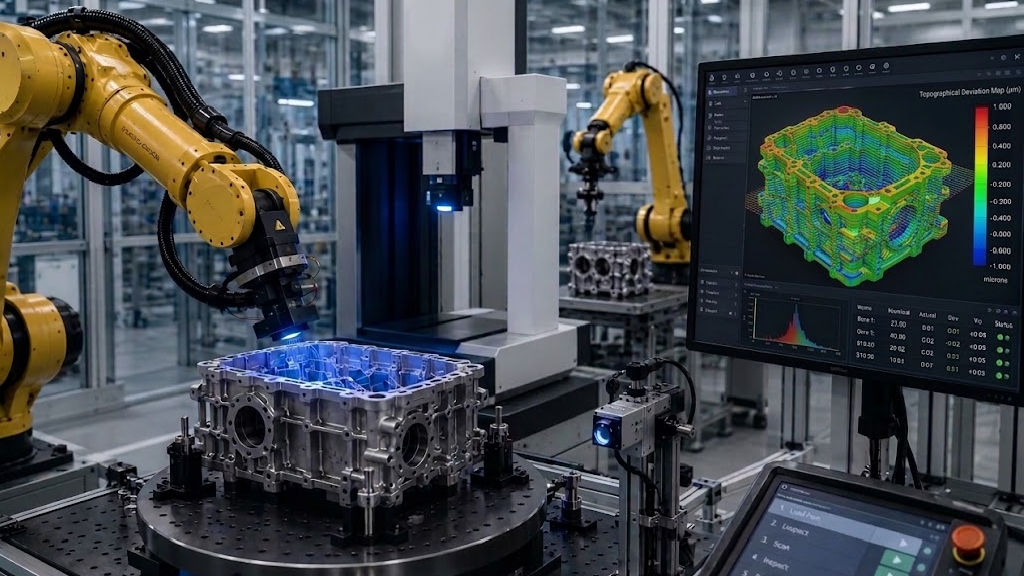
The technology could have implications for automated inspection and manufacturing, where production systems increasingly combine robots, cameras, measurement equipment and other machines from multiple suppliers.
Standardizing AI-to-Machine Communication
According to Anthropic, MHS uses a standardized software driver between a computer’s operating system and a physical device. The driver exposes a common set of commands, including operations to read information from equipment and write or modify settings.
The system also provides a standardized description of the connected hardware. This can include information about what a device can measure, which parameters can be adjusted and what safety limits apply.
The approach is intended to reduce the need for separate software integrations between individual pieces of equipment. Anthropic says that integrating new hardware into an existing laboratory or manufacturing environment can otherwise take days or weeks, depending on the complexity of the system.
MHS is designed to work with equipment that has a programmable interface and is not tied to a particular AI model. Anthropic says agents can access the standard using established protocols such as the Model Context Protocol.
Application to Automated Quality Assurance
One of the more relevant applications for manufacturing is being explored by Doosan Robotics.
Anthropic says Doosan is testing MHS with its robotic arms for automated quality assurance and for coordinating operations across multiple robots. The announcement does not describe a specific production inspection application or provide measurement performance data. However, the approach points toward a system in which an AI agent could potentially coordinate multiple pieces of equipment involved in an inspection process rather than operating a single machine in isolation.
Universal Robots has also had early access to MHS and plans to add support to its robotics platform.
The ability to connect multiple robots and other programmable devices through a common interface could be particularly relevant to inspection cells combining robotic handling, imaging and measurement equipment.
From Automation to AI-Orchestrated Inspection
Traditional automation generally relies on predefined programs that specify how each machine should operate and how information should move between systems.
MHS introduces another layer in which an AI agent can act as an orchestration system. The agent can discover available equipment, determine which device can perform a particular operation and coordinate activities across multiple machines.
Anthropic demonstrated this approach in laboratory environments rather than a conventional factory. In one example, an AI-controlled system coordinated a liquid handler, robotic arm, plate reader and cameras.
The company reports that the system was able to run experiments approximately three times faster by allowing the AI agent to programmatically control several pieces of laboratory equipment.
The same principle could potentially be applied to industrial inspection systems, although the requirements for deterministic operation, measurement traceability and safety are considerably different from those of laboratory automation.
Closed-Loop Measurement and Error Handling
The Anthropic release also illustrates how the approach can extend beyond simply issuing commands to machines.
In one laboratory application, a camera identified bubbles in a liquid-handling process. The AI agent recognized that the problem required a physical intervention and identified a connected centrifuge that could be used to remove the bubbles.
This represents a form of closed-loop operation in which sensing, analysis and machine control are connected.
For industrial metrology, a comparable architecture could potentially allow an inspection system to identify a problem, determine which equipment is capable of addressing it and initiate a corrective operation. Such applications would require considerably stronger validation and safeguards where measurement results affect product acceptance.
AI and Measurement Systems
The MHS announcement is also relevant because Anthropic’s examples include systems that combine measurement with machine control.
In one application, an AI agent retrieves accuracy data from a plate reader, analyzes the results and uses the information to suggest changes to the machine-control software. The objective is to improve predictions of transfer accuracy and compensate for systematic errors.
The underlying concept is similar to a closed-loop manufacturing system in which measurement data is fed back into the process rather than being used solely for final inspection.
For metrology, however, the distinction between using AI to interpret measurement data and allowing AI to control measurement equipment is important. The latter raises additional questions around calibration, measurement uncertainty, traceability, validation and the authority given to an autonomous system.
Anthropic itself acknowledges limitations in the current system. The company says AI agents can have difficulty understanding physical causes of equipment failures and that expert oversight remains necessary.
Industry Support
Anthropic has begun working with a number of equipment and automation companies as part of the MHS research preview.
These include Doosan Robotics and Universal Robots in robotics, Danaher in laboratory instrumentation, Tecan in liquid handling, QIAGEN in laboratory automation and MBF Bioscience in microscopy. Amazon Web Services is also working to support MHS through its Strands Robots software, while Hugging Face is adding MHS support to its LeRobot robotics platform.
Anthropic says the current version remains a research preview. The company intends to use the program to develop safety evaluations and operating practices before making the standard open source.
Towards AI-Native Manufacturing
MHS represents a shift from integrating AI into individual manufacturing applications toward providing AI agents with a standardized way to interact with physical equipment.
The immediate applications described by Anthropic are predominantly in scientific laboratories, but the participation of robotics and industrial-equipment companies suggests that the approach is also being evaluated for physical automation.
If standards such as MHS can eventually provide reliable and safe communication between AI systems, robots, measurement equipment and other industrial hardware, they could become an important component of more autonomous manufacturing systems.
For metrology, the longer-term question is whether AI agents will simply analyze inspection results or become capable of orchestrating the complete measurement process — selecting equipment, controlling inspection operations, interpreting results and initiating appropriate responses.
That transition would require more than a common software interface. It would also require defined limits on autonomous control, validated measurement procedures and mechanisms for maintaining the traceability and reliability expected of industrial measurement systems.
Editor