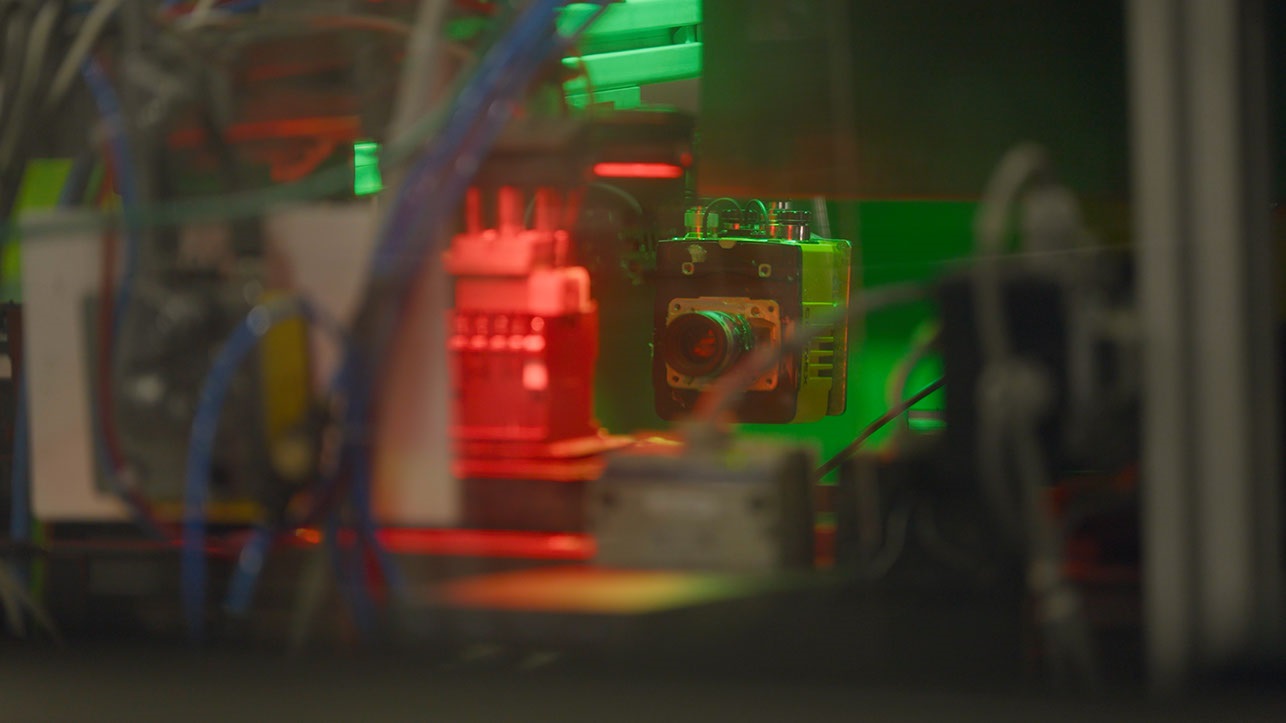
Schneider Electric Sets a New Benchmark for AI-Driven Inspection
For decades, Cognex and Schneider Electric have partnered to advance machine vision in industrial manufacturing. But as production demands intensified and workforce challenges grow, Schneider Electric recognized that traditional inspection systems were no longer enough.
Schneider Electric set out to solve a pressing challenge: how to expand inspection coverage, increase throughput, and reduce manufacturing costs—without increasing complexity or reliance on individual technical expertise. The answer came with the integration of Cognex In-Sight cameras and the OneVision AI development environment.
The result? A transformation in quality control that doubled production yield, reduced false rejects by 70x, and established a global standard for AI-powered inspection.
The Challenge: Expanding Inspection Without Adding Complexity
The team’s goal was clear: develop advanced inspection capabilities in France, if successful the solution would be deployed as a standardized solution worldwide.
An earlier generation of vision tools was used for on-line inspections, primarily focused on assembly inspection and measurement. While effective for basic validation, these tools could not support the broader inspection needs required to scale production or meet increasing quality expectations.
Schneider Electric faced several challenges:
- The need to inspect more control points without slowing production
- Scarcity of skilled vision engineers
- Increasing pressure to reduce manufacturing costs
- The desire to democratize AI for operators and plant engineers
- Growing demand for global standardization across facilities
- Having a centralized validated models replicable / scalable worldwide to create global standard
The factory team recognized that incremental improvements would not be enough. They needed a platform that could expand inspection capabilities, simplify AI adoption, and enable collaboration across locations.
Originated by engineers and operations leaders, this initiative identified the improvement opportunities and pushed the project upward to management, to align it with broader corporate goals of efficiency, scalability, and digital transformation.
The Solution: Cognex OneVision and In-Sight Cameras
Schneider Electric wanted to enhance its existing ecosystem rather than seeking alternatives. The objective was to increase throughput and capability within a trusted platform.
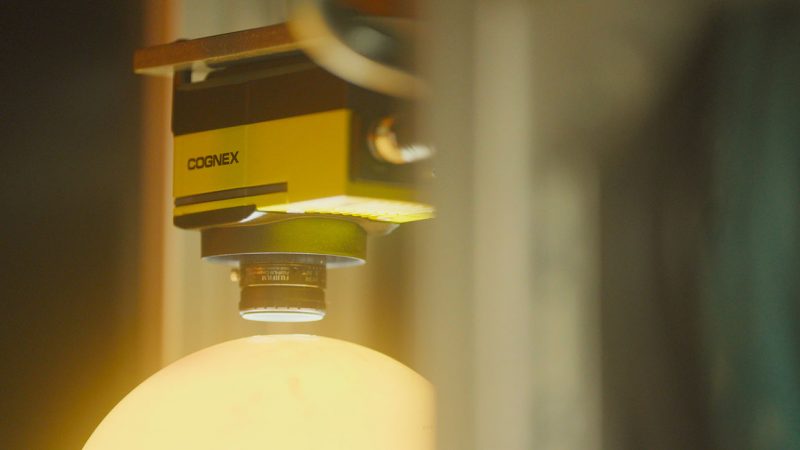 The implementation integrated OneVision and In-Sight cameras with the In-Sight Vision Suite, a unified environment for all In-Sight devices, to combine traditional rule-based vision tools with an advanced AI toolset.
The new setup expanded inspection from limited measurement checks to 17 distinct control areas. These inspections included:
- Height control
- Screw Position & Rotation validation
- Sorting
- Orientation detection
- Detection of shortages at the base or head of contactors
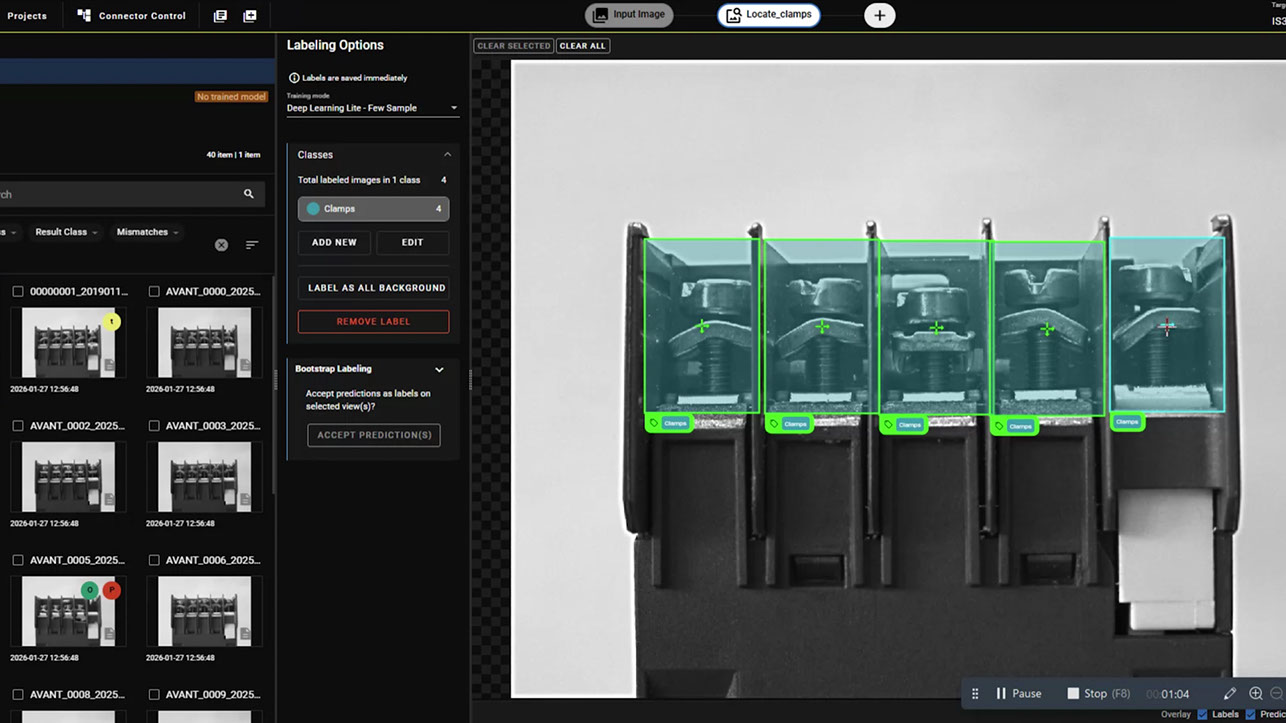
Using the Advanced AI tools in OneVision engineers can label images with a high degree of granularity and details as well as refine ROI and retrain models rapidly
One of the most powerful capabilities is the ability to train models efficiently, even starting with minimal image sets, and refine them iteratively within a collaborative environment.
The platform also eliminated an ongoing hardware challenge. Previously, advanced AI inspection often required PCs equipped with high-performance graphics cards. With OneVision, that requirement disappeared. This not only reduced direct hardware costs but simplified system architecture and maintenance.
Overcoming Security and Adoption Challenges
As with any cloud platform in a global enterprise, security validation was critical in evaluating OneVision.
Schneider Electric conducted a comprehensive security assessment of the cloud-based solution. Security and engineering teams from Cognex supported the process by completing third-party security questionnaires and providing necessary certifications. The platform met Schneider Electric’s most demanding global standards.
The broader testing and validation process spanned approximately six months. Much of the effort was concentrated at the beginning, where teams focused on training, validation, and ensuring operational reliability before full-scale deployment.
Despite the rigorous process, the ease of use and ergonomic interface of OneVision accelerated adoption. Engineers found that new inspection solutions could be developed and integrated 30% faster compared to previous approaches.
The Results: Measurable and Transformational
The impact of the implementation was substantial and measurable.
Decreasing non quality costs without increasing cycle time
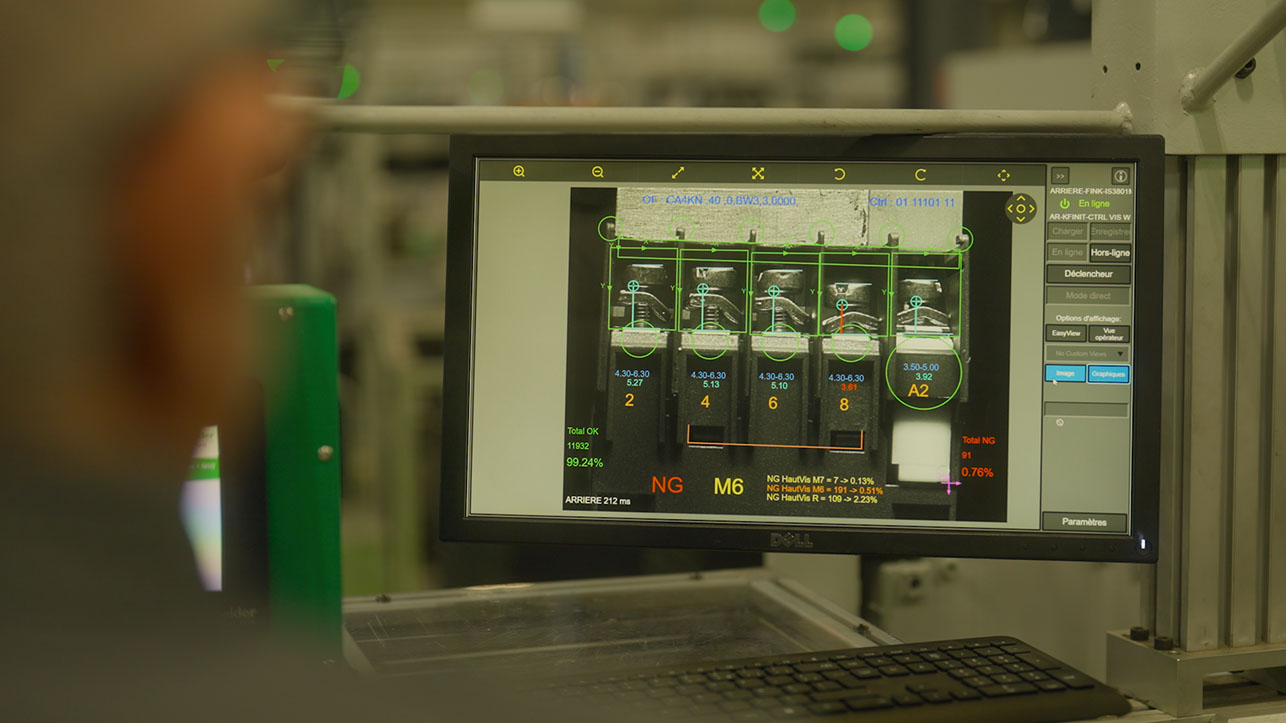
Schneider Electric enhanced production line control by expanding inspection coverage from 5 critical areas with traditional methods to 17 areas using OneVision, and significantly improved detection accuracy. Additionally, reducing cycle time from 400 ms to 200 ms.
70× reduction in false bad rates
Using the advanced AI capabilities of OneVision, Schneider Electric reduced false bad rates by a factor of 70. This dramatically improved operational efficiency and reduced unnecessary waste.
30% faster integration of new controls
The simplicity and execution speed of the platform reduced integration time for new inspection applications by 30%. This enabled faster iteration and continuous improvement.
Cost reduction — direct and indirect
Direct cost savings:
- No need for PCs with graphics cards
- Reduced hardware complexity
Indirect cost savings:
- Less time spent in meetings coordinating development
- Faster collaboration across teams
- Reduced development effort
- Lower maintenance overhead
Together, these improvements delivered quality and cost savings at approximately twice the previous rate.
Unexpected Benefits
While the team anticipated quality and efficiency gains, several benefits exceeded expectations:
- The dramatic 70× reduction in false bad rates
- Significant reduction in coordination and meeting time
- Faster development cycles than originally forecast
Perhaps most importantly, the platform’s simplicity unlocked new possibilities. Engineers can now imagine new applications because development requires only a few clicks. This mindset shift, from constraint to capability, may be one of the most powerful outcomes of the project.
Enabling Global Collaboration
One of the most strategic advantages of OneVision was its centralized collaboration capability.
The location in France could develop inspection standards and refine a project that can then be deployed to other facilities almost instantly. This level of global collaboration was not previously possible. Traditional camera-based training was constrained by hardware limitations. Now, models can be trained, refined, and distributed worldwide through a centralized platform creating a standardized inspection framework and replicating them across factories with just a few clicks.
This capability is especially powerful in addressing workforce scarcity. Instead of requiring each plant to develop expertise independently, knowledge and AI models can be shared seamlessly across the organization, and even external 3rd parties can be leveraged to optimize the solution.
Democratizing AI for Manufacturing
A key objective for this project was to make AI in machine vision more inclusive, intuitive, collaborative, and accessible.
The intuitive interface and simplified model training process in OneVision allow operators and engineers, without deep AI specialization, to participate in building and refining inspection solutions.
The combination of traditional rule-based tools and advanced AI in a single environment provides flexibility and versatility. Teams can choose simpler inspection modes or more accurate AI-driven classification as needed.
This hybrid capability lowers the learning curve, which also helps Schneider Electric address one of the most pressing challenges in modern manufacturing: workforce limitations.
Competitive Advantage
The transformation goes beyond operational efficiency. By expanding inspection coverage, reducing false rejects, and lowering manufacturing costs, Schneider Electric strengthened its competitive position.
The ability to deploy advanced AI inspection globally, quickly, and collaboratively provides a distinct advantage. Fewer false rejects mean less waste. Faster integration means quicker innovation cycles. Standardization across plants ensures consistent quality worldwide. The site now serves as a model for broader deployment. Schneider Electric’s stated goal is to expand this solution more widely across its global operations.
The collaborative platform makes this expansion feasible and scalable.
Looking Ahead
Schneider Electric’s journey with OneVision is just beginning. With proven results in France, the company is positioned to standardize intelligent vision systems across additional factories.
The platform has demonstrated that AI in manufacturing does not have to be complex or resource intensive. It can be collaborative, secure, scalable, and transformative. As Schneider Electric continues expanding this solution, the benefits are clear:
- Higher quality
- Greater efficiency
- Lower costs
- Faster innovation
- Global standardization
Through the combination of advanced hardware and collaborative AI, Schneider Electric has redefined what is possible in machine vision – and set a new benchmark for intelligent manufacturing worldwide.
For more information: www.cognex.com