From Model to Measurement: How Metrology Software Powers the MBD-Driven Digital Thread
 As manufacturing accelerates toward the Model-Based Enterprise (MBE), metrology software is evolving from a standalone inspection tool into a critical enabler of the digital thread. By connecting engineering intent, manufacturing execution, and quality validation, software platforms are helping organizations move beyond disconnected workflows toward fully traceable, model-driven manufacturing.
In this interview article, Verisurf Software President Ernie Husted discusses the role of metrology software in preserving engineering intent, advancing Model-Based Definition (MBD), and enabling intelligent manufacturing through open standards such as STEP AP242 and the Quality Information Framework (QIF).
Q: Software as the Backbone of the Digital Thread – Metrology software is increasingly described as the connective tissue of the digital thread. How does Verisurf define its role in linking design intent, manufacturing execution, and quality outcomes in a model-based environment?
A: The digital thread depends on maintaining a continuous connection between engineering intent, manufacturing execution, and quality verification. Verisurf has been focused on this challenge for nearly two decades.
In 2006, Verisurf introduced one of the industry’s first practical Model-Based Definition (MBD) solutions, helping manufacturers use semantic GD&T directly from 3D CAD models. That work supported early MBD initiatives, including adoption by Boeing on the 787 program, where the need to communicate engineering requirements digitally across a complex global supply chain became increasingly important.
Today, Verisurf extends that same vision through support for the Quality Information Framework (QIF), an open digital quality standard that enables the communication of product definition, inspection requirements, measurement results, and statistical quality information throughout the manufacturing enterprise.
Our role is to ensure that the digital definition created in engineering remains intact throughout manufacturing and quality verification. By maintaining associativity to native CAD models and semantic GD&T, manufacturers can automate inspection planning, measurement, and reporting directly from the digital product definition while preserving traceability and confidence across the product lifecycle.
Q: MBD as a Catalyst for Change – How is Model-Based Definition reshaping inspection planning, execution, and reporting
A: MBD fundamentally changes how quality is executed because it allows engineering intent to be consumed directly throughout manufacturing rather than recreated at each downstream step.
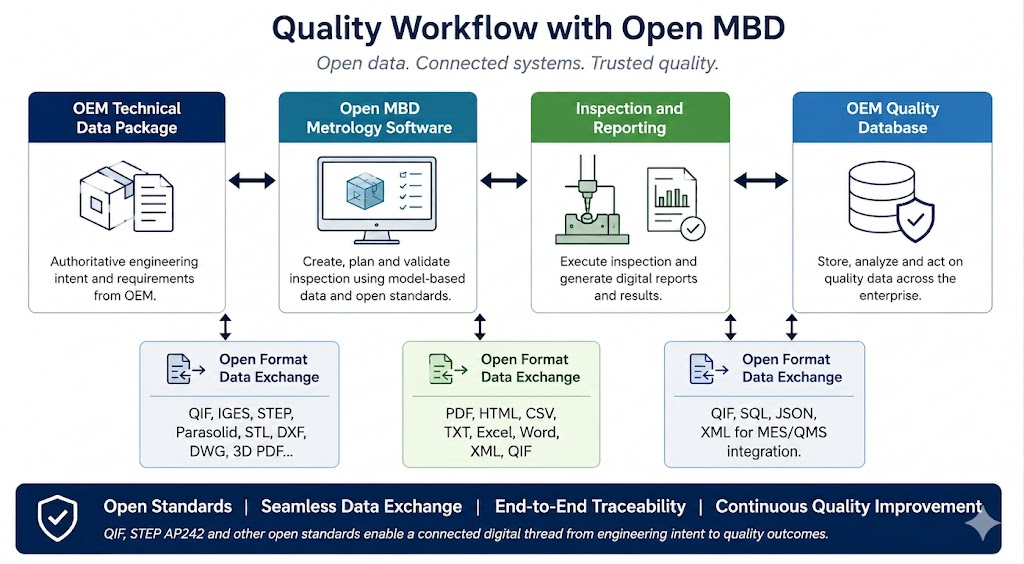
When semantic PMI and GD&T are embedded within the 3D model, inspection planning, measurement execution, and reporting can be generated from a common digital source. This reduces interpretation, improves consistency, and enables a much higher degree of automation.
While significant progress has been made, many manufacturers continue to operate in hybrid environments where semantic MBD data coexists with traditional drawings and non-semantic file formats. As a result, the industry is still working toward realizing the full automation potential of the digital thread.
The long-term objective is clear: a single authoritative digital product definition that can flow seamlessly across engineering, manufacturing, and quality systems without translation or manual intervention. MBD is both Man and Machine Readable. Forward-looking, Machine Readable enables automated CMM programming with great AI potential in the future. As adoption increases, MBD will become the foundation that enables scalable digital manufacturing.
Q: From Model to Measurement to Reporting – What are the biggest technical and organizational challenges manufacturers face when transitioning to MBD-centric, model-driven inspection workflows, and how can software help lower those barriers?
A: The biggest challenge is not simply adopting new software – it is aligning people, processes, and technology around a shared digital definition.
Successful digital transformation requires confidence that every stakeholder, from engineering through manufacturing and quality, is working from the same source of truth. That demands common standards, interoperable systems, and organizational commitment to model-based processes.
Software plays an important role by helping manufacturers bridge the gap between current-state operations and future-state digital workflows. Open standards such as QIF provide a framework for communicating inspection requirements, measurement results, and quality data in a machine-readable format. When quality information becomes digital, traceable, and reusable, organizations can reduce manual effort, accelerate decision-making, and improve confidence in production outcomes.
Ultimately, the goal is not simply automation; it is creating a connected environment where quality information becomes an active participant in the manufacturing process rather than a byproduct of it.
Q: Digital Thread Maturity Across Industry – Based on your experience, where do most manufacturers sit today in terms of digital thread maturity, and what role does metrology software play in helping them advance to the next stage?
A: One of the challenges in discussing digital transformation is that organizations often lack a practical framework for measuring progress. At Verisurf, we view digital thread adoption as a maturity journey.
At the lower levels, manufacturers remain heavily dependent on drawings, disconnected workflows, and manual data transfer. As organizations advance, they begin adopting semantic MBD, digital inspection planning, and model-based quality processes. At the highest levels, engineering, manufacturing, inspection, and enterprise systems operate within a fully connected and traceable environment.
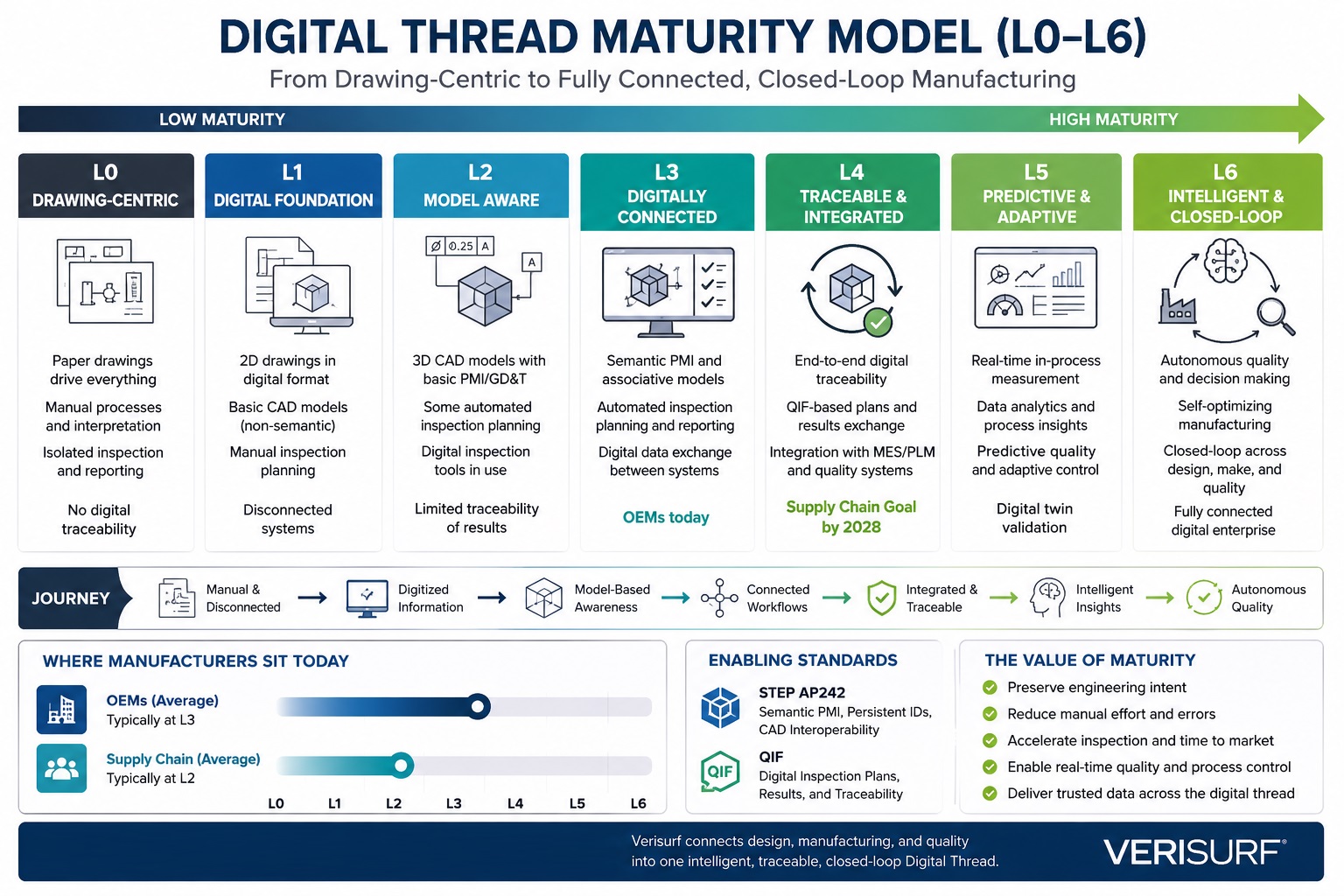
Today, we see most aerospace and defense OEMs operating between Levels 2 and 3, while much of the supply chain remains between Levels 1 and 2. The next major industry milestone is achieving Level 4, where product definition and quality information move digitally between OEMs and suppliers through standards such as STEP AP242 and QIF.
Metrology software plays a central role in that progression because quality provides the evidence that the digital thread is functioning as intended. Inspection validates that engineering intent has been successfully translated into manufactured reality. Without trusted quality data, there is no reliable digital thread.
Q: Interoperability and Open Ecosystems – A true digital thread depends on seamless interoperability. How is Verisurf addressing the challenge of connecting CAD, CAM, PLM, MES, and metrology systems without creating new data silos?
A: Interoperability is one of the defining challenges of digital manufacturing. No manufacturer operates within a single software ecosystem, and the digital thread can only succeed if information moves freely between systems.
That is why Verisurf has long-supported open standards such as STEP AP242 and QIF. These standards provide a common language for communicating product definition, manufacturing requirements, inspection plans, and quality results across diverse software environments.
Equally important is the ability to connect with a wide range of metrology hardware. Manufacturers rely on coordinate measuring machines, laser trackers, scanners, portable arms, probing systems, and automated inspection platforms from multiple suppliers. The value of the digital thread increases significantly when those technologies can operate within a consistent and traceable workflow.
Ultimately, interoperability is not simply a technical requirement – it is the foundation upon which scalable digital transformation is built.
Q: Automation, Intelligence, and Shop-Floor Impact – How are automation and intelligent capabilities – such as feature recognition, rule-based inspection, or AI-assisted workflows—changing how metrology software is used on the shop floor?
A: Inspection is increasingly becoming an integrated manufacturing process rather than a separate quality function.
We are seeing quality move much closer to the manufacturing process itself. Rather than functioning solely as a final verification activity, inspection is increasingly becoming an integrated component of production.
Advances in automated feature recognition, model-based inspection planning, scanner integration, CNC probing, and real-time reporting are reducing reliance on manual programming and interpretation. These capabilities allow manufacturers to deploy inspection processes more consistently and respond more quickly to production variability.
The broader impact is that quality information becomes available earlier, when it can influence manufacturing decisions rather than simply document outcomes. This shift supports faster first article inspections, improved repeatability, reduced cycle times, and more proactive process control.
As automation continues to evolve, metrology software will increasingly serve as a decision-support platform that helps manufacturers understand and respond to process variation in real time.
Q: Real-Time Quality, Digital Twins, and Data Trust – As manufacturers move toward real-time quality control and digital twins, how must metrology software evolve to support fast feedback, in-process verification, traceability, and trusted data across the digital thread?
A: The value of a digital twin depends entirely on the quality and trustworthiness of the information feeding it. Manufacturers need confidence that engineering, manufacturing, and quality systems are working from a consistent and traceable digital definition.
Open standards play an important role because they provide a framework for communicating information across diverse systems without losing context or meaning. As digital twins become more prevalent, quality data must remain machine-readable, traceable, and accessible throughout the product lifecycle.
At the same time, manufacturers will continue operating in heterogeneous environments that combine multiple software platforms and legacy processes. Metrology software must therefore act as a bridge, ensuring that trusted quality information can move seamlessly between engineering, manufacturing, quality, and enterprise systems.
The organizations that succeed will be those that can transform measurement data into actionable intelligence that supports continuous improvement and closed-loop manufacturing.
Q: Workforce and the Road Ahead – As metrology becomes more software-centric and model-driven, what new skills will quality professionals need? Looking 5–10 years ahead, how do you see the role of metrology software evolving in fully connected manufacturing ecosystems?
A: The quality professional of the future will need to combine traditional metrology expertise with a broader understanding of digital manufacturing systems, model-based workflows, interoperability standards, automation technologies, and data analytics.
As manufacturing becomes increasingly connected, quality professionals will play a more strategic role in managing the integrity of the digital thread. Their responsibility will extend beyond measurement to ensuring that information remains accurate, traceable, and actionable throughout the manufacturing lifecycle.
Workforce development will therefore remain a critical industry priority. Manufacturers, software providers, and educational institutions all have an important role to play in preparing the next generation for model-based manufacturing environments.
Looking ahead, metrology software will evolve into the operational quality layer of the digital enterprise. Inspection will become increasingly automated, connected, and integrated with manufacturing execution systems. Quality will no longer be viewed as a final checkpoint; it will become a continuous source of intelligence that informs decisions across engineering, production, and supply chain operations.
The future of manufacturing is model-based, data-driven, and connected – and trusted quality information will be at the center of making that vision a reality.
For more information: www.verisurf.com