The Rise of Digital Twins: Transforming Predictive Maintenance and Manufacturing Efficiency
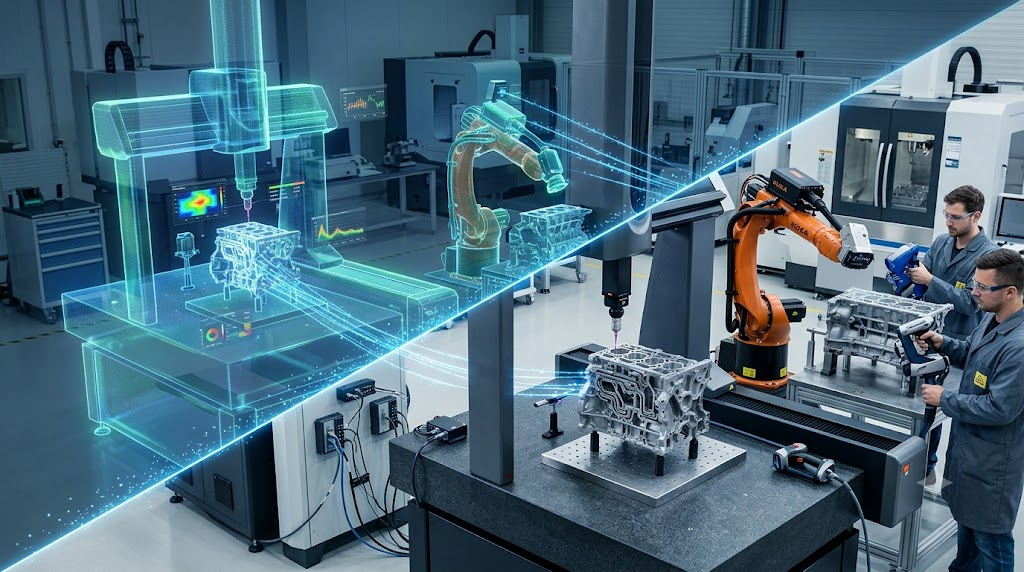
Digital twins have evolved from an innovative concept into one of the most transformative technologies in modern manufacturing. By creating a dynamic virtual representation of physical assets, production lines or even entire factories, manufacturers are gaining unprecedented visibility into their operations. This capability enables organisations to monitor equipment in real time, optimise production processes, predict equipment failures before they occur and make informed decisions based on continuous streams of operational data.
As Industry 4.0 continues to mature, digital twins are becoming the intelligence layer that connects design, manufacturing, inspection, maintenance and product lifecycle management into a single, integrated digital ecosystem. Rather than operating as isolated disciplines, these functions now share information that allows manufacturers to improve efficiency, reduce costs and enhance product quality throughout the manufacturing process.
More Than a Digital Model
A digital twin is far more sophisticated than a traditional three-dimensional CAD model. While CAD provides a static representation of a product, a digital twin evolves continuously throughout the life of an asset by receiving live information from sensors, production equipment and enterprise software systems. It reflects the current condition of a machine or production system while simultaneously retaining its historical operating data, maintenance records and performance trends.
Information feeding a digital twin can originate from numerous sources, including Industrial Internet of Things (IIoT) sensors, programmable logic controllers, coordinate measuring machines (CMMs), laser scanners, industrial computed tomography systems, vision inspection equipment, manufacturing execution systems and enterprise resource planning platforms. The combination of these data sources allows the virtual model to mirror real-world behaviour with remarkable accuracy, providing manufacturers with an increasingly complete understanding of their operations.
Transforming Equipment Maintenance
One of the most compelling applications of digital twins lies in predictive maintenance. For decades, manufacturers have relied primarily on reactive maintenance, repairing equipment only after it has failed, or preventive maintenance, servicing machines at scheduled intervals regardless of their actual condition. Both approaches have significant limitations. Unexpected breakdowns can halt production and incur substantial costs, while routine maintenance often replaces components that still have considerable service life remaining.
Digital twins introduce a far more intelligent approach. By continuously analysing machine data such as vibration, temperature, spindle loads, energy consumption and operating conditions, the digital twin can detect subtle changes that indicate the early stages of mechanical wear or impending failure. Artificial intelligence and machine learning algorithms analyse these patterns continuously, identifying anomalies that would be almost impossible for human operators to recognise.
Maintenance teams can therefore intervene before equipment fails, dramatically reducing unplanned downtime while extending the operational life of expensive manufacturing assets. Spare parts can be ordered only when required, maintenance resources can be allocated more efficiently and production schedules become significantly more predictable.
Metrology Provides the Critical Feedback
For digital twins to deliver meaningful insights, they require accurate and reliable measurement data. This is where metrology plays an increasingly strategic role.
Inspection systems no longer serve solely as quality control checkpoints positioned at the end of production. Instead, they have become essential sources of information that continuously validate whether manufactured components conform to their digital definitions. High-precision measurement data collected by coordinate measuring machines, laser trackers, portable measuring arms, structured-light scanners, industrial CT systems and advanced vision inspection equipment is fed directly into the digital twin.
This continuous feedback enables manufacturers to identify process drift, tooling wear, fixture movement, thermal distortion and machine calibration issues long before defects become significant enough to create scrap or require costly rework. Rather than simply determining whether a component passes or fails inspection, metrology systems are increasingly providing the intelligence needed to optimise manufacturing processes in real time.
Connecting the Digital Thread
Digital twins have become a cornerstone of the digital thread, creating continuous connections between product design, simulation, manufacturing, inspection, maintenance and operational performance.
This integrated flow of information allows engineers to understand precisely how decisions made during product development influence manufacturing performance and how production variations ultimately affect the finished product. If inspection data consistently identifies dimensional variation within a particular feature, engineers can trace the issue back through machining parameters, tooling conditions, environmental influences and production history to determine the root cause.
By eliminating disconnected data silos, manufacturers gain complete visibility across the entire product lifecycle, allowing decisions to be based on comprehensive operational intelligence rather than isolated measurements.
Improving Manufacturing Performance
The ability to simulate manufacturing processes before implementing changes on the shop floor represents another major advantage of digital twins. Engineers can evaluate alternative production schedules, tooling strategies, robot movements, fixture designs, material flows and energy consumption within a virtual environment before making physical changes to equipment.
This capability significantly reduces commissioning time while minimising the risk associated with introducing new production methods. Manufacturing improvements can be validated digitally, allowing organisations to optimise productivity without disrupting ongoing operations.
As production environments become increasingly automated, these simulations are proving invaluable for manufacturers seeking continuous improvement while maintaining high levels of operational stability.
Supporting Flexible Production
Manufacturers across many industries are facing growing pressure to deliver increasingly customised products while maintaining high productivity. Product lifecycles continue to shorten, batch sizes are becoming smaller and customer expectations continue to rise.
Digital twins provide manufacturers with the flexibility needed to adapt rapidly to these changing requirements. New product variants can be evaluated within the virtual environment before entering production, allowing engineers to optimise manufacturing parameters while ensuring quality standards are maintained.
This capability is particularly valuable in sectors such as aerospace, automotive, medical device manufacturing and precision engineering, where tight tolerances, regulatory requirements and product complexity demand exceptional levels of process control.
Artificial Intelligence Accelerates Digital Twins
Artificial intelligence is rapidly expanding the capabilities of digital twins beyond monitoring and simulation.
Machine learning algorithms continuously analyse enormous volumes of operational, inspection and maintenance data to identify opportunities for optimisation. These systems can recommend machine parameter adjustments, suggest maintenance schedules, optimise inspection frequency and identify production bottlenecks that may otherwise remain hidden.
Generative AI is beginning to enhance this capability even further by enabling engineers to interact with digital twins using natural language. Instead of manually analysing complex datasets, engineers can ask questions about production performance, equipment condition or quality trends and receive intelligent recommendations supported by real-time manufacturing data.
As AI technologies continue to mature, digital twins are evolving from passive monitoring systems into active decision-support platforms capable of guiding manufacturing operations with increasing levels of autonomy.
Driving More Sustainable Manufacturing
Digital twins are also helping manufacturers achieve ambitious sustainability goals.
By improving process control and identifying inefficiencies before they generate waste, manufacturers can reduce scrap, minimise rework and lower overall material consumption. Virtual process optimisation decreases the need for multiple physical prototypes during product development, reducing both costs and environmental impact.
Predictive maintenance also contributes to sustainability by extending equipment life, reducing unnecessary component replacement and improving overall energy efficiency. These combined benefits support manufacturers seeking to lower both operating costs and carbon emissions while maintaining high levels of productivity.
Overcoming Implementation Challenges
Despite their considerable advantages, digital twins are not without challenges. Many manufacturers continue to operate legacy production equipment that was never designed to support modern connectivity. Integrating older machinery into a digital twin environment often requires additional sensors, communication gateways and specialised software.
Data quality remains equally important. A digital twin is only as accurate as the information it receives, making reliable sensor networks, robust metrology systems and standardised data structures essential for successful implementation. Organisations must also address cybersecurity concerns as increasing connectivity creates additional exposure to potential cyber threats.
Finally, manufacturers must ensure their workforce possesses the digital skills needed to interpret the insights generated by these sophisticated systems and translate them into effective operational decisions.
The Future of Intelligent Manufacturing
As manufacturing becomes increasingly connected, digital twins are poised to become central decision-making platforms that integrate engineering, production, quality assurance and maintenance into a unified digital environment.
The combination of advanced metrology, artificial intelligence, cloud computing and industrial connectivity provides manufacturers with unprecedented visibility into their operations. Rather than responding to problems after they occur, organisations can anticipate failures, optimise production continuously and improve quality throughout every stage of the manufacturing lifecycle.
For the metrology community, this evolution represents a fundamental change in the role of measurement. Inspection is no longer simply about verifying dimensional compliance. It is becoming a vital source of operational intelligence that powers predictive maintenance, strengthens the digital thread and enables truly intelligent manufacturing.
As digital twins continue to mature, manufacturers that successfully combine accurate measurement with real-time analytics and intelligent automation will be best positioned to improve productivity, reduce operational costs and compete successfully in an increasingly data-driven industrial landscape.
Author: Guest Writer William Jones II