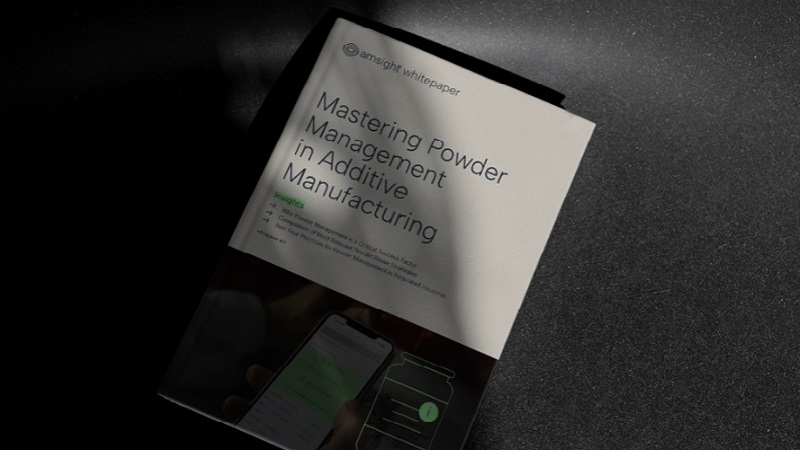
Amsight Releases Whitepaper on Powder Management in Additive Manufacturing
Amsight has released a new whitepaper entitled “Mastering Powder Management in Additive Manufacturing”, setting out why powder control is becoming one of the decisive quality issues in industrial metal AM.
The whitepaper focuses on a reality that many production teams recognise but do not always manage systematically, powder is not a static input. In powder-bed additive manufacturing, powder changes through reuse, exposure, handling, sieving, blending, and storage. Those changes may affect chemistry, particle size distribution, morphology, flowability and — ultimately — part quality, process stability, scrap risk, and audit readiness.
The document provides a practical, production-led guide to powder management, with a particular focus on metal powder-bed fusion and L-PBF environments. It explains where variability enters the powder lifecycle, what typically changes during reuse, and why powder history needs to be connected to builds, post-processing, and inspection outcomes if manufacturers want usable quality evidence rather than disconnected records.
“Powder management is often treated as a material-handling task, but in production AM it is a quality-management task,” says Tim Wischeropp, CEO at amsight. “If teams cannot connect powder history to part outcomes, they cannot reliably understand drift, optimise reuse, or build the evidence needed for regulated production. The goal is not more paperwork. The goal is controlled, queryable quality data.”
The whitepaper compares four dominant powder reuse strategies — single use, fixed refresh ratio, batch method, and blending — and discusses the trade-offs each introduces around cost, waste, simplicity, traceability, and quality control. It also sets out best practices for regulated industries, including standards-aligned thinking, centralised audit-ready documentation, full powder traceability, operator qualification, controlled infrastructure, and continuous monitoring of relevant powder properties.
A central theme is the move from fixed cycle limits toward condition-based control. Rather than relying only on conservative reuse rules, the paper argues for identifying critical-to-quality powder characteristics, linking them to part outcomes, setting control limits, and progressively applying SPC so teams can detect drift earlier and keep powder management under continuous control.
“Customers are not only asking whether a part conforms,” says Peter Lindecke, CCO of amsight. “They increasingly want evidence that the process behind the part is controlled. Powder is a major part of that evidence chain. This whitepaper is designed to help AM teams understand where their powder data maturity is today and what practical steps they can take next.”
By placing powder management inside the wider AM quality evidence chain, amsight reinforces its role as a digital quality backbone for production additive manufacturing, connecting powder, process, machine, post-processing and inspection data at part level.
Download the whitepaper.
For more information: www.amsight.de