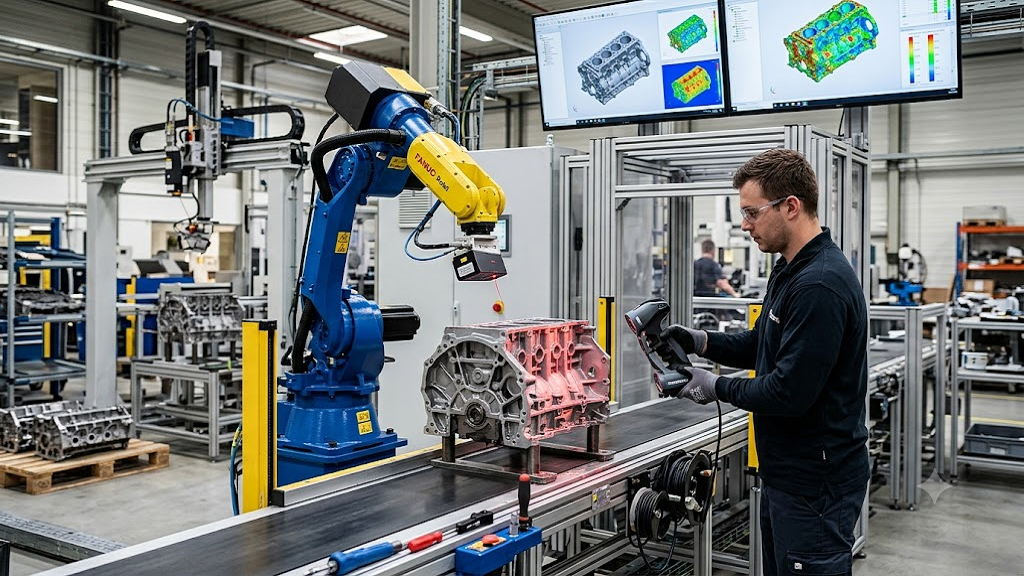
Hybrid Measurement Strategies – Combining Portable and Inline Data Streams
Manufacturers continue to accelerate their digital transformation efforts, investing heavily in automated inspection technologies, connected production systems, and real-time quality monitoring. Inline metrology has emerged as a critical component of modern manufacturing, providing continuous process feedback and enabling increasingly sophisticated quality control strategies. At the same time, portable measurement technologies, including portable coordinate measuring machines (PCMMs), laser trackers, and handheld 3D scanners, remain indispensable for addressing inspection challenges that extend beyond the capabilities of fixed systems.
Rather than viewing portable and inline metrology as competing approaches, many manufacturers are now combining them into hybrid measurement strategies. This integrated approach leverages the strengths of both technologies, creating a more comprehensive measurement ecosystem capable of supporting advanced quality initiatives, improving process control, and delivering greater confidence in production outcomes.
The Role of Inline Metrology
Inline metrology systems are designed to operate directly within manufacturing environments, often inspecting every component or a large percentage of production output without interrupting workflow. Their primary advantage lies in their ability to provide immediate feedback, enabling manufacturers to identify process deviations as they occur and respond before quality issues escalate.
The benefits of this approach are substantial. Continuous monitoring provides unprecedented visibility into production performance, while automated inspection minimizes the need for manual intervention and supports higher throughput. Real-time quality data allows manufacturers to implement closed-loop control systems that can automatically adjust production parameters when variation is detected.
Despite these advantages, inline systems are typically optimized for specific inspection tasks and production conditions. They often focus on critical dimensions and process indicators rather than conducting comprehensive part verification. Environmental factors such as vibration, temperature fluctuations, and contamination can also influence measurement performance. Furthermore, adapting inline systems to new products or changing inspection requirements may require significant investment and engineering effort.
The Enduring Importance of Portable Metrology
Portable measurement technologies provide a level of flexibility that fixed installations cannot easily match. These systems can be deployed wherever measurement challenges arise, whether on the production floor, in a quality laboratory, during assembly operations, or at supplier facilities.
Their versatility makes them particularly valuable for first-article inspections, tooling verification, large-scale assembly measurement, maintenance activities, and detailed investigations of quality issues. Portable systems enable engineers and quality professionals to capture highly detailed geometric information from virtually any location, often providing insights that are difficult to obtain through automated inspection alone.
This flexibility comes with a different operational model. Unlike inline systems that generate a continuous stream of measurement data, portable technologies are typically deployed in response to specific inspection requirements. As a result, they produce highly detailed datasets but do not offer the same level of ongoing process visibility.
Building a Unified Measurement Ecosystem
The true value of hybrid measurement strategies emerges when portable and inline systems are no longer treated as separate inspection resources but are integrated into a unified quality framework.
In this environment, inline systems provide continuous monitoring of manufacturing processes while portable technologies deliver validation, verification, and deeper diagnostic capabilities. Data from both sources is brought together within common software platforms, creating a more complete understanding of production performance and product quality.
One of the most significant benefits of this approach is measurement validation. Portable systems can be used to periodically verify the accuracy and stability of inline inspection equipment, helping manufacturers identify calibration drift, environmental influences, or sensor degradation before they impact quality outcomes.
Hybrid strategies also enhance root-cause analysis. When an inline system detects an anomaly, portable measurement technologies can be deployed to collect additional data and investigate the issue in greater detail. This supplementary information often provides the context needed to identify the underlying source of variation and accelerate corrective action.
The integration of multiple measurement technologies also contributes to more accurate digital twins. Inline systems generate real-time operational data, while portable technologies provide detailed geometric verification. Together, these complementary datasets support more realistic simulations, improved process models, and stronger predictive capabilities.
In addition, combining measurement sources strengthens traceability by creating a richer historical record of product and process performance. This expanded documentation can be particularly valuable during audits, customer reviews, and regulatory assessments.
Data Fusion as a Competitive Advantage
As manufacturing organizations continue to digitize operations, data fusion is becoming one of the most promising developments in industrial metrology.
Data fusion involves combining information from multiple measurement technologies into a unified analytical environment. Rather than evaluating inspection results in isolation, manufacturers can correlate inline measurement data with portable inspection results, machine performance metrics, environmental conditions, and production parameters.
This broader perspective often reveals relationships that would otherwise remain hidden. A dimensional variation identified by an inline system, for example, may ultimately be linked to temperature fluctuations, tooling wear, machine maintenance cycles, or changes in production scheduling. By examining these factors together, manufacturers can gain a far deeper understanding of process behavior.
The emergence of artificial intelligence and machine learning technologies is further increasing the value of integrated measurement datasets. Advanced analytics systems require large volumes of high-quality data to identify patterns and generate reliable predictions. Hybrid measurement strategies provide precisely the kind of diverse and comprehensive information needed to support predictive quality initiatives.
The Strategic Importance of a Unified Software Platform
The full value of a hybrid metrology strategy depends on a unified software platform that connects data from inline and portable measurement systems. By aggregating and standardizing inspection data within a common environment, manufacturers gain greater visibility across operations, simplify data management, and establish a single source of truth for quality decisions. This integrated approach supports traceability, process optimization, predictive analytics, and digital thread initiatives, transforming measurement data from isolated inspection results into a strategic asset for continuous improvement.
Supporting the Next Generation of Smart Manufacturing
Hybrid measurement strategies align naturally with the objectives of Industry 4.0 and smart manufacturing. Modern production environments require both speed and adaptability, and no single measurement technology can satisfy every inspection requirement.
Inline systems excel at providing immediate process visibility and supporting automated decision-making, while portable technologies offer flexibility, mobility, and investigative depth. Together, they create a measurement infrastructure capable of supporting advanced manufacturing objectives, including predictive quality control, digital thread initiatives, process optimization, and increasingly autonomous production systems.
This convergence is becoming particularly important as manufacturers seek to balance higher levels of automation with growing demands for product customization. Quality systems must become more intelligent while remaining adaptable enough to accommodate changing production requirements.
Practical Considerations for Implementation
Successfully implementing a hybrid measurement strategy requires more than simply deploying multiple inspection technologies. Manufacturers must establish a framework that allows data from different sources to be effectively integrated and interpreted.
Data standardization is a critical requirement. Measurement information must be captured in formats that support comparison, correlation, and analysis across different systems and platforms. Open architectures and interoperable software solutions are becoming increasingly important as organizations seek to eliminate data silos.
Equally important is the development of clear measurement governance procedures. Quality teams must define when portable measurements should supplement inline inspections, how measurement discrepancies will be resolved, and how inspection data will be managed throughout the product lifecycle.
Connectivity also plays a central role. Measurement data must move efficiently between inspection systems, manufacturing execution systems, quality management platforms, and analytics tools if organizations are to fully realize the benefits of integrated metrology.
Finally, workforce development remains a key consideration. The metrology professionals of the future will require expertise that extends beyond traditional measurement science to include data analytics, software integration, and digital manufacturing technologies.
Looking Ahead
The future of industrial metrology is unlikely to be defined by a choice between portable and inline measurement systems. Instead, it will be shaped by the intelligent integration of both approaches.
As manufacturers pursue greater process visibility, stronger quality assurance, and more sophisticated use of production data, hybrid measurement strategies offer a practical and scalable path forward. By combining the continuous monitoring capabilities of inline systems with the flexibility and diagnostic power of portable technologies, organizations can create more resilient quality frameworks and develop a deeper understanding of their manufacturing operations.
In an increasingly data-driven manufacturing environment, the ability to merge multiple measurement streams into a unified quality ecosystem may become one of the defining characteristics of next-generation metrology.
Author: Guest Writer William Jones II