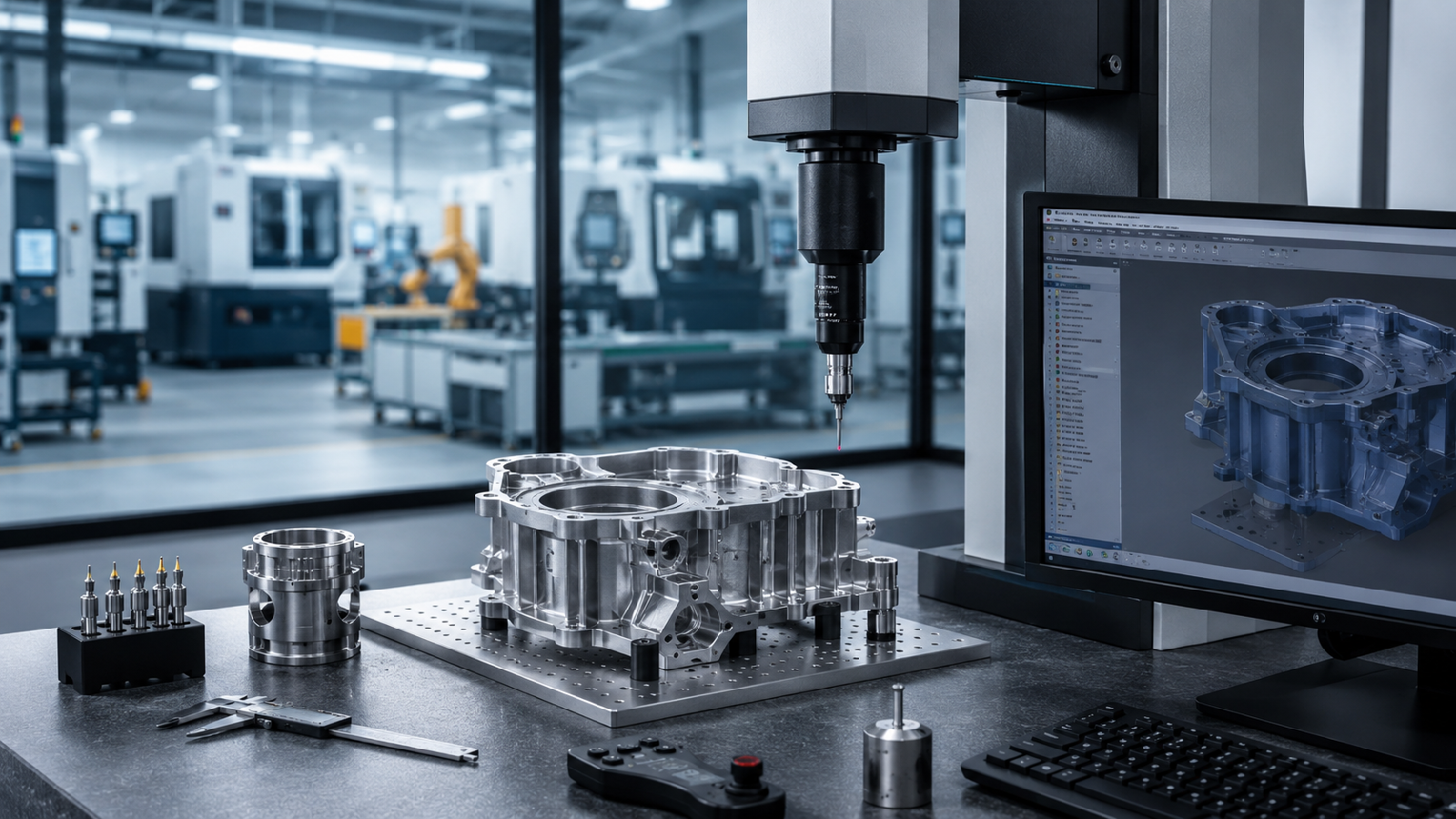
Beyond Inspection – How Connected Metrology Powers the Digital Enterprise
Digital transformation in manufacturing is no longer about implementing isolated software solutions. Today’s most successful manufacturers are connecting quality data across the enterprise, enabling metrology software to communicate seamlessly with Product Lifecycle Management (PLM), Enterprise Resource Planning (ERP), and Manufacturing Execution Systems (MES). The result is a digital ecosystem where measurement data becomes a strategic business asset rather than simply a quality control record.
Digital Ecosystems: When Metrology Software Talks to PLM, ERP, and MES
For decades, metrology software has played a critical role in ensuring dimensional accuracy and product quality. However, much of this data has remained confined within inspection departments, disconnected from the wider manufacturing operation. As manufacturers embrace Industry 4.0 and digital transformation, this siloed approach is rapidly disappearing.
Today’s leading manufacturers are integrating metrology platforms directly with enterprise software systems, creating a continuous digital thread that links product design, manufacturing, inspection, and business operations. Rather than simply generating inspection reports, metrology software is becoming an intelligent data hub that informs engineering decisions, production planning, maintenance strategies, and supply chain management.
Building the Digital Thread
Every manufactured component begins life as a CAD model within a Product Lifecycle Management (PLM) system. Traditionally, quality engineers would manually transfer design data into inspection software before generating reports that were later archived independently.
Modern integrated workflows eliminate these disconnected steps.
Inspection programs can now automatically retrieve CAD models, Product Manufacturing Information (PMI), Geometric Dimensioning and Tolerancing (GD&T), revision histories, and inspection characteristics directly from PLM platforms. When engineering changes occur, updated inspection routines can be generated automatically, ensuring manufacturing always measures against the latest approved design.
This digital continuity reduces programming time, eliminates version control issues, and significantly lowers the risk of inspecting components against obsolete specifications.
Closing the Loop with Manufacturing
Integration with Manufacturing Execution Systems (MES) extends the value of metrology even further.
Inspection results no longer remain isolated within the quality department. Instead, measurement data flows directly into production systems where it can trigger immediate responses.
If dimensional drift is detected on a machining centre, the MES can automatically notify operators, schedule corrective maintenance, adjust production parameters, or temporarily halt production before large quantities of non-conforming parts are produced.
Rather than discovering quality problems at the end of a production batch, manufacturers can react in near real-time, dramatically reducing scrap, rework, and downtime.
This closed-loop manufacturing model is becoming increasingly important as factories pursue autonomous production environments.
ERP Becomes Smarter
Enterprise Resource Planning (ERP) systems traditionally manage purchasing, inventory, scheduling, finance, and customer orders. By integrating metrology data, ERP gains a new level of manufacturing intelligence.
Quality trends can influence supplier ratings, trigger warranty investigations, or automatically initiate corrective action workflows.
If incoming inspection identifies recurring dimensional issues from a particular supplier, ERP systems can generate alerts, adjust procurement decisions, or provide evidence during supplier performance reviews.
Similarly, production yield information collected through metrology systems enables more accurate production costing, inventory planning, and delivery forecasting.
Quality becomes a measurable business metric rather than simply a manufacturing function.
Data Without Manual Intervention
One of the greatest advantages of integrated digital ecosystems is the elimination of manual data handling.
Historically, inspection reports were exported as PDFs, spreadsheets, or printed documents before being manually distributed to production managers, engineers, or customers.
Today’s connected software platforms exchange structured data automatically through APIs, OPC UA, MTConnect, QIF (Quality Information Framework), and other open communication standards.
This removes repetitive administrative work while improving data consistency, traceability, and audit readiness.
For regulated industries such as aerospace, medical devices, automotive, and energy, automated traceability has become an essential competitive advantage.
Artificial Intelligence Needs Connected Data
Artificial Intelligence is rapidly entering manufacturing, but AI is only as effective as the data available to it.
Integrated digital ecosystems provide AI with complete contextual information—not just measurement results, but machine conditions, production parameters, environmental data, tooling history, supplier information, and product revisions.
This enables predictive quality applications capable of identifying process drift before parts move out of tolerance.
Instead of detecting defects, manufacturers begin predicting them.
Machine learning algorithms can identify subtle correlations that would remain invisible using traditional statistical process control alone.
As AI adoption accelerates, connected metrology data will become one of the most valuable information sources within smart factories.
Cloud Connectivity Expands Collaboration
Cloud-native metrology platforms are extending digital ecosystems beyond individual factory sites.
Inspection results can now be securely shared across multiple manufacturing plants, design centres, suppliers, and customers.
Global engineering teams can review measurement results in real time, compare production performance across facilities, and collaborate on quality improvements without transferring large files manually.
Cloud connectivity also enables centralised dashboards that provide executives with live visibility into manufacturing quality performance across entire organisations.
For multinational manufacturers, this level of transparency is becoming increasingly valuable.
The Rise of Open Standards
One of the most significant developments enabling digital ecosystems is the growing adoption of open interoperability standards.
Quality Information Framework (QIF), MTConnect, OPC UA, STEP AP242, and Digital Product Definition standards are helping software vendors exchange information without proprietary interfaces.
This allows manufacturers greater flexibility when selecting equipment and software while reducing dependence on single-vendor ecosystems.
As these standards continue to mature, integrating multi-vendor metrology environments will become increasingly straightforward.
The Future is Connected
The future of metrology extends far beyond precision measurement.
Inspection software is evolving into a central intelligence platform that connects engineering, production, quality, maintenance, supply chain, and executive decision-making.
Rather than simply confirming whether a part passes or fails, metrology systems are becoming active participants in optimising manufacturing performance.
The factories leading the next generation of digital manufacturing will not necessarily be those with the fastest CMMs or the most advanced scanners. They will be the organisations that transform measurement data into enterprise-wide intelligence by integrating metrology seamlessly with PLM, MES, ERP, and the broader digital ecosystem.
In this connected manufacturing landscape, every measurement contributes to a continuous feedback loop that improves product quality, production efficiency, and business performance. Metrology is no longer just measuring parts – it is helping drive the intelligent factory.
Editor