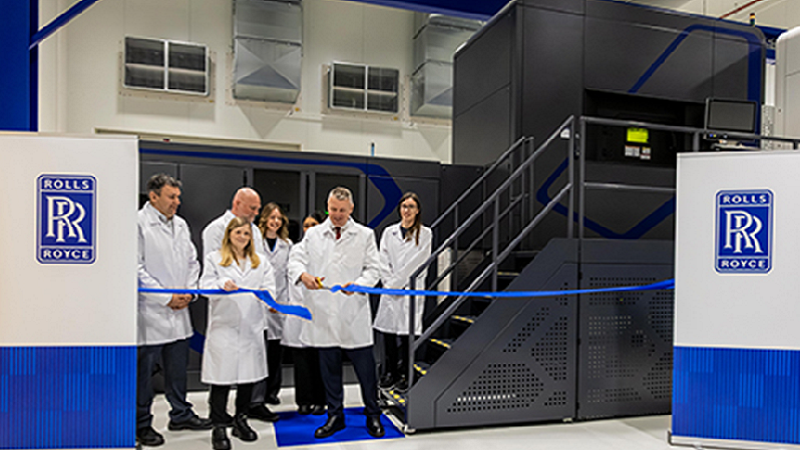
Rolls-Royce Advances Additive Manufacturing for Next-Generation Aerospace
A new additive manufacturing (AM) cell, supported by funding from the UK Ministry of Defence, is set to strengthen the UK’s position at the forefront of aerospace innovation. Installed at Rolls-Royce’s UK Bristol facility, the advanced system will produce critical components for next-generation aircraft engines, supporting both defence programmes and wider industrial applications.
The introduction of this German-engineered technology marks a significant step forward in the UK’s ability to manufacture complex aerospace components. By leveraging additive layer manufacturing (ALM), the facility enables faster production cycles, reduced costs, and improved efficiency compared with conventional manufacturing processes.
Precision Manufacturing for Advanced Aerospace
Housed within a purpose-built 350 m² controlled environment, the AM cell maintains strict regulation of humidity, temperature, and air pressure to ensure consistent, high-quality output. Using laser-based powder bed fusion, metal super-alloy powders are melted layer by layer to create intricate geometries that would be difficult, or impossible, to achieve through traditional manufacturing methods.
This level of precision not only enhances component performance but also reduces material waste. By using only the required amount of raw material, the process improves sustainability while lowering energy consumption during production.
Supporting GCAP and Future Combat Air Capabilities
The new facility is expected to play a pivotal role in advancing the Global Combat Air Programme (GCAP) and other future combat air initiatives. By accelerating innovation cycles and enabling rapid prototyping and production, additive manufacturing will contribute to the development of more powerful, fuel-efficient propulsion systems.
Optimised and lightweight components produced through ALM are central to achieving these gains. Reduced component weight directly translates into improved engine efficiency and enhanced aircraft performance, key priorities for next-generation military aviation.
Andy Higginson, Senior Vice President of Manufacturing, Assembly and Test at Rolls-Royce, emphasised the strategic importance of the investment:
“Across Rolls-Royce we are committed to the continued development and enhancement of our technologies to meet the demands of today, while providing scalable infrastructure required for the future. Programmes like FCAS and GCAP will be fundamental to the UK’s future aerospace sector and capabilities like additive manufacturing will be crucial to enabling innovation at pace, driving cost savings and enhancing the skills and capabilities of our people.”
Transformational Benefits of Additive Layer Manufacturing
The deployment of ALM within Rolls-Royce’s production ecosystem highlights a broader shift in aerospace manufacturing strategy. Key benefits include:
- Enhanced performance through optimised component design enabling greater engine power
- Improved efficiency via lightweight structures that reduce fuel consumption
- Reduced lead times supporting faster development and delivery cycles
- Superior material properties achievable through precise process control
- Greater flexibility allowing production at distributed or remote locations, including customer facilities
As additive manufacturing continues to mature, its integration into high-value aerospace applications is expected to expand. For the UK, investments such as this reinforce its leadership in advanced engineering while supporting critical defence capabilities and future air power development.
For more information: www.rolls-royce.com