How 3D Metrology Powers China’s Competitive Automotive Industry
China’s automotive industry has undergone a major transformation over the past decade, moving from a focus on high-volume manufacturing to competing at the highest level in terms of engineering precision, design quality, and technological sophistication. A key enabler of this shift has been advanced 3D metrology, which now plays a central role in how vehicles are designed, validated, and manufactured. Rather than functioning as a final inspection step, metrology has become embedded throughout the entire product lifecycle, supporting digital manufacturing and accelerating innovation.
Tightening Tolerances in the Era of Electric Vehicles
Today’s vehicles, particularly electric vehicles, require extremely tight dimensional control. Components such as battery enclosures, structural frames, and aerodynamic body panels must match their digital design intent with very small tolerances. Advanced 3D metrology makes this possible by capturing complete surface geometries using technologies such as laser scanning, structured light systems, and coordinate measuring systems. These tools allow manufacturers to compare physical parts directly against CAD models, detect deviations early, and reduce the need for repeated tooling adjustments. In effect, they bridge the gap between virtual design and physical production.
The Rise of High-Speed Optical Scanning
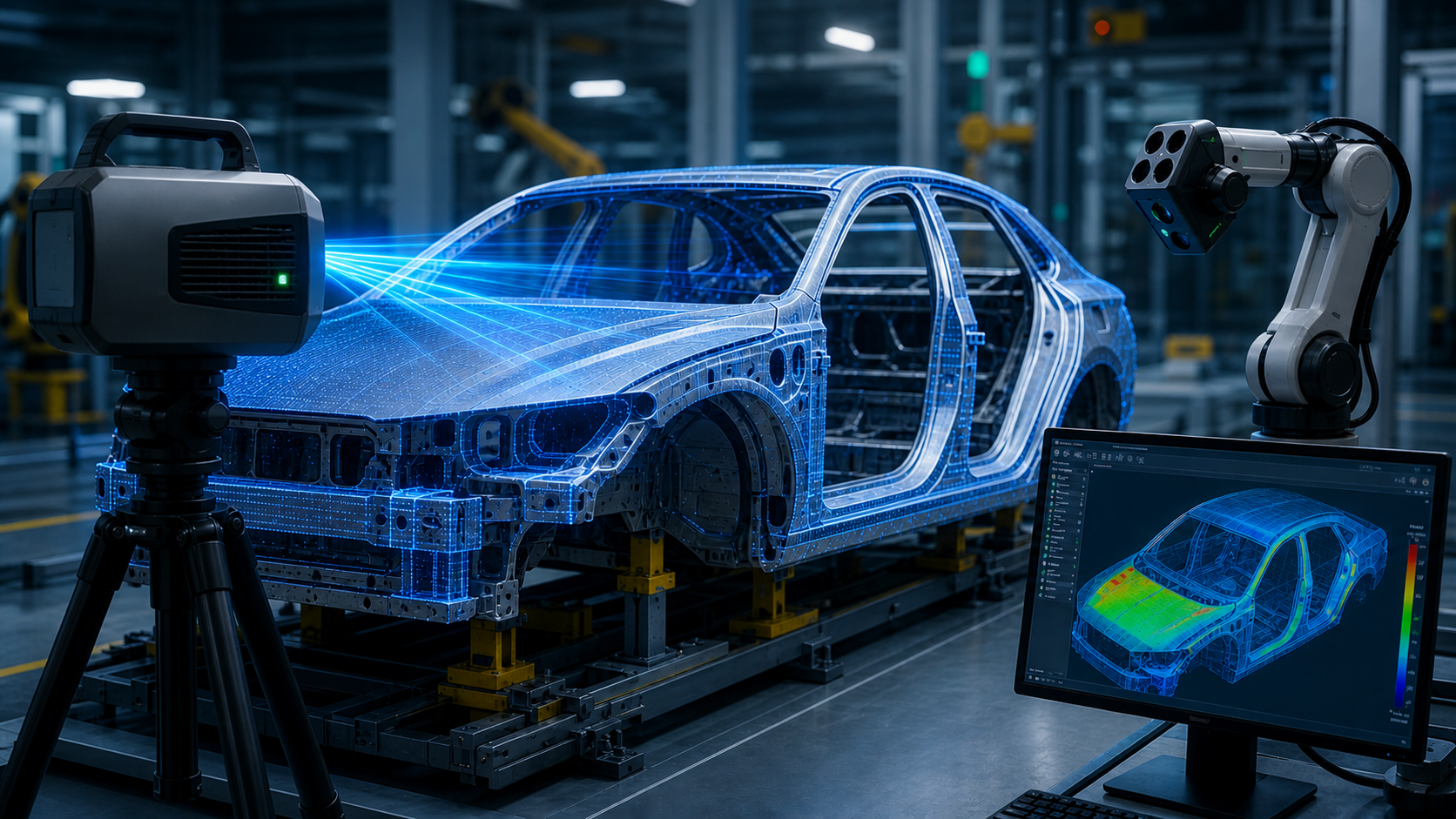
One of the most important technological developments has been the widespread adoption of high-speed optical scanning systems. These systems can capture full-field 3D data of complex automotive components, including entire vehicle bodies, and convert them into highly detailed digital models. Engineers can then visualize deviations using colour-mapped comparisons, making it much easier to identify manufacturing issues such as deformation, misalignment, or tooling errors. This capability is especially valuable in body-in-white production, where even minor deviations can affect assembly quality and long-term vehicle performance.
Laser Scanning in Large-Scale Manufacturing
Laser scanning has also become essential in large-scale automotive manufacturing environments. Compared to traditional contact-based measurement methods, laser scanners provide much faster and more comprehensive data acquisition. This is particularly important when inspecting large structures such as car bodies or stamping dies, where thousands of measurement points are required to fully understand surface geometry. As a result, manufacturers can perform more frequent inspections without slowing down production.
Chinese EV Leaders Driving Metrology Adoption
In China’s rapidly expanding electric vehicle sector, companies such as BYD, Geely, SAIC Motor, NIO, and XPeng have heavily invested in advanced metrology systems to support their aggressive product development cycles. These companies rely on 3D measurement technologies not only for final quality checks, but also for early-stage prototype validation and continuous production monitoring. For example, during body-in-white assembly, optical metrology systems are used to analyse panel alignment and gap consistency across entire vehicle structures. This ensures a high level of build quality, which is increasingly important as Chinese brands move into more premium market segments.
This technological evolution is reflected in China’s staggering production volumes, which have now positioned the nation as the undisputed leader of the global automotive landscape. As of 2026, China’s annual output has reached approximately 34.5 million units, accounting for nearly 44% of total global production. This output significantly eclipses that of other traditional automotive hubs; for comparison, the European Union produces roughly 12.1 million units (15% share), while the United States accounts for approximately 10.6 million units (13% share). The sheer scale of this manufacturing engine necessitates the ultra-high-speed, automated inspection workflows that only advanced 3D metrology can provide.
Export Growth and the Demand for Global Quality Standards
The shift toward high-precision metrology is further driven by China’s aggressive expansion into international markets. In 2025, China exported approximately 7.1 million vehicles, representing over 20% of its total domestic production. Projections for the remainder of 2026 suggest this figure could approach 10 million units, as manufacturers leverage high-margin foreign sales to offset a hyper-competitive domestic market. To succeed in these diverse global markets, particularly in the premium segments of Europe and North America, Chinese OEMs must guarantee a level of “perceived quality” and inherent reliability that meets or exceeds international standards.
Central to this export surge is the Electric Vehicle (EV) sector, which accounts for nearly 37% of China’s current exports. The complex architectures of EVs, involving integrated battery trays and lightweight multi-material frames, demand the micron-level tolerances and full-field surface data provided by laser scanning and structured light systems. By embedding these metrology tools into the heart of their smart factories, Chinese manufacturers are not only achieving the volume required to dominate global charts but also the engineering consistency required to compete with established Western brands.
A particularly important application is in stamping die validation, where precision is critical because any error in tooling is replicated across thousands of parts. In one example from a Chinese automotive supplier, the transition from photogrammetry to high-precision laser scanning significantly improved the accuracy and richness of inspection data. This allowed engineers to identify tooling deviations more effectively and communicate issues more clearly with OEM partners. It also shortened the feedback loop between production and design teams, reducing the time needed for corrections.
Inline Inspection and Real-Time Quality Control
3D metrology is also widely used in full-body digital inspection systems integrated directly into production lines. These systems can scan entire vehicles during or immediately after assembly, enabling near real-time quality control. In some cases, multicamera vision systems are capable of achieving measurement precision on the order of tenths of a millimetre while scanning large volumes. This makes it possible to identify assembly issues without removing vehicles from the production flow, supporting the broader move toward smart manufacturing.
Accelerating Innovation Through Prototype and Reverse Engineering
Beyond production, metrology plays a significant role in prototype development and reverse engineering. During early design stages, manufacturers use scanning systems to digitize clay models, physical prototypes, or even competitor vehicles. This data is then compared against CAD designs or used to refine aerodynamic surfaces and structural components. In some cases, high-resolution laser trackers have been used to capture full vehicle geometries for performance analysis and design optimisation, allowing engineers to better understand real-world behaviour before mass production begins.
The impact of these technologies on competitiveness is significant. Advanced 3D metrology reduces product development cycles by enabling faster validation of prototypes and tooling. It improves perceived vehicle quality by ensuring consistent fit and finish across large production volumes. It also reduces manufacturing costs by identifying defects earlier in the process, thereby minimising scrap and rework. At the supply chain level, digital measurement data improves coordination between OEMs and suppliers, creating a more integrated production ecosystem.
More broadly, 3D metrology supports the development of smart factories by feeding precise measurement data into digital manufacturing systems. This data can be used in simulation models, AI-driven quality control systems, and predictive maintenance platforms. As vehicles become increasingly complex, with integrated electronics, lightweight materials, and autonomous driving systems, the need for accurate dimensional control will continue to grow.
A Foundational Technology for Global Competitiveness
Ultimately, advanced 3D metrology has become one of the foundational technologies behind China’s rise in the global automotive industry. It allows manufacturers to connect digital design with physical production at an unprecedented level of precision and speed. As a result, Chinese automakers are not only rapidly improving the quality of their vehicles but also accelerating their ability to innovate and compete globally in the rapidly evolving automotive industry.
Editor