Closing the Loop: The Digital Quality Ecosystem
 Measurement data holds immense potential, but it only delivers real value when properly harnessed and flows seamlessly across plants, suppliers, and engineering/manufacturing systems. In a continuation of the recent interview article ‘Building the Foundation for Data-Driven Manufacturing Intelligence’ with Marc Soucy, PhD, President and co-founder of InnovMetric, we continue to discuss how PolyWorks 2026 is creating a networked quality-management ecosystem built on centralized data, collaboration, and interoperability.
Q: From Data to Decisions – We’re seeing a shift from data collection to decision intelligence. How far is PolyWorks today from enabling predictive, or even prescriptive quality, where the system doesn’t just report issues but actively guides corrective action?
A: We have already moved beyond dashboards towards correlation and actionable insights.
We took a first step in this direction three years ago with the introduction of a data analytics solution. We added statistical tools that allow users to select metadata and determine whether it correlates with dimensional failures. We are now working on integrating an AI-based technology to automatically diagnose dimensional inspection issues, identify the most likely causes, and propose corrective actions. This would tremendously accelerate problem-solving, shifting the role of inspection from “reporting what went wrong” to “indicating what to fix”.
Q: Closing the Loop in Manufacturing – Many manufacturers still struggle to truly “close the loop” between design, production, and inspection. What’s missing today and what role could PolyWorks play in enabling a fully autonomous feedback loop where quality data continuously drives process correction in real time?
A: I think the missing link is “discoverable” context.
Today, quality rarely knows how manufacturing uses their data, and nobody tells design how their work impacts production.
Why? Because sharing information without digital connectivity is inherently difficult.
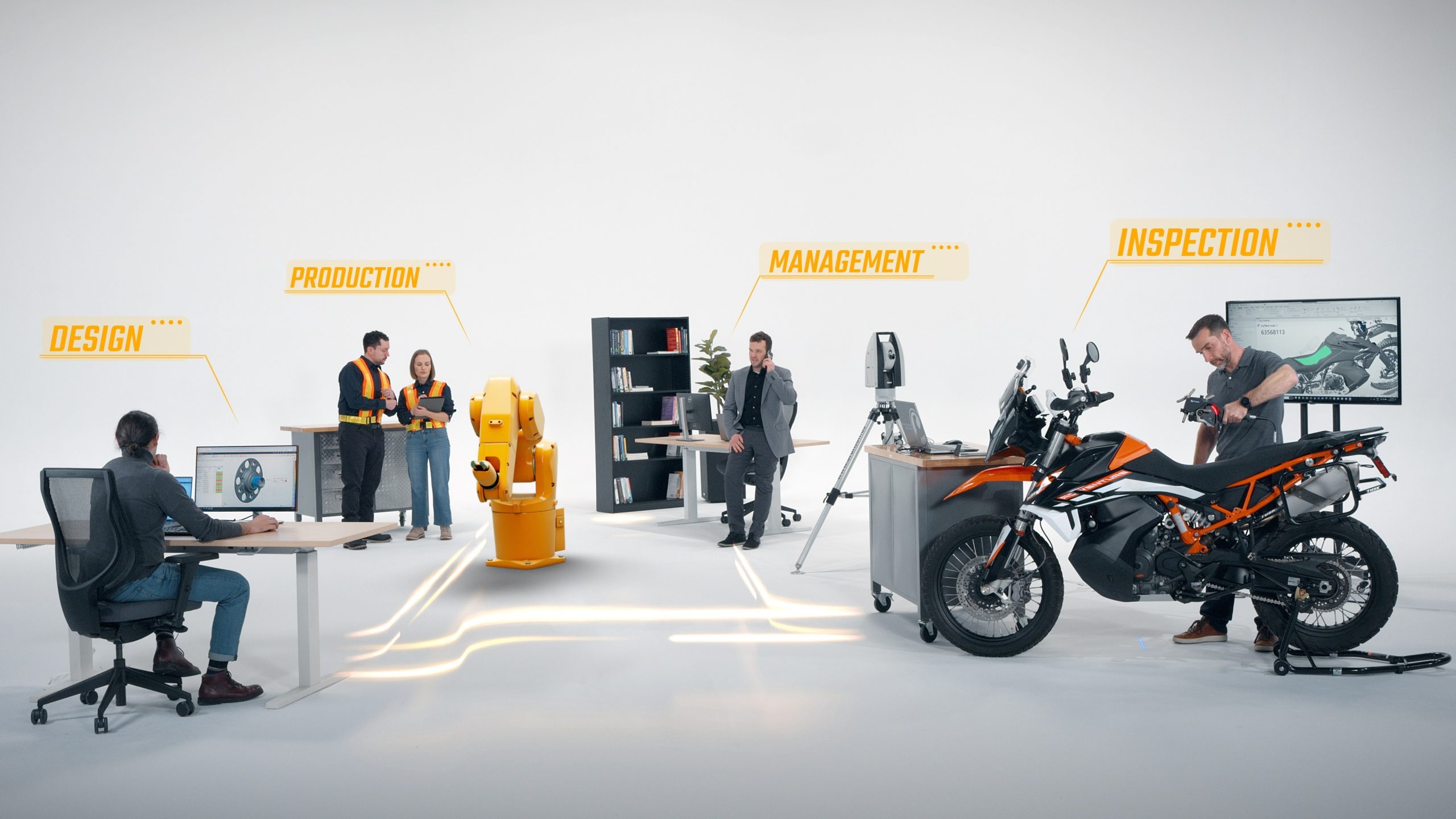
In enterprises that have adopted our digital thread, teams collaborate, discuss, and share analyses effortlessly because the foundation is “real-time data at everybody’s fingertips”.
Automating the feedback loop is the next level, as it calls for expertise from multiple domains. I believe that implementing automated feedback will require collaboration between solution providers. Our role is to serve as the open data layer they plug into, allowing corrective actions to be automated in a safe and supervised way.
Q: Ownership of the Quality Data Layer – As quality data becomes central to manufacturing intelligence, who ultimately owns that layer within the enterprise – the metrology function, IT, or operations? And how is InnovMetric positioning PolyWorks within that shifting balance of power?
A: With the deployment of a digital thread for dimensional inspection, quality control teams and IT teams are jointly responsible for the data management lifecycle. The quality control team creates and shares dimensional inspection data, while the IT team ensures the digital thread infrastructure operates reliably. However, which team stands to gain the most from a digital thread for dimensional inspection? It should be the quality assurance team. Why? Because dimensional inspection data is fundamental to achieving the core mission of quality assurance, that is, improving processes to deliver high-quality products. As such, quality assurance teams should play a central role in expanding the use of this data across all stages of the product development lifecycle.
Q: Rethinking the Role of the Metrologist – As automation, AI, and integrated workflows evolve, what happens to the role of the metrologist? Are we moving toward a future of fewer specialists or more empowered ones with broader influence across manufacturing?
A: In the past, the role of the metrologist was challenging. Metrologists had to learn and use a large number of measurement software platforms and solutions, while colleagues from other departments constantly requested new inspection reports that had to be shared manually. Now, thanks to a digital thread for dimensional inspection built on a universal platform and data management server, metrologists can focus on their primary responsibilities, which consist of:
- Mastering measurement hardware and software;
- Ensuring the repeatability and reliability of measurement processes; and
- Leveraging powerful analysis tools to identify issues and determine probable causes.
Metrologists work on the front line, like emergency physicians in a hospital. They should strive to be dimensional analysis experts who proactively alert other teams to quality issues.
With the newer technologies now within reach, their role is being elevated. They find themselves being freed from repetitive reporting tasks and empowered to take on broader influence.
Q: Platform or Infrastructure? – Looking ahead to 2036, do you envision PolyWorks as a software platform within the manufacturing stack, or as foundational infrastructure underpinning how quality data flows across the entire enterprise?
Our objective is to become the foundational infrastructure for managing dimensional inspection data across all sources and at every stage of the product development lifecycle. To achieve this, we plan to open our infrastructure to third-party measurement solutions at some point in time, enabling our customers to enjoy similar quality data flows across all their software portfolio. This way, their systems continuously feed the data layer, making the data portable, consistent, and available at all times. This is also a prerequisite for scalability, AI enablement, and true closed-loop manufacturing.
Part One of this interview article can be read here.