Embraer and Hexagon Advance Predictive Quality for Next-Generation Aircraft Manufacturing
At the Farnborough International Airshow 2026 (FIA2026), Embraer and Hexagon Manufacturing Intelligence announced an extension of their long-term collaboration to advance predictive quality solutions for aircraft production and maintenance. The partnership brings together aerospace manufacturing expertise, precision metrology, automation, and artificial intelligence to transform how aircraft are inspected, assembled, and maintained.
The announcement reflects a fundamental shift taking place across aerospace manufacturing: quality inspection is evolving from a reactive verification process into a predictive capability. Measurement data is no longer viewed simply as a record confirming whether a component meets specification. Instead, it is becoming a strategic manufacturing asset that can be analysed to identify potential issues before they impact production, reduce rework, and improve operational efficiency.
By combining Hexagon’s advanced measurement technologies with Embraer’s aerospace manufacturing expertise, the companies aim to accelerate the adoption of intelligent quality processes that support faster decision-making, improved process control, and increased manufacturing flexibility.
Moving from Inspection to Prediction
For decades, aerospace manufacturers have relied on rigorous inspection processes to ensure that aircraft structures and components meet demanding safety and performance requirements. These inspection operations remain essential, but traditional approaches often identify problems only after manufacturing steps have been completed.
When deviations are discovered late in the production cycle, manufacturers can face costly consequences, including rework, production delays, and additional engineering analysis. Predictive quality introduces a new approach by using measurement data, automation, and artificial intelligence to identify trends and potential issues earlier.
Rather than simply asking whether a component is within specification, predictive quality seeks to understand manufacturing behaviour — identifying why variations occur and how processes can be improved before defects are created.
For aerospace manufacturers producing complex aircraft structures with thousands of interconnected components, this capability has the potential to significantly improve productivity while maintaining the highest standards of quality.
Advanced Metrology for Aerospace Assembly
Aircraft manufacturing presents some of the most demanding measurement challenges in industry. Large structures, complex geometries, and extremely tight assembly tolerances require measurement technologies capable of delivering both accuracy and flexibility.
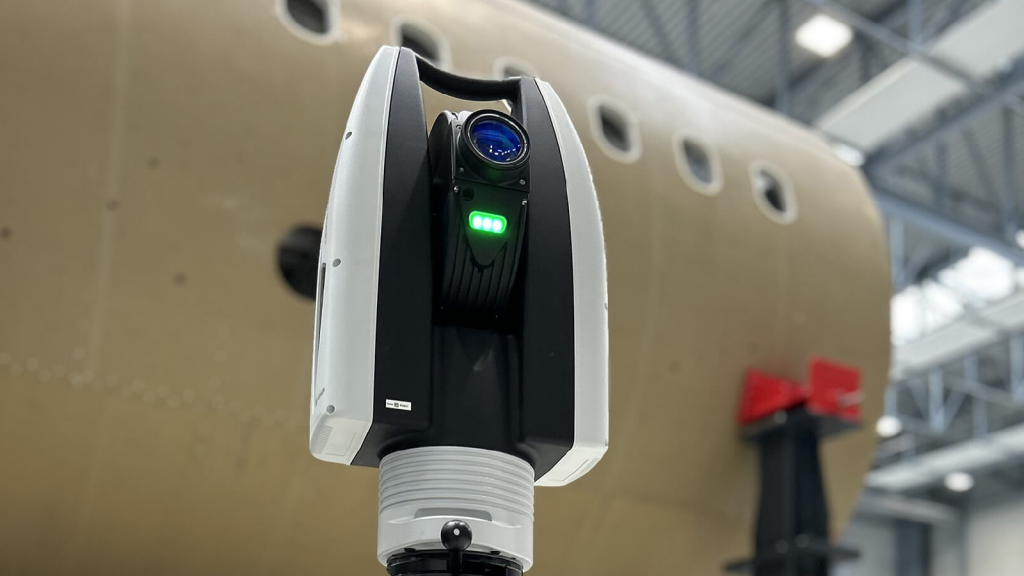
A key technology supporting Hexagon’s aerospace inspection capabilities is the Leica Absolute Tracker ATS800, which combines high-accuracy laser tracking with scanning capabilities for large-scale measurement applications.
Such systems enable manufacturers to capture detailed dimensional information from aircraft structures and assemblies, providing valuable insight throughout the manufacturing process. When combined with automated workflows and digital manufacturing systems, measurement data can be transformed into actionable intelligence.
In aircraft assembly environments, this capability enables manufacturers to verify alignment, positioning, and geometric accuracy during production rather than relying solely on final inspection. Potential issues can be identified earlier, allowing corrective action to be taken before they affect downstream operations.
Artificial Intelligence Enhances Quality Decision-Making
Artificial intelligence is becoming an increasingly important element of modern manufacturing and metrology strategies. While measurement systems have always generated large volumes of valuable data, AI provides the ability to analyse this information rapidly and identify patterns that may not be visible through traditional methods.
Within a predictive quality environment, AI can help correlate measurement results with manufacturing conditions, identify recurring sources of variation, and provide recommendations to improve process stability.
For aerospace manufacturers, where production complexity is exceptionally high, intelligent analysis can deliver significant benefits. Even incremental improvements in process capability can reduce manufacturing interruptions, improve delivery performance, and increase confidence in production outcomes.
The integration of AI into metrology workflows represents a major evolution in the role of measurement — moving from simply reporting quality results to actively supporting manufacturing decisions.
Building the Aerospace Digital Thread
The Embraer and Hexagon collaboration also highlights the growing importance of the digital thread within modern aerospace manufacturing.
Today’s advanced factories are increasingly based on connected ecosystems where design data, manufacturing processes, inspection results, and quality information are linked together. This connectivity enables manufacturers to create a continuous flow of information throughout the product lifecycle.
By integrating metrology data into the wider manufacturing environment, companies can establish closed-loop quality processes. Inspection results can provide feedback to engineering and production teams, helping optimise processes and improve future manufacturing performance.
This approach supports the broader Industry 4.0 vision of smart factories, where machines, software, and people work together using real-time information to improve productivity and quality.
Extending Predictive Quality into MRO
While aircraft production is a primary focus, predictive quality technologies also offer significant opportunities within aircraft maintenance, repair, and overhaul (MRO).
Aircraft operators and maintenance organisations require accurate information about structural condition throughout an aircraft’s service life. Advanced measurement technologies and digital inspection workflows can help improve maintenance efficiency, support faster decision-making, and provide more comprehensive records of aircraft condition.
By combining high-accuracy measurement with historical data and intelligent analysis, MRO organisations can gain deeper insights into structural changes, wear patterns, and potential maintenance requirements.
This creates the opportunity for a more proactive approach to aircraft maintenance — moving from scheduled inspection alone toward condition-based decision-making.
The Future of Aerospace Quality is Predictive
The collaboration announced by Embraer and Hexagon at Farnborough International Airshow 2026 reflects a broader transformation underway across advanced manufacturing industries.
As aerospace manufacturers face increasing pressure to improve efficiency, manage complexity, and maintain uncompromising quality standards, digital metrology will play an increasingly strategic role.
The future aerospace factory will not simply inspect quality after production. It will continuously monitor, analyse, and optimise manufacturing performance throughout the entire process.
By combining precision measurement, automation, and artificial intelligence, Embraer and Hexagon are demonstrating how metrology is evolving from a final inspection function into a core component of intelligent manufacturing.
The next generation of aerospace manufacturing will not only measure quality — it will predict it.
For more information: www.hexagon.com