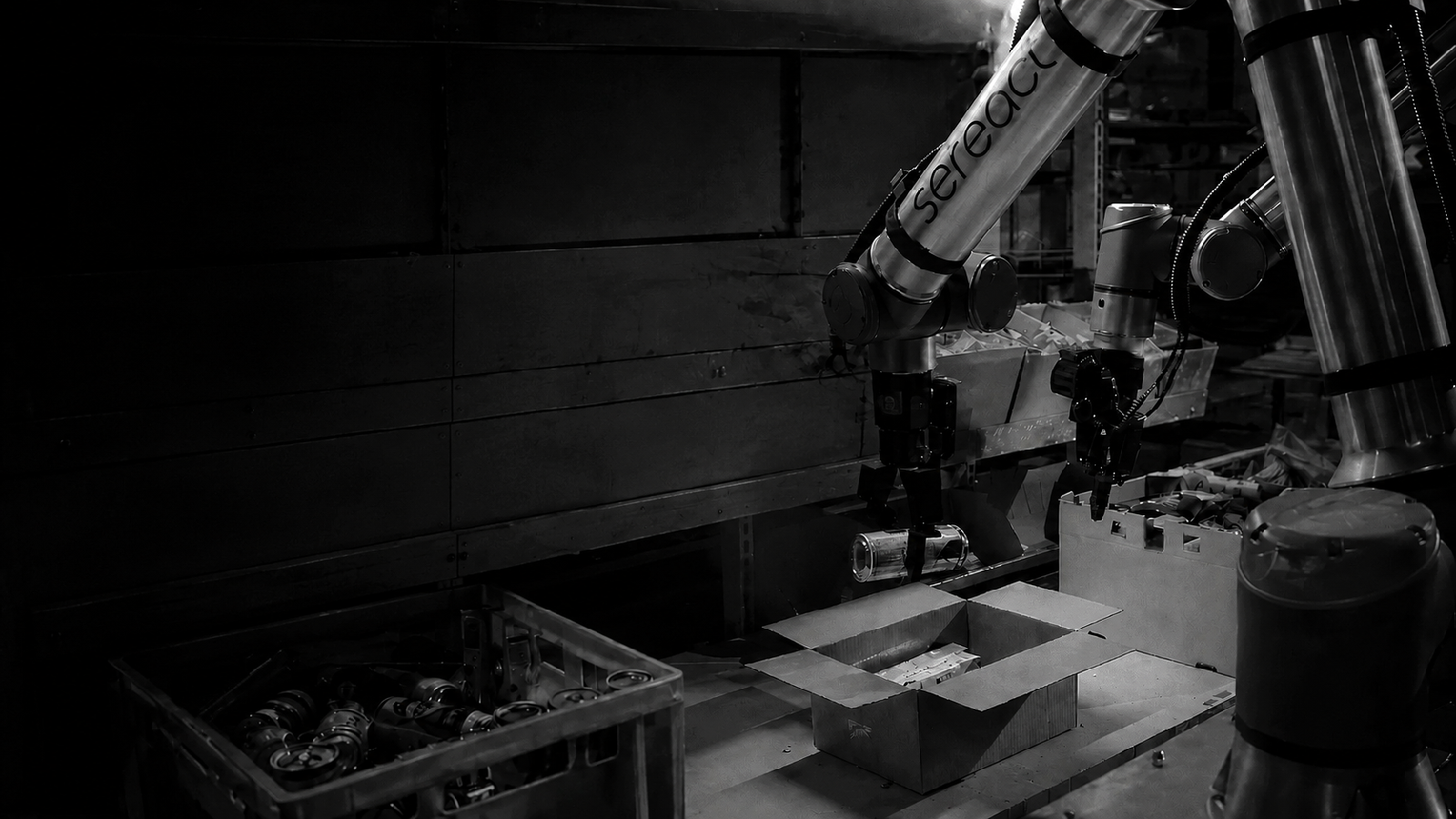
Sereact Raises $110M to Scale Physical AI and Bring ‘Thinking’ Robots to Industry
German robotics AI company Sereact has secured a $110 million Series B funding round led by Headline. The funding marks a significant milestone for the Stuttgart-based company as it accelerates development of its next-generation robotic AI platform, Cortex 2.0, and expands into the United States with a new office in Boston.
From Reactive Robots to Predictive Intelligence
At the core of Sereact’s strategy is Cortex 2.0, an evolution of its AI ‘robotic brain’ that moves beyond reactive automation toward predictive, decision-driven robotics.
Where traditional systems, and even earlier versions of Cortex, operate on a ‘see and act’ basis, Cortex 2.0 introduces a fundamentally different paradigm: ‘think, then act’.
The system combines a vision-language-action (VLA) model with a world model capable of simulating multiple potential future outcomes before executing a movement. By generating and evaluating candidate trajectories against learned models of physics and object behavior, the robot selects the optimal action based on stability, risk, and efficiency.
This shift is particularly relevant for applications where contact precision is critical – such as component assembly under tension, fragile part placement, or orientation-sensitive kitting operations.
According to CEO and co-founder Ralf Gulde, this approach reflects a broader philosophy about how robotics AI must be developed: “You can’t build real robotics AI in a lab. You build it with a data flywheel fed by real deployments… letting the model learn from what actually happens on the floor.”
A Data Flywheel Built on Real Operations
Sereact’s differentiation lies in its large-scale, real-world data loop.
The company reports:
- 200+ systems deployed across Europe
- Over 1 billion real production picks completed
- Only 1 in ~ 53,000 picks requiring human intervention
Each robotic interaction feeds back into a centralized model. Data from successful picks, failures, and recoveries, captured with synchronized sensor inputs and robot states, is filtered and used to continuously retrain and redeploy updated policies across the fleet. This closed-loop learning system enables rapid performance improvements and expanding coverage of edge cases, often referred to as the “long tail” in automation.
CTO and co-founder Marc Tuscher describes the system as giving robots a form of ‘imagination’: “The robot dreams in latent space… anticipating how the world will respond before it moves.”
Generalisation Across Hardware Platforms
A key technical advantage of Cortex 2.0 is its ability to generalise across different robotic embodiments. By planning in visual latent space rather than relying on robot-specific joint commands, the system can transfer knowledge across single-arm picking systems, dual-arm returns stations, humanoid robots and fixed industrial cells.
This hardware-agnostic approach aligns with Sereact’s positioning – not as a robotics manufacturer, but as a provider of a universal AI model that can run on existing industrial platforms.
Customers already using Cortex-powered systems include major industrial and logistics players such as BMW, Mercedes-Benz, Daimler Truck, and PepsiCo.
Scaling to the U.S. Market
With its Series B funding, Sereact is now targeting international expansion, beginning with the United States. The company has opened its first U.S. office in Boston and is actively building local teams across commercial, engineering, and application roles.
Implications for Metrology and Quality Control
While Sereact’s primary focus has been robotic picking, the underlying technologies, particularly its world modelling, real-time decision-making, and continuous learning loop, have clear implications for metrology and quality assurance. The company’s Sereact Lens platform already extends into 3D perception for inventory and quality control, suggesting a convergence between robotic manipulation and inspection systems.
For metrology professionals, the shift toward predictive AI systems that evaluate outcomes before execution represents a notable evolution. Instead of simply measuring results after the fact, future systems may increasingly anticipate and prevent errors during the process itself.
The Road Ahead
With more than $140 million raised to date, Sereact is positioning itself at the forefront of what it calls ‘physical AI’ – a category defined by systems that learn continuously from real-world interactions rather than simulated environments. As Cortex 2.0 rolls out and the company scales globally, its approach raises broader questions for the automation ecosystem: whether data-rich, continuously learning models will outpace traditional rule-based and simulation-driven robotics.
Sereact’s metrics, particularly its low intervention rate at scale, suggest that real-world data may be the decisive factor in closing the gap between robotic capability and human-level adaptability on the factory floor.
For more information: www.sereact.ai