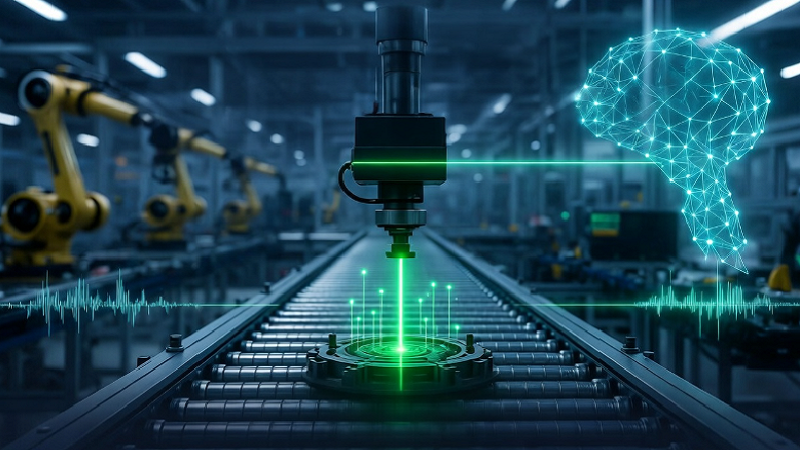
From Inline Inspection to AI Automation – The Evolution of Laser Sensors
Most engineers don’t start by wanting inline inspection. They end up needing it.
The trigger is usually the same. A batch fails late. Scrap goes up. Someone asks why the issue wasn’t caught earlier. Then the conversation shifts from inspection to timing. Not whether to measure, but when.
End-of-line inspection works until it doesn’t. It assumes the process is stable enough that you can check results after the fact. That assumption breaks quickly in high-volume environments where small drifts compound over hours, not days.
Inline inspection changes the mindset. Instead of verifying parts, you start watching the process while it’s happening. That sounds straightforward, but in practice it introduces a different set of compromises.
You are no longer measuring in a controlled environment. You are measuring in the middle of production, where:
- Parts are moving
- Surfaces are inconsistent
- Temperature shifts during the shift
- Machines vibrate whether you like it or not
Laser sensors became popular in this space for a simple reason. They measure without touching the part. That alone solves a lot of mechanical problems.
But what made them stick was not just speed or convenience. It was the ability to get just enough accuracy without stopping the line.
And that’s usually the real requirement. Not perfect measurement. Usable measurement, early enough to matter.
From Basic Laser Sensors to Industrial Metrology Workhorses
The first laser sensors many of us worked with were not metrology tools. They were detection devices with better optics.
They could tell you if something was there. Sometimes they could estimate distance. That was fine for automation tasks, but not for dimensional control.
Things changed when triangulation sensors became reliable enough for production use. Suddenly you could measure small variations in height or position with consistency.
That opened the door to real applications:
Thickness measurement was one of the first to scale. Two sensors, one above and one below, and you get continuous readings without touching the material. Simple idea, but getting it stable across alignment and thermal variation took effort.
Surface profiling came next. Machined parts could be checked inline for variation that previously required offline inspection. Not full geometry, but enough to catch issues early.
At the same time, time-of-flight sensors filled a different role. They were never about high precision. They were about coverage. If you needed to measure over distance or track position across a larger area, they made sense.
In most real systems, both types ended up working together. One handled precision. The other handled context.
What improved over time was not just resolution. It was consistency. Early systems were sensitive. You had to adjust them often. Modern sensors are far more stable, which is why they can stay in place for months without constant intervention.
That stability is what allowed them to move into core production roles.
How Laser Sensors Became Embedded in Inline Inspection Systems
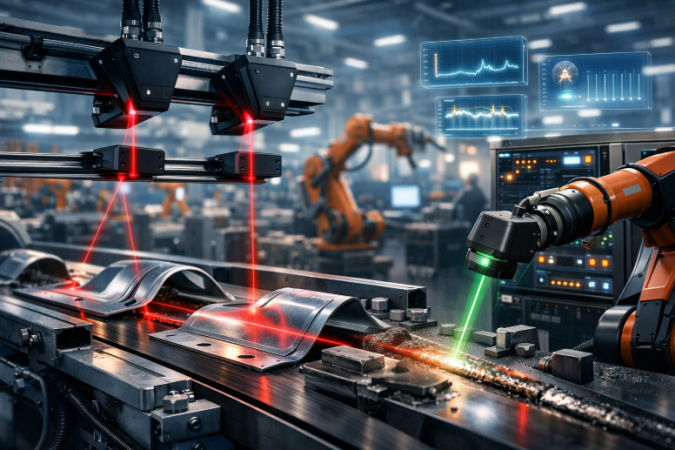
There wasn’t a single moment when laser sensors became “inline.” It happened gradually as production systems became more connected.
At first, sensors were added to solve specific problems. A thickness check here. A gap measurement there. Over time, those checks became part of the process itself.
Now it’s common to see sensors integrated directly into machines or lines.
On a conveyor, a sensor might measure every part that passes without any pause. In a robotic cell, the robot moves the sensor rather than the part. Inside a machine, measurements happen between operations.
A good example is weld inspection. A profile sensor scans the seam right after welding. In theory, it’s straightforward. In practice, you deal with spatter, surface variation, and positioning tolerance. The sensor gives you data, but making that data reliable takes work.
Another example is gap and flush measurement in assembly. These are small measurements, but highly visible in the final product. Getting consistent readings across different surface finishes and lighting conditions is not trivial.
Integration is where most of the effort goes. It’s not just mounting a sensor. You need:
- Timing aligned with part movement
- Stable communication with the control system
- Enough processing to handle continuous data
At that point, the sensor is no longer an add-on. It’s part of how the line operates.
Limitations of Traditional Laser-Based Inspection
Anyone who has deployed these systems knows where they struggle.
Surface variation is a constant issue. A shiny part behaves differently from a matte one. A slightly oily surface behaves differently again. You end up tuning parameters more than you would like.
Environmental conditions don’t help. Dust, heat, and vibration all introduce noise. You can filter some of it, but not all.
But the bigger limitation is not hardware. It’s logic.
Most systems still operate on fixed thresholds. Measure a value, compare it to limits, and decide.
That approach works when variation is predictable. It struggles when variation evolves slowly or behaves differently under changing conditions.
Tool wear is a good example. Dimensions drift gradually. You won’t catch it early with a simple limit check. By the time it fails, you already have a problem.
Sampling strategy is another weak point. Measuring at fixed intervals assumes the process behaves consistently. It often doesn’t.
And then there’s the data itself. High-frequency measurements get reduced to a pass or fail result, and the rest is ignored. That’s a lot of information that never gets used.
So the limitation is not that sensors can’t measure. It’s that systems don’t fully use what they measure.
The Rise of Smarter Sensors and Onboard Analytics
To improve this, sensors started doing more of the work themselves.
Instead of sending raw signals, they began extracting useful features. Peak height, edge position, gap width. Things that actually matter to the process.
This reduced the amount of data moving through the system and made integration easier.
At the same time, signal processing improved. Sensors became better at handling variation in surface conditions and lighting. Not perfect, but more forgiving.
You also started seeing more flexibility. One sensor could handle multiple measurement types depending on configuration.
From a practical standpoint, this made life easier:
Setup took less time.
Systems were more stable.
You needed less external processing.
But the underlying logic didn’t change. These systems still followed predefined rules. They didn’t learn from what they saw over time.
That gap is what led to the next step.
From Smart Sensors to AI-Enabled Inline Inspection
The move toward AI was not about replacing sensors. It was about making sense of the data they were already producing.
Instead of checking each measurement against a fixed limit, AI models look at patterns.
A simple example is thickness measurement over time. A traditional system checks if each value is within tolerance. An AI model looks at how those values behave over minutes or hours.
If the pattern changes, even slightly, it flags it.
That matters because most processes don’t fail suddenly. They drift.
Weld inspection is another case. Instead of trying to define every defect with rules, models learn from examples. Good welds, bad welds, and everything in between.
They don’t eliminate measurement uncertainty. They work alongside it.
To make this practical, processing happens close to the source. Edge systems handle inference so decisions can be made in real time.
This keeps the system responsive and avoids delays that would make inline inspection ineffective.
Practical Examples of AI-driven Laser Inspection in Manufacturing
You can see the impact of this approach in specific applications.
In welding, small variations in bead shape can indicate deeper issues. Traditional systems might ignore them if they fall within tolerance. AI models can flag them based on learned patterns.
In machining, dimensional data over time can reveal tool wear before it becomes critical. Instead of reacting to out-of-spec parts, adjustments happen earlier.
In electronics, height measurements can show subtle placement issues that don’t cause immediate failure but affect long-term reliability.
Adaptive sampling is another practical benefit. When the process is stable, you don’t need to measure everything. When variation increases, the system focuses more closely.
This is less about adding complexity and more about using attention where it matters.
How AI Changes the Role of Metrology and Quality Teams
The introduction of AI shifts the focus of metrology work.
You still need accurate sensors and proper calibration. That doesn’t change. But now you also need to understand how data behaves over time.
Engineers spend more time asking:
Is this variation real or noise?
Is the model reacting correctly?
What does this anomaly mean physically?
There is also more responsibility around data. If the data is inconsistent or incomplete, the model will reflect that.
Traceability becomes more layered. You’re not just validating measurements. You’re validating how those measurements are interpreted.
It’s not a completely new role, but it does require a broader skill set.
Data, Explainability, and Trust in AI-Driven Measurement
Trust takes time to build, especially in environments where measurement decisions have real consequences.
With traditional systems, the logic is clear. You can trace a result back to calibration and uncertainty.
With AI, the path is less direct. That makes some engineers uncomfortable, and for good reason.
To make these systems usable, they need to provide context. Trends, comparisons, and visibility into how decisions are made.
Data quality is a major factor. Poor data leads to unreliable models. That’s not a theoretical issue. It shows up quickly in practice.
There is also the issue of change. Processes evolve, and models need to be updated. That requires monitoring and maintenance.
These systems are not set-and-forget. They need to be managed like any other part of the production process.
The Future: Autonomous Metrology and Closed-Loop Quality
The direction is moving toward tighter integration between measurement and control.
Instead of detecting problems, systems begin to correct them.
A sensor detects a shift.
The system interprets it as process drift.
Machine parameters are adjusted.
New measurements confirm the effect.
That loop continues continuously.
This approach has clear benefits, but it also introduces new challenges. Validation becomes more complex. Traceability needs to account for dynamic behavior.
Still, the goal is clear. Not just to measure quality, but to maintain it.
Takeaways for Metrology and Quality Professionals
The evolution of laser sensors is not just about better hardware. It’s about how measurement is used.
A few things stand out in practice.
Inline inspection is now part of the process, not separate from it.
Laser sensors remain one of the most practical tools for non-contact measurement.
Fixed rules are no longer enough for complex processes.
AI adds value by interpreting patterns, not replacing measurement.
The fundamentals still apply. Accuracy, repeatability, and traceability don’t go away.
What changes is the expectation. Measurement is no longer a checkpoint. It’s part of how the process is controlled.
And that’s where the real shift is happening.
Author: Faisal Mahmood – originality.ai