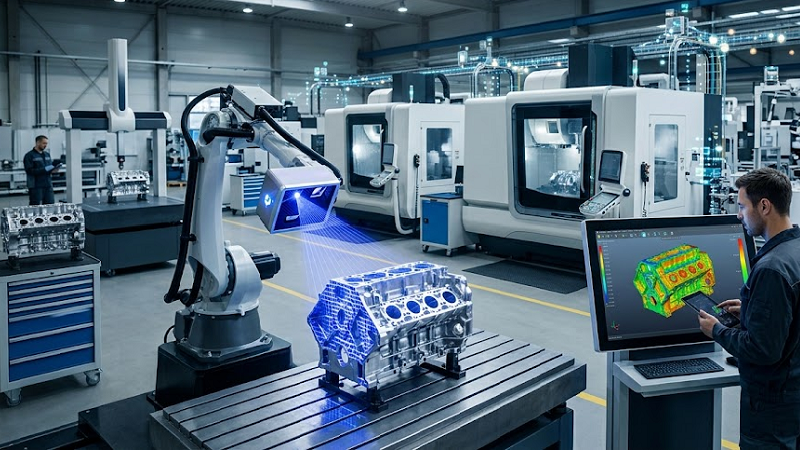
Metrology – Rewriting the Rules of Manufacturing
Manufacturing has always been driven by innovation. From mechanisation and automation to robotics and digitalisation, each industrial revolution has promised greater productivity, improved quality and increased competitiveness. Yet despite remarkable advances in machine capability, many manufacturers continue to grapple with the same fundamental questions: Why did this component fail? Why has the process drifted? Where is variation being introduced? How can quality be improved without simply adding more inspection?
The answer increasingly lies not in purchasing more sophisticated equipment, but in making better use of something every factory already possesses in abundance – DATA.
From Information Overload to Manufacturing Intelligence
Today’s manufacturing environment generates vast quantities of information. CNC machines continuously monitor cutting parameters. Coordinate measuring machines produce highly detailed dimensional data. Vision systems, laser scanners, sensors and Industrial IoT devices stream information throughout the production process, while enterprise systems record everything from material traceability to production scheduling. Yet despite this wealth of information, many organisations still struggle to transform data into meaningful knowledge.
The challenge is no longer collecting data; it is connecting it.
For decades, manufacturing systems have evolved independently. Design engineers work within CAD environments. Manufacturing engineers optimise machining strategies. Quality departments analyse inspection reports. Maintenance teams monitor equipment health. Each function creates valuable information, but too often those datasets remain isolated within departmental silos. The result is an organisation rich in information but poor in insight.
Metrology Becomes the Trusted Source of Truth
This is where metrology is assuming a new and increasingly strategic role.
Traditionally, measurement has been viewed as the final checkpoint before a product reaches the customer—a means of determining whether a component complies with specification. While that responsibility remains essential, modern metrology systems deliver far more than pass-or-fail decisions. Every measurement provides evidence of how the manufacturing process is performing. Inspection data reveals machine behaviour, tooling condition, thermal influences, process capability and production stability. Instead of simply confirming quality, metrology is becoming one of manufacturing’s richest sources of process intelligence.
This evolution places measurement at the heart of the digital manufacturing ecosystem.
Standards Provide the Foundation for Trusted Data
The vision of the Digital Thread has become central to modern manufacturing strategy, promising seamless information flow from design through production, inspection and ultimately into service. Achieving that vision, however, depends upon one critical requirement: trusted data. Without confidence in the quality, consistency and traceability of information, digital manufacturing quickly becomes little more than disconnected software systems exchanging unreliable data.
This is why international standards have become increasingly important. Reliable decision-making begins with reliable information, and that requires a common framework for defining, measuring and exchanging data. The ISO Geometrical Product Specifications (GPS) framework provides the internationally recognised language for specifying and verifying product geometry, ensuring that a feature defined by the designer is interpreted consistently throughout manufacturing and inspection. Complementing this are standards governing calibration, measurement uncertainty, traceability and digital data exchange, all of which contribute to ensuring that measurements remain accurate, repeatable and trustworthy regardless of where they are produced.
More recently, the industry has recognised that consistency of measurement alone is not enough. As manufacturing becomes increasingly model-based, every product characteristic must also possess a consistent digital identity. This is precisely the challenge addressed by the Digital Metrology Standards Consortium’s Model-Based Characteristics (MBC) v1.0 standard. MBC assigns every product characteristic a persistent, machine-readable identifier that remains with it throughout the product lifecycle. Whether that characteristic is referenced by a CAD system, CAM software, inspection planning application, coordinate measuring machine, statistical process control package or quality management system, every application knows it is referring to exactly the same feature.
Although this may appear a subtle development, its significance is profound. For the first time, quality data can flow seamlessly across software platforms without ambiguity or manual interpretation. Combined with standards such as the Quality Information Framework (QIF), MBC enables a truly connected digital thread in which design intent, manufacturing execution and inspection results remain digitally linked from concept through production and beyond. The result is data that is not simply collected, but understood.
AI is Only as Good as the Data it Learns From
This foundation is becoming increasingly important as Artificial Intelligence begins to influence manufacturing decision-making. AI promises predictive maintenance, autonomous process optimisation and intelligent quality analysis, but these capabilities depend entirely upon the quality of the underlying data. Algorithms cannot distinguish between reliable information and inconsistent datasets. Poor data simply produces poor conclusions more quickly.
Metrology provides exactly the type of structured, traceable and validated information that intelligent systems require. When every measurement is linked to a uniquely identified product characteristic and supported by internationally recognised standards, AI gains the context necessary to identify trends, correlations and emerging process variation with confidence. Rather than replacing engineers, intelligent analytics become powerful decision-support tools, allowing experienced professionals to focus on understanding causes and implementing improvements.
Perhaps the greatest opportunity lies in moving manufacturing from reactive quality control towards predictive process control.
When machine parameters, environmental conditions, inspection results and production information are analysed together in real time, subtle changes can be identified long before they produce non-conforming parts. Tool wear becomes predictable rather than unexpected. Machine drift can be corrected before tolerance limits are exceeded. Maintenance activities become planned rather than reactive. Scrap is reduced, productivity improves and quality becomes something that is actively managed rather than retrospectively inspected.
Data is Manufacturing’s New Competitive Advantage
Yet perhaps the greatest transformation is cultural rather than technological.
Historically, manufacturing has divided responsibility between design, production, quality and maintenance. Data encourages a different perspective. When every department works from the same trusted information, discussions move away from assigning blame towards understanding processes. Measurement ceases to be the sole responsibility of the quality department and instead becomes a strategic source of knowledge that informs engineering, manufacturing, maintenance and management alike.
The manufacturers that will lead the next decade are unlikely to be distinguished simply by owning faster machines or investing in more automation. Those technologies are becoming increasingly accessible to everyone. The real competitive advantage will belong to organisations that understand their manufacturing processes more deeply than their competitors because they know how to transform measurement into knowledge and knowledge into action.
In this new industrial landscape, data is no longer a by-product of production. It is becoming one of manufacturing’s most valuable assets.
For the metrology community, this represents a remarkable opportunity. Measurement is evolving beyond verification to become the trusted foundation upon which digital manufacturing, artificial intelligence and continuous improvement are built. Supported by robust international standards and emerging frameworks such as MBC and QIF, metrology is no longer simply measuring the future of manufacturing – it is helping to create it.
The next chapter of industrial progress will not be defined solely by smarter machines. It will be defined by smarter use of the information those machines generate. In that respect, data is giving manufacturing exactly what it needs: a new start.
Author: Gerald Jones Editorial Assistant