Neuralyze Brings the Complete Vision AI Workflow into One Software Platform
Vision AI has established itself as a field-proven technology for industrial quality assurance. Rather than relying exclusively on rigid, rule-based image-processing algorithms, Deep Learning enables inspection systems to learn from image data and identify the characteristics that distinguish good components from defective ones.
With Neuralyze, senswork GmbH is making its Vision AI technology available as a standalone software platform. The solution has already been proven in industrial applications over several years and is designed to address one of the key challenges facing manufacturers: moving Vision AI from development and testing into reliable, continuous production.
From Data to Production
Manufacturing environments are facing continually increasing demands for quality, product variety, and throughput. At the same time, manual inspection processes can become increasingly difficult to maintain reliably and cost-effectively, particularly when production volumes are high or product variants change frequently.
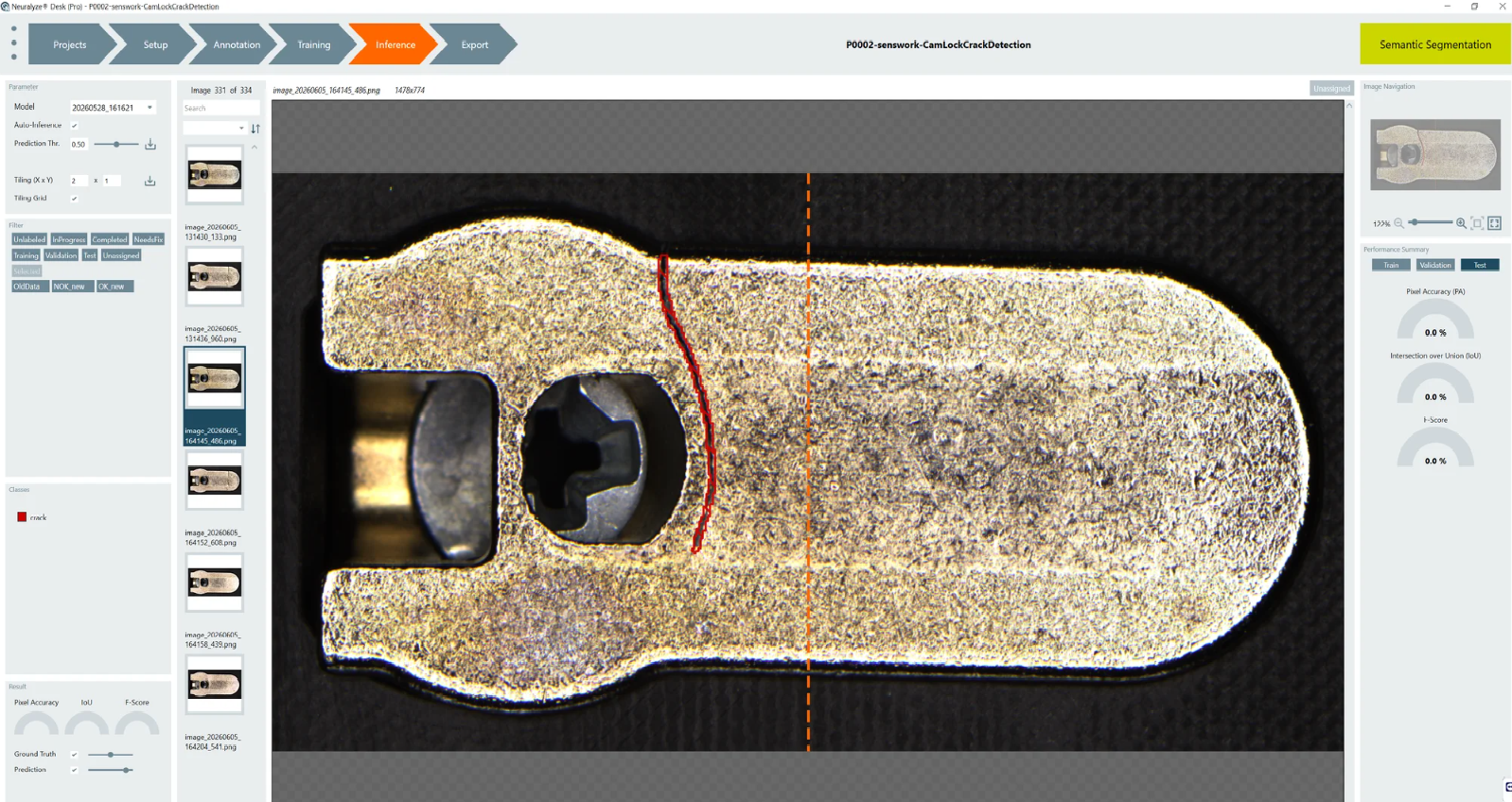
Neuralyze addresses these challenges by providing a complete workflow for Vision AI within a single application. The platform covers the stages of a typical AI project, from the structured management and annotation of image data through model training and systematic evaluation, to deployment on industrial hardware and continuous monitoring during live operation.
This integrated approach is intended to simplify the implementation of AI while addressing the practical requirements of production environments, including reliability, robustness, maintainability, and reproducible inspection quality.
Learning from Real Production Data
At the heart of Neuralyze is the ability to train AI models using representative image data. Instead of requiring engineers to define every possible defect through conventional image-processing rules, the system learns from examples of acceptable and defective components.
Once trained and validated, the resulting models can make inspection decisions in real time during production. This approach can be particularly valuable for applications where component appearance varies or where defects are difficult to describe using conventional deterministic rules.
Typical applications include surface-defect detection, completeness inspection, Optical Character Recognition (OCR), anomaly detection, and assembly and part identification.
Combining AI with Conventional Machine Vision
Neuralyze is not limited to pure AI-based inspection. The software supports hybrid strategies that combine Vision AI with traditional image-processing techniques.
This allows manufacturers to use conventional algorithms where they provide a straightforward and deterministic solution while applying Deep Learning to more complex inspection characteristics. Multiple technologies can therefore be incorporated into a single inspection workflow, providing engineers with greater flexibility when developing automated quality-control applications.
The platform also supports different Deep Learning approaches, including classification, object detection, and semantic segmentation. AI-based 3D inspection capabilities further extend its potential applications beyond conventional 2D machine vision.
Production-Ready Rather Than Laboratory AI
According to senswork, the key challenge in industrial Vision AI is no longer simply training a neural network. The greater challenge is ensuring that the technology operates reliably under real production conditions and can be maintained throughout the lifetime of an inspection system.
“Vision AI is no longer a technology of the future; it has been running productively on production lines for years. The challenge lies not in model training, but in reliable implementation under real production conditions,” says Markus Schatzl, Head of the Innovation Lab at senswork.
“Neuralyze was developed precisely for this purpose: as an industrial software platform that enables Vision AI to be operated reliably, scalably, and continuously on production lines.”
This focus on production deployment is reflected in the platform’s architecture. Neuralyze is designed to support the complete lifecycle of an AI inspection application rather than treating model development as an isolated laboratory activity.
Open Standards and Flexible Deployment
The software is based on open standards and commonly used Deep Learning frameworks, including TensorFlow, PyTorch, and ONNX. Neuralyze can be operated on-premises using a manufacturer’s own hardware and supports edge computing hardware for applications where real-time processing is required close to the production process.
For engineers, the platform provides no-code interfaces intended to simplify AI model development and deployment without requiring specialist programming knowledge. Developers can also access APIs for integration into customized software and automation environments.
The on-premises approach also enables manufacturers to retain control over their production and image data. By supporting established standards and frameworks, senswork aims to provide flexibility while avoiding dependence on a proprietary cloud environment or a closed AI ecosystem.
Built on Industrial Experience
Neuralyze is the result of more than 15 years of senswork experience in industrial image processing. The company has specifically developed the platform for Vision AI applications since 2019.
This experience extends beyond software and AI development. Reliable industrial vision systems require the interaction of multiple disciplines, including optics, lighting, mechanics, automation, image processing, and data science. senswork has incorporated these areas of expertise into the development of Neuralyze, with the objective of creating a platform suited to the practical realities of manufacturing environments.
Supporting the Complete AI Lifecycle
A major distinction of the Neuralyze approach is its focus on the complete lifecycle of a Vision AI application.
The workflow begins with the collection and organization of image data. Relevant images can then be annotated and used to train AI models. Models can subsequently be evaluated systematically before being deployed to production hardware.
Once an application is running, monitoring becomes an important part of maintaining inspection performance. Production conditions can change over time, new product variants can be introduced, and previously unseen defect characteristics may emerge. Neuralyze’s workflow is designed to support this ongoing process rather than ending once an initial AI model has been deployed.
This lifecycle approach is increasingly important as manufacturers move from individual AI pilot projects toward the broader deployment of AI across production operations.
A Practical Route to Vision AI
With Neuralyze, senswork is targeting manufacturers with challenging inspection tasks who want to implement Vision AI as a production technology rather than simply evaluate its potential in a laboratory environment.
Companies can begin with feasibility studies, pilot projects, or technology workshops before progressing to full industrial deployment. This provides a route for manufacturers to assess the suitability of Vision AI for specific inspection challenges while developing the image data and application knowledge required for a successful implementation.
By bringing data management, annotation, AI model development, evaluation, deployment, and monitoring together within a single platform, Neuralyze aims to reduce the complexity associated with implementing industrial Vision AI.
For manufacturers looking to automate increasingly demanding quality-assurance tasks, the platform represents an approach in which AI becomes part of the established machine vision and production infrastructure – combining the flexibility of Deep Learning with the reliability and maintainability expected from an industrial inspection system.
For more information: www.senswork.com