How Point Clouds Are Revolutionizing Manufacturing Quality Control
For decades, manufacturing quality control relied on discrete measurements – touch probes, calipers, and coordinate measuring machines (CMMs) capturing individual points to verify tolerances. While effective, this approach inherently sampled only a fraction of a part’s geometry, leaving potential blind spots in quality assurance.
Today, point cloud technology is transforming that paradigm. By capturing millions of data points across entire surfaces in seconds, manufacturers can now analyze complete geometries rather than isolated features. This shift from sampling to full-field inspection is redefining how quality is measured, controlled, and improved. The rise of Industry 4.0 and digital twins has accelerated adoption, enabling manufacturers to integrate inspection data directly into design, production, and process optimization loops.
What Is a Point Cloud?
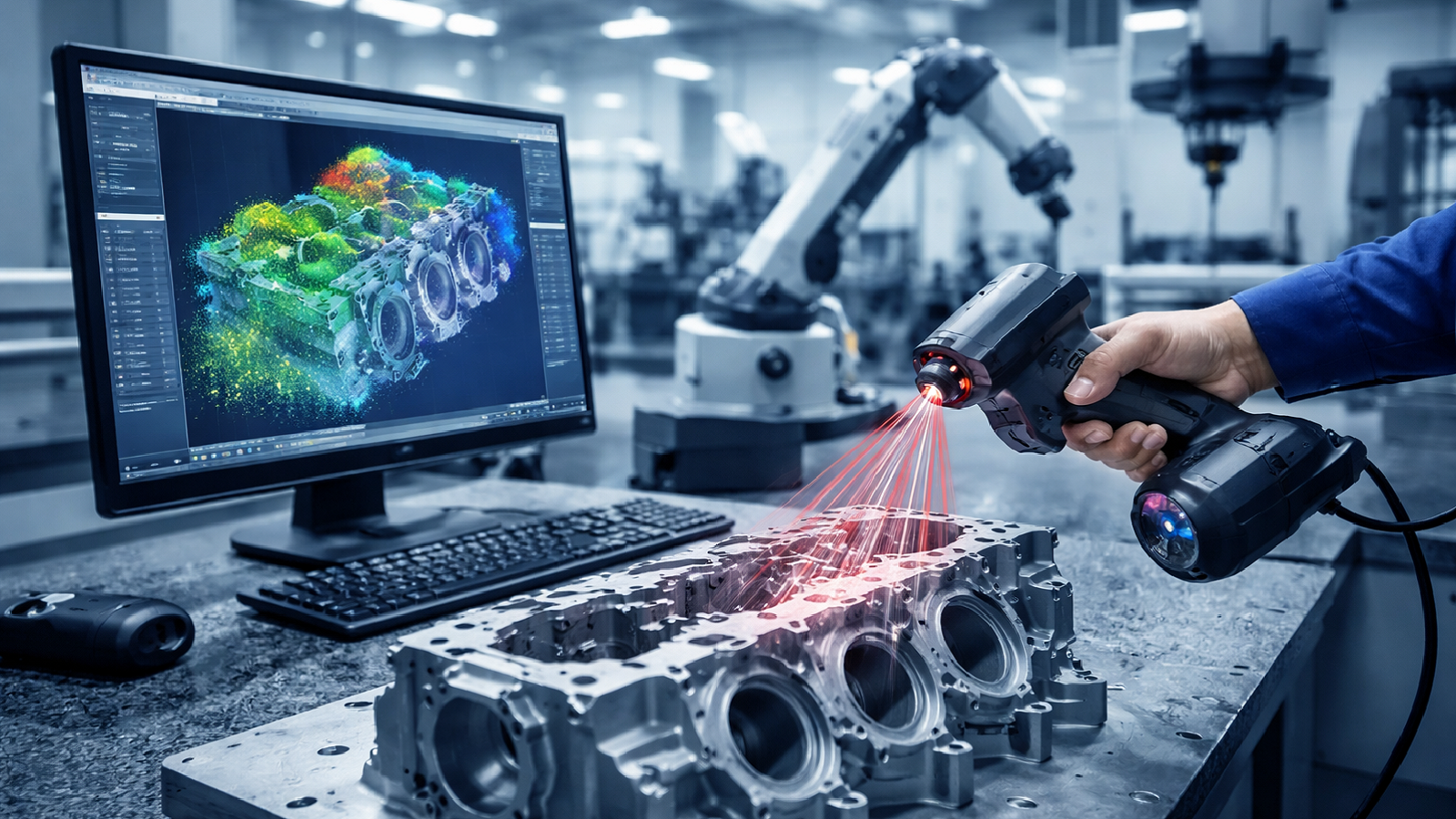
A point cloud is a dense set of spatial data points representing the external surface of an object. Generated by 3D scanning technologies such as laser scanners, structured light systems, photogrammetry, and even emerging technologies like time-of-flight sensors, each point contains precise X, Y, and Z coordinates—and often additional attributes such as color, intensity, or surface normal vectors.
Unlike traditional inspection methods, which rely on predefined measurement paths, point clouds capture the entire surface without prior knowledge of critical features. This allows engineers to extract measurements after scanning, rather than deciding in advance what to measure.
Generation Methods
Laser scanning employs triangulation or time-of-flight principles to measure distances by calculating the time it takes for a laser to reflect off a surface. High-speed scanners can capture millions of points per second, making them ideal for complex or large components. Structured light scanning projects a known light pattern onto a part and measures distortions with cameras, excelling in capturing fine surface details and widely used in medical and consumer product inspection. Photogrammetry uses multiple photographic images from different angles to reconstruct a 3D surface. While slower than laser scanning, photogrammetry is highly portable and cost-effective for large-scale or outdoor objects. For internal features, computed tomography generates volumetric point clouds representing both exterior and interior geometries, which is useful in medical devices and aerospace components.
The Shift to Full-Field Inspection
Full-field inspection enabled by point clouds allows engineers to move beyond sampling and measure the entire surface of a component. Instead of validating a handful of dimensions, manufacturers can compare entire surfaces against CAD models with micron-level accuracy.
The advantages are significant. Every visible surface is measured, eliminating blind spots and reducing the risk of undetected defects. Subtle deviations, such as warping, sink marks, porosity, or surface deformation, are identified immediately. Measurement is no longer limited by operator decisions on where to probe, standardizing quality across shifts and sites. Additionally, point clouds facilitate reverse engineering by reconstructing accurate digital models of legacy parts or prototypes, providing a feedback loop for design validation and re-manufacturing.
Complex geometries in aerospace, such as wing skins, fuselage panels, and turbine blades, benefit tremendously from full-field inspection. Point clouds capture surface deviations and warping that traditional CMMs might miss, allowing engineers to correct mold alignment or machining processes before assembly, reducing rework costs and ensuring regulatory compliance.

Speed and Throughput: Enabling Inline Quality Control
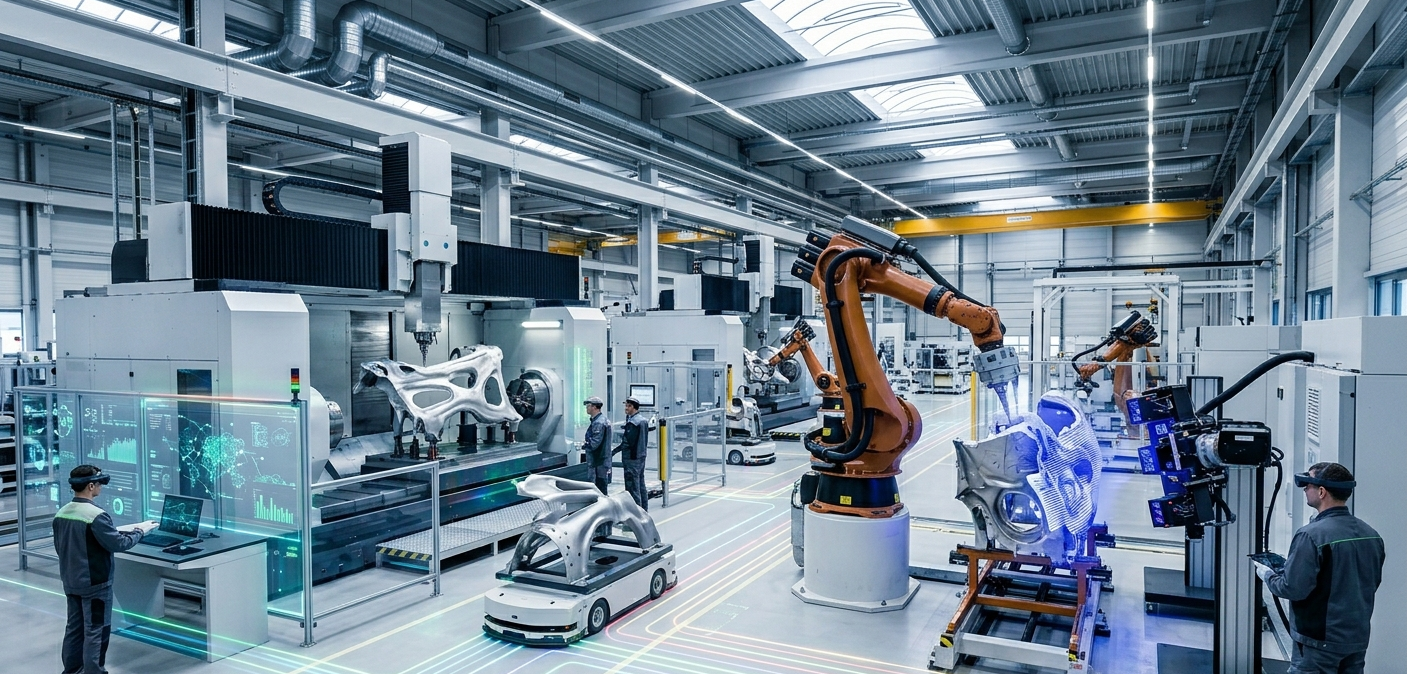
Traditional inspection often occurs offline, creating bottlenecks between production and validation. Point cloud acquisition dramatically reduces inspection time, enabling high-speed data capture directly on the shop floor. Modern scanning systems can acquire millions of points per second, allowing entire parts to be digitized in seconds or minutes. When integrated with automated systems, such as robotic arms, conveyor belts, or inline stations, this capability supports real-time or near-real-time inspection.
Manufacturers implement automated scanning cells where robotic arms equipped with laser scanners traverse the part, collecting point clouds with minimal human intervention. Conveyor-based systems allow parts to pass under fixed scanners for rapid, continuous inspection. Hybrid approaches combine tactile CMM probes for critical dimensions with point cloud scans for complex surfaces, ensuring full coverage without sacrificing precision. Inline inspection enables immediate defect detection and feedback, reduces scrap and rework, and allows continuous monitoring of process consistency.
Digital Twins and Closed-Loop Manufacturing
Point clouds are not just inspection tools – they are foundational to digital twin strategies. By continuously capturing the as-built state of parts and comparing it with the as-designed model, manufacturers maintain a live digital representation of production. Closed-loop applications include adaptive machining, where deviations detected in point cloud scans are fed back into CNC controllers to correct tool paths in real-time. Process optimization leverages the data to highlight systematic errors, such as mold shrinkage or fixture misalignment, enabling preemptive corrections. Scans also reveal early signs of tool wear or machine drift, supporting predictive maintenance and reducing unexpected downtime.
Through these feedback loops, point clouds transform quality control from reactive to proactive, reducing waste and increasing product consistency.
Advanced Analytics and AI Integration
The richness of point cloud data opens new opportunities for advanced analytics and artificial intelligence (AI). Machine learning algorithms can detect anomalies in point clouds that may not be immediately visible, such as micro-cracks or subtle surface waviness. Pattern recognition enables classification of recurring defects linked to specific production batches or tools, while historical datasets inform predictive insights for maintenance schedules and process adjustments. Integrating 2D imagery with point cloud 3D data further enhances defect detection, allowing accurate recognition of surface blemishes, color deviations, or texture changes. Automated reporting software generates actionable insights directly from point cloud analysis and integrates seamlessly with ERP and MES systems for complete traceability.
Challenges: Data Volume and Processing Complexity
Despite their advantages, point clouds introduce challenges. Millions or billions of points per scan require significant computational resources for processing, storage, and analysis. Efficient storage, retrieval, and backup of large datasets are critical. Aligning, filtering, and comparing point clouds quickly often necessitates GPU acceleration or distributed computing. Standardizing workflows and ensuring interoperability across hardware and software platforms are ongoing concerns. Higher resolution scans improve detail but increase data size and processing time, requiring careful optimization. Recent developments in cloud computing, AI-assisted processing, and edge computing are helping to make point cloud workflows increasingly practical.
Integration with Existing Metrology Workflows
Adopting point cloud technology often involves integration with established metrology processes. Manufacturers employ hybrid inspection strategies, using point clouds for complex surface evaluation while retaining CMMs for critical dimensions. Scanning data can be combined with geometric dimensioning and tolerancing (GD&T) evaluation, and reporting can be automated to fit within existing quality management systems. This approach leverages the speed and comprehensiveness of point clouds along with the precision of traditional methods, ensuring confidence in inspection results.
Industry Applications
Point cloud technology is delivering value across multiple sectors. In automotive manufacturing, high-speed scanning of body panels, assemblies, and tooling ensures consistency in high-volume production, while AI integration enables automated recognition of dents, weld deformations, or surface defects. Aerospace components, with complex geometries and tight tolerances, benefit from full-field inspection, capturing entire assemblies to detect warping, misalignment, or structural deviations before assembly, reducing costly rework. Medical devices require precision and traceability; point clouds support detailed analysis of implants, surgical instruments, and custom prosthetics, ensuring compliance with regulatory standards. Additive manufacturing, particularly for 3D-printed parts with organic geometries, uses point clouds to verify surfaces, wall thicknesses, and internal structures, aiding both quality assurance and reverse engineering. In energy and heavy equipment, large structures such as turbines, pipelines, and industrial machinery can be scanned to monitor wear, alignment, and deformation over time, facilitating preventive maintenance.
Towards Autonomous Quality Control
Point cloud technology is increasingly integrated with automation and AI, moving quality control toward a fully autonomous future. Emerging trends include autonomous inspection cells where robotic systems scan, analyze, and make decisions without human intervention. Real-time process feedback allows inline scans to adjust production parameters dynamically. Standardized digital workflows integrate design, production, and quality, ensuring consistency and traceability. AI-driven decision-making uses continuous learning algorithms to optimize inspection processes and predict potential defects before they occur. These trends indicate a shift where quality control is embedded directly into production, creating self-optimizing manufacturing environments.
Point clouds are fundamentally changing manufacturing quality control. By providing complete, high-resolution representations of parts, they eliminate the limitations of traditional sampling-based inspection and enable real-time, data-driven decision-making. While challenges remain, ongoing advances in hardware, software, AI, and analytics are rapidly expanding the accessibility and impact of point cloud technology. For manufacturers aiming to improve quality, reduce waste, and compete in an increasingly digital landscape, point clouds are not just an innovation – they are becoming a necessity.
Author: Gerald Jones Editorial Assistant