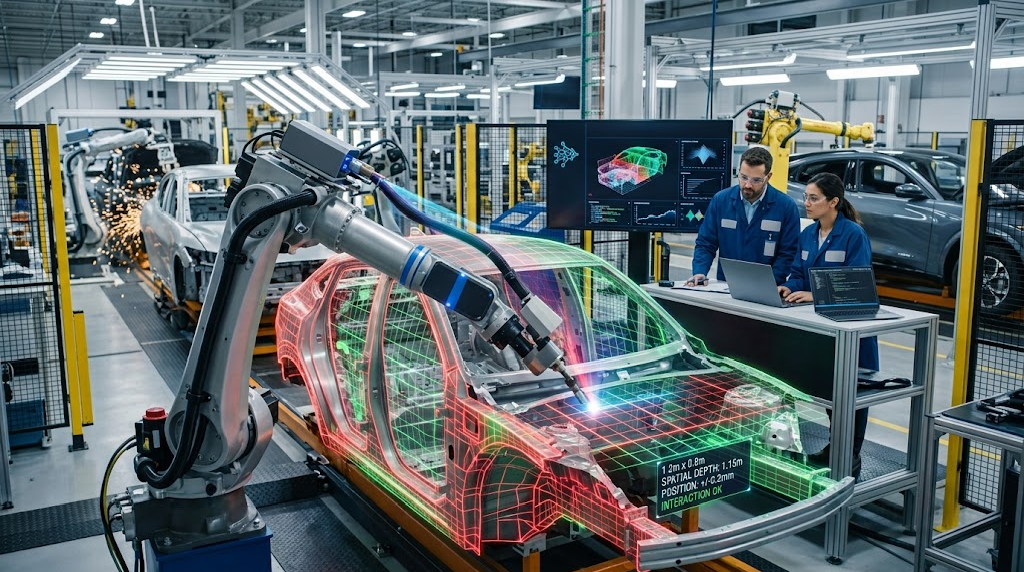
From Computer Vision to Physical AI – The Next Frontier for 3D Metrology
As industrial automation and 3D measurement move towards increasingly sophisticated spatial awareness, a new generation of artificial intelligence is beginning to change how machines perceive and interact with the physical world.
One company pursuing this direction is Perceptron, an AI startup founded in November 2024 by two former Meta research scientists. The company is developing advanced vision models intended to give machines a more capable understanding of their physical surroundings.
The development is significant for manufacturing because conventional computer vision has largely been built around specific, predefined tasks. Systems can recognise components, detect defects and verify assembly with remarkable speed and reliability, but they generally operate within carefully defined parameters.
Physical AI aims to go further, enabling machines to interpret their environment, understand spatial relationships and use that information to determine appropriate actions.
From Seeing to Understanding
The implications for metrology are potentially significant.
Modern inspection systems already combine cameras, 3D scanners, robots, CAD models and measurement software. However, much of the inspection process remains programmed in advance: what to measure, where to measure it and how the resulting data should be evaluated.
AI could introduce a more adaptive layer of intelligence.
Rather than simply following a predefined inspection sequence, a future system could identify the component entering an inspection cell, establish its orientation, recognise relevant features and determine which measurements are required.
This would represent a shift from ‘scripted machine vision to adaptive spatial intelligence‘.
The objective would not necessarily be to replace high-precision metrology equipment. A CMM or 3D scanner would continue to provide the accurate, traceable measurements required for quality assurance. AI could instead determine how and where those measurement capabilities should be applied.
Connecting Perception and Measurement
The concept becomes particularly interesting when combined with robotic inspection.
A robot equipped with vision and a 3D measurement sensor could potentially identify a component, locate its position in space and adapt its inspection path accordingly. If the component were positioned differently from the expected location, the system could adjust rather than requiring a new programmed routine.
This could help address one of the challenges facing automated inspection as manufacturers introduce greater product variety and more flexible production.
The same principle could eventually extend to closed-loop manufacturing. Instead of simply identifying that a part is out of tolerance, an intelligent inspection system could combine measurement results with production information to help determine what has happened and what action should follow.
The resulting architecture could be represented as Perceive → Measure → Understand → Act → Verify.
This is where physical AI could become an important technology for future automated quality control.
The Importance of 3D Spatial Intelligence
For physical machines, understanding the world requires more than recognising objects in two-dimensional images.
Robots and automated inspection systems need to understand depth, position, orientation and the relationships between objects. This makes developments in 3D vision and spatial intelligence particularly relevant to metrology.
However, there is an important distinction between AI-based perception and high-accuracy measurement.
Foundation vision models may be capable of identifying features and understanding complex scenes, but they do not replace the requirements for measurement uncertainty, repeatability and traceability.
Instead, the two technologies could become complementary.
AI could provide the perception and reasoning, while established metrology technologies provide the measurement certainty.
This combination could make sophisticated measurement systems easier to deploy in less structured manufacturing environments.
From AI-Assisted to AI-Native Inspection
Perceptron’s emergence reflects a broader movement of AI research from digital applications into the physical world.
For manufacturing, the longer-term opportunity is not simply to add AI to existing inspection systems for tasks such as defect classification. It is to develop inspection architectures in which AI becomes an integral part of the process—connecting vision, measurement, robotics and manufacturing data.
Such systems could potentially adapt to changing products, determine inspection strategies dynamically and feed measurement results back into production in real time.
The technology remains at an early stage, and industrial deployment presents challenges that are very different from those encountered by consumer AI. Manufacturing systems must operate reliably in the presence of changing lighting, reflective surfaces, occlusion, dimensional variation and other sources of uncertainty.
For metrology, the consequences of incorrect decisions can also be significant.
Nevertheless, the direction of development is clear. Computer vision is evolving from recognising what a machine sees towards understanding what it sees and determining what should happen next.
As physical AI develops, this convergence of perception, measurement and robotics could become an important foundation for the next generation of autonomous inspection and 3D metrology.
Editor