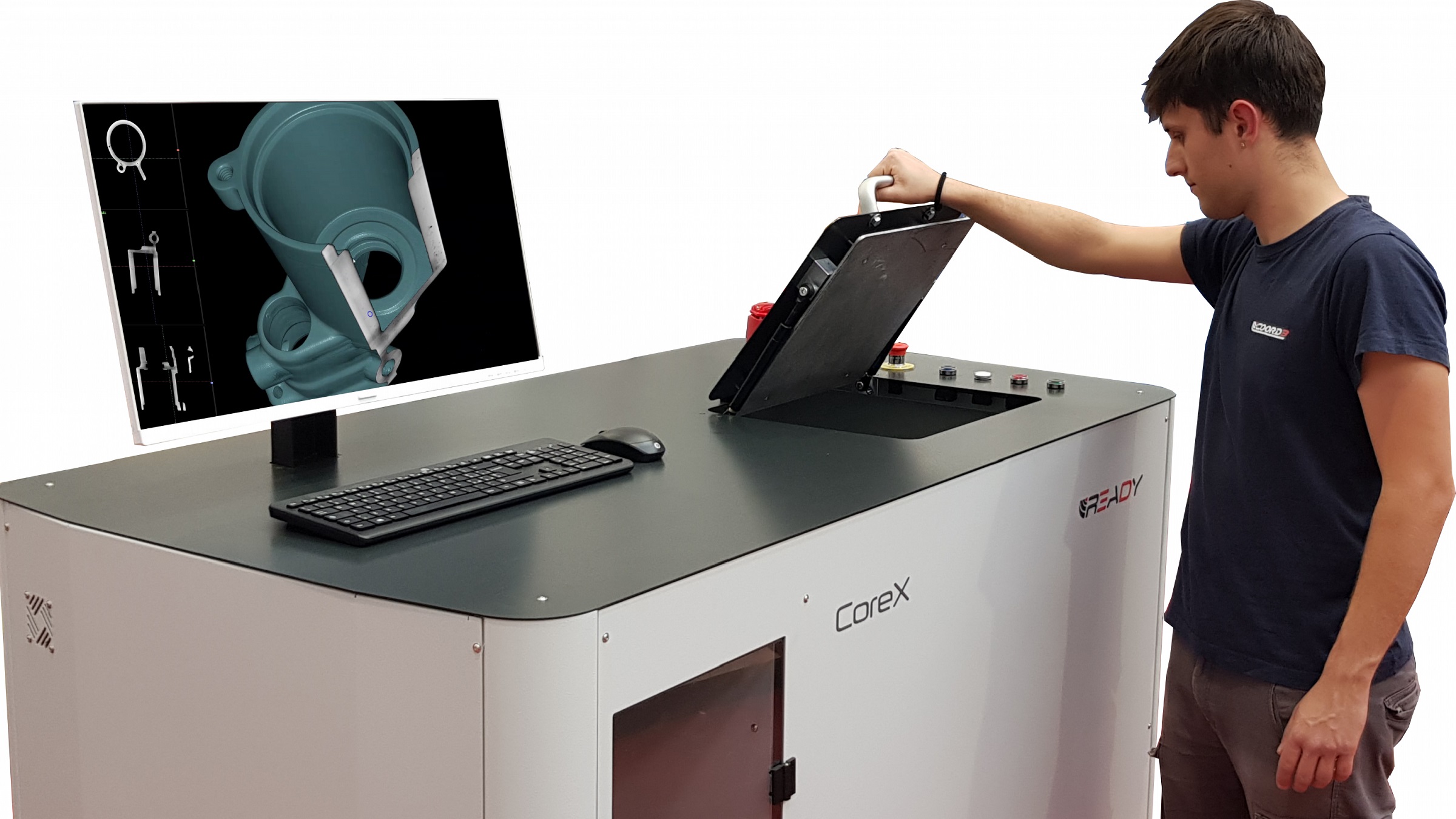
COREX ONE Brings Industrial CT Inspection Directly to the Production Floor
Industrial computed tomography (CT) has long been regarded as one of the most powerful inspection technologies available to manufacturers. Its ability to reveal internal structures, measure hidden features, detect porosity, and verify critical dimensions without cutting or destroying a part has made it an indispensable tool in quality laboratories. However, CT systems have traditionally remained confined to specialist environments due to their size, complexity, cost, and operational requirements.
A new system, COREX ONE, aims to change that by bringing industrial tomography directly onto the shop floor.
CT Inspection Without the Laboratory
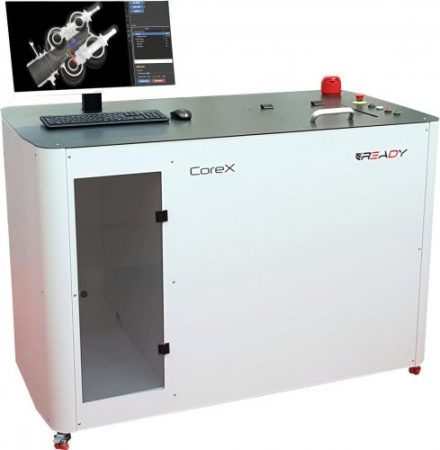 Designed specifically for production environments, COREX ONE combines industrial CT capability with a compact, self-shielded design that eliminates the need for dedicated bunkers, shielded rooms, or additional radiation protection infrastructure. The system can be installed directly alongside manufacturing operations, allowing inspection to become an integrated part of the production process rather than a separate laboratory activity.
The system features a top-loading configuration that differs from conventional laboratory CT systems. According to the manufacturer, this approach reduces floor space requirements while simplifying loading and unloading operations for production personnel.
Simplifying Tomography for Production Operators
One of the key challenges facing wider adoption of industrial CT has been the expertise typically required to operate the equipment and interpret results. COREX ONE addresses this by focusing on ease of use and operator accessibility.
The system is designed to be operated through a simple workflow in which inspections are initiated using a physical start button. Measurement results are generated automatically within seconds, providing objective and repeatable evaluations without requiring specialist CT knowledge.
The user interface has been developed around concepts familiar to production operators. Rather than presenting complex three-dimensional data sets, results are displayed through two-dimensional section views similar to those used with traditional profile projectors.
Measurements are presented using a traffic-light system, enabling operators to immediately identify pass/fail conditions without extensive data interpretation. Selecting a measurement provides additional information, including dimensional trends over time and the corresponding sectional view, allowing operators to quickly identify process drift before non-conforming parts are produced.
From 3D Volume Data to Automated Measurements
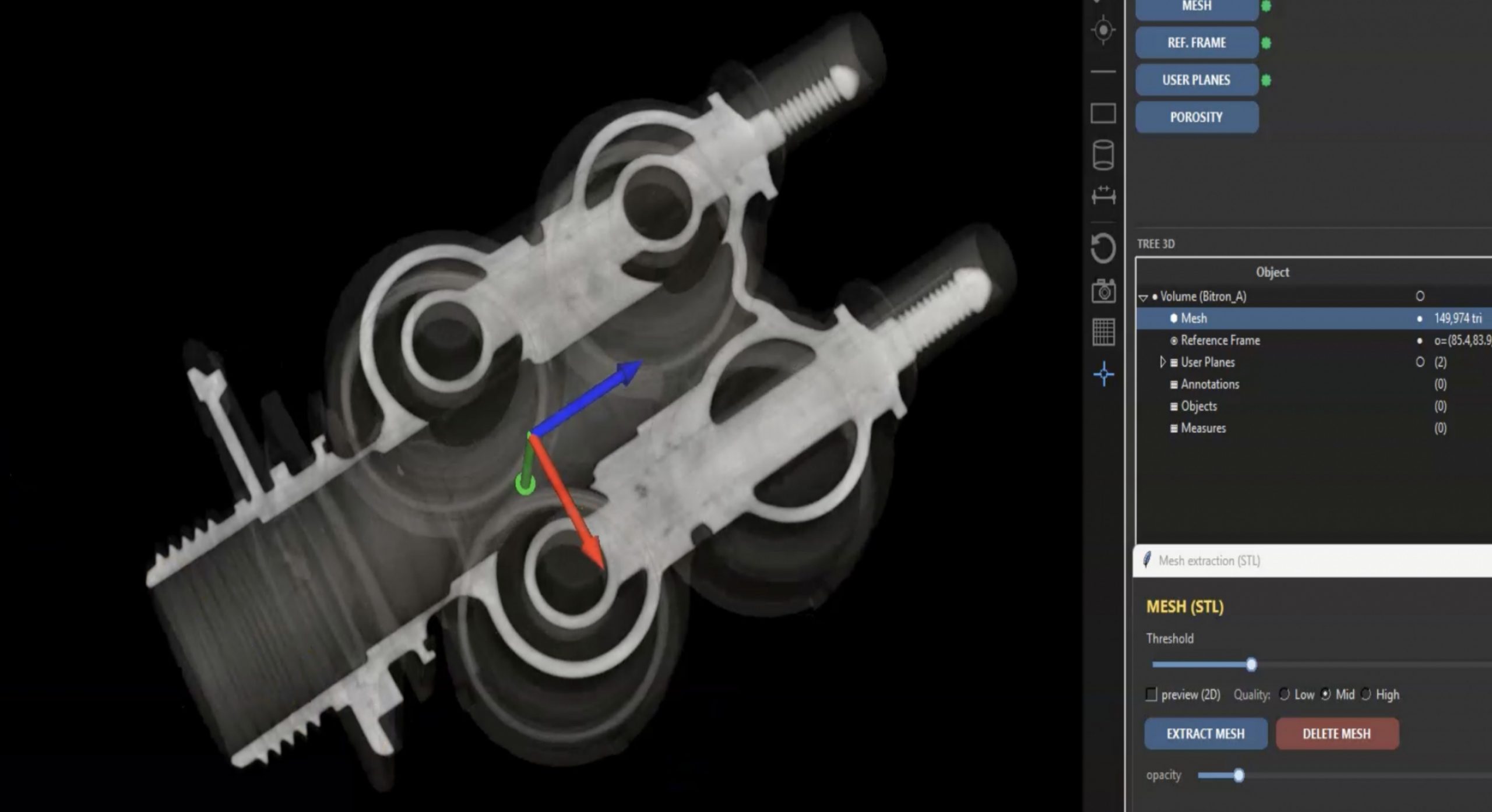 Behind the simplified user experience lies a fully automated CT measurement workflow.
During programming, measurement references and coordinate systems are established directly on either the acquired three-dimensional volume or an STL model. Reference features such as planes, cylinders, and points can be defined based on key process-related characteristics, including moulding planes and draft directions.
Virtual section planes are then created from these references, with dimensional checks and tolerances assigned to each section. During inspection, the system automatically extracts the required sections and performs the measurements without operator intervention.
The result is a workflow that delivers the familiarity of profile projector inspection while extending measurement capability to both internal and external features that would otherwise be inaccessible.
Inspection Beyond Dimensional Measurement
In addition to dimensional verification, COREX ONE offers capabilities typically associated with advanced CT inspection systems.
These include:
- Inspection of internal and external dimensions from a single scan
- Automated porosity detection and evaluation
- Surface comparison using colour map analysis
- Trend monitoring through histograms and statistical displays
- Instant report generation for quality documentation and traceability
The ability to automatically identify internal defects such as porosity, cavities, and blowholes is particularly relevant for manufacturers producing components where sealing performance or mechanical integrity are critical.
Applications Across Multiple Manufacturing Sectors
COREX ONE has been developed for a broad range of manufacturing applications, including plastics processing, aluminium and light-alloy casting, rubber products, glass components, carbon fibre structures, and titanium parts.
The system is particularly suited to manufacturers of extruded profiles and sealing components, where dimensional verification often requires laborious sample preparation and sectioning. Instead of physically cutting samples, operators can place a part into the system, initiate a scan, and view the required cross-sections and measurements automatically.
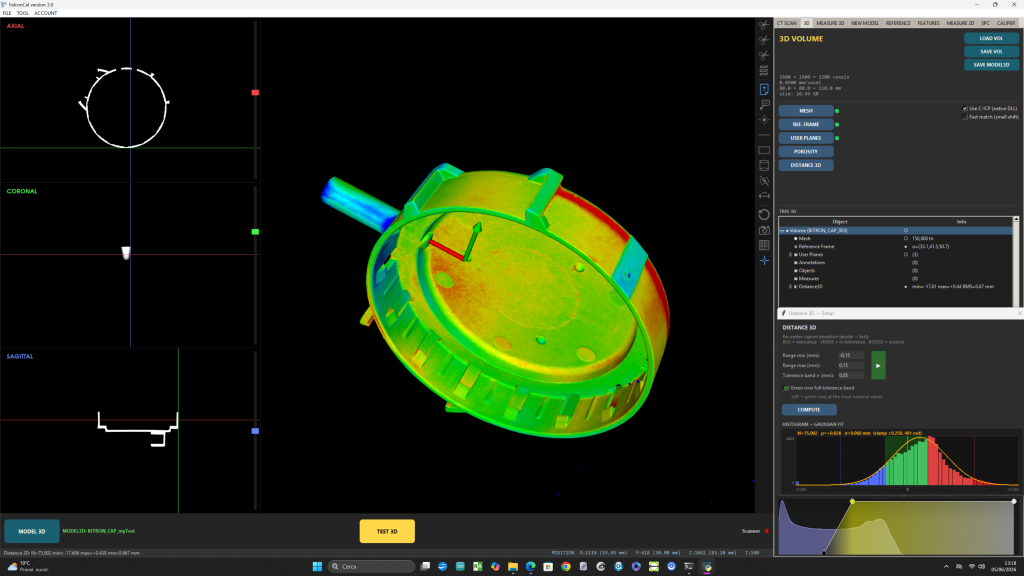
For injection moulding and die-casting operations, the ability to inspect internal porosity and cavity formation provides a non-destructive method for verifying product quality and process stability.
Manufacturers with frequent production changeovers may also benefit from using the system as a setup verification tool, enabling rapid dimensional confirmation at the start of a shift or when changing batches.
Making CT a Production Tool
Industrial CT has traditionally been viewed as a powerful but specialised technology reserved for laboratory environments and expert users. COREX ONE seeks to reposition tomography as a routine production-floor inspection tool by combining automated measurements, intuitive operation, and a compact self-shielded design.
By delivering internal and external dimensional inspection, porosity analysis, and process trend monitoring through an interface familiar to production operators, the system represents a significant step toward making CT inspection accessible to a much wider manufacturing audience.
As manufacturers continue to seek faster, more comprehensive quality control methods, solutions that bridge the gap between laboratory-grade inspection and shop-floor practicality are likely to attract considerable attention.
For more information: www.readymetrology.com