Bruker Alicona Celebrate 25 Years of Advancing Focus Variation in Industrial Metrology
In the late 1990s and early 2000s at Graz University of Technology, a small group of researchers and students set out to answer a question that industry had yet to solve: how to reliably extract accurate 3D information from optical images under real-world conditions.
From this academic environment, the concept of Focus Variation emerged – not as a commercial product, but as a research-driven exploration. The first working implementations were developed during a diploma thesis, with progress advancing rapidly. Initial algorithms were operational within days, and within weeks the underlying principle had demonstrated clear viability. At the time, few could have anticipated that this approach would go on to reshape optical surface metrology.
In April 2001, this research effort transitioned into a company: Alicona, now Bruker Alicona and part of Bruker Corporation.
From Research to Industrial Relevance
At the turn of the millennium, surface metrology faced a distinct technological gap. Tactile measurement systems offered high accuracy but struggled with complex geometries, steep flanks, and delicate surfaces. Optical methods existed, yet often lacked the robustness and repeatability required for industrial use. The core challenge was not simply measurement—but reliable, repeatable measurement across varying materials, geometries, and environments.
Focus Variation addressed this need directly. By analysing sharpness along the optical axis, the technique enables high-resolution 3D surface measurement largely independent of reflectivity, while also handling steep surface slopes. Crucially, the ambition extended beyond theoretical validation. As Franz Helmli, one of Alicona’s early engineers and now R&D Director, explains: the goal was never to create a method that worked only under ideal laboratory conditions, but one capable of delivering consistent results in industrial environments.
Building Without a Blueprint
In its early years, development at Alicona was characterised by speed, experimentation, and a lack of formal structure. There was no clear separation between software development, hardware design, and application engineering. Systems were conceived, assembled, tested, and refined by the same small team – often within the same workspace.
As Hannes Steinke, now Head of Infrastructure at Bruker Alicona, recalls, the team operated without departmental boundaries, tackling whatever tasks were necessary – from coding to system integration. Many of these early contributors were connected through their academic roots, having encountered the technology during lectures before joining the start-up directly.
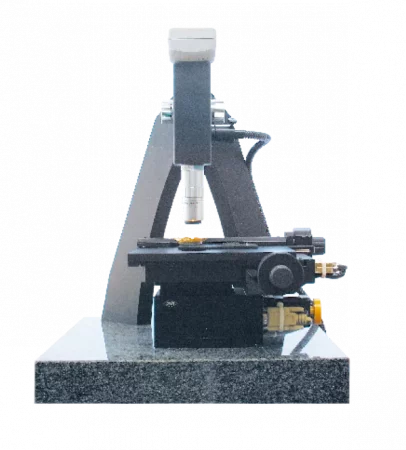
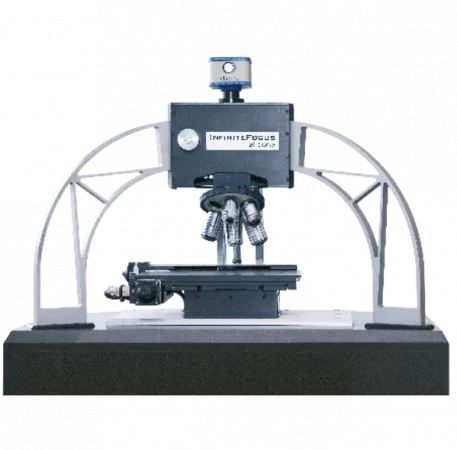
Despite the iterative and often non-linear process, the technology steadily matured. Early prototypes evolved into the first product generation, InfiniteFocus, marking the transition of Focus Variation from an experimental setup to a viable industrial measurement system.
From Custom Projects to Scalable Products
A pivotal shift occurred in the mid-2000s: moving away from bespoke project-based development towards standardized products. Until then, solutions had largely been tailored to individual customer requirements. Standardisation introduced scalability, comparability, and repeatability – key prerequisites for industrial adoption.
With systems such as InfiniteFocus and EdgeMaster, Focus Variation became reproducible, comparable, and ready for deployment on the production floor. This transition marked the point at which a promising technology matured into a scalable product platform.
Market Validation
The moment when market demand became unmistakable did not arise from internal milestones, but from customer response. At an early Control Exhibition in Sinsheim around 2004, interest in the technology exceeded expectations. What began as a routine setup evolved into sustained engagement with a continuous flow of visitors.
For Helmli, this experience marked a turning point. The level of interest demonstrated that Focus Variation was not only technically compelling—it addressed a real and pressing industrial need. It was the moment the technology moved beyond demonstration into practical relevance for manufacturing.
Growth and Industrial Integration
From its origins as a small, academically linked team, Alicona expanded into an international organisation. The company established a presence across key sectors including aerospace, automotive, cutting tool manufacturing, and medical technology.
Measurement systems transitioned from laboratory environments into production settings, increasingly becoming integrated within automated manufacturing processes. This shift reflected a broader trend in metrology: the movement of measurement closer to the point of manufacture.
Advancing Focus Variation
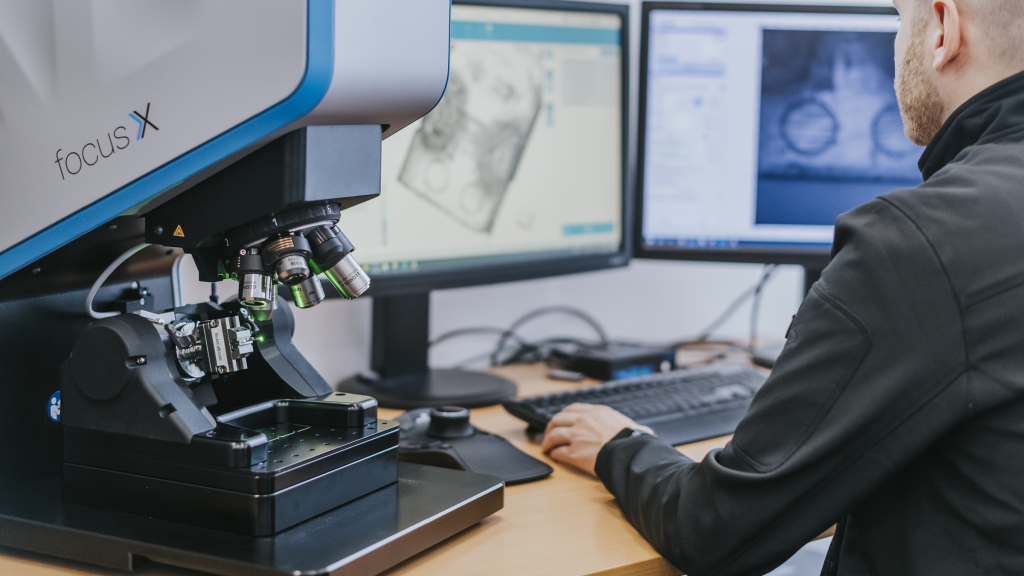
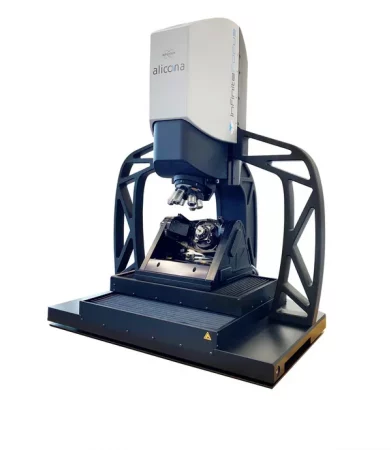
Now part of Bruker, the technology has evolved into Advanced Focus Variation. The product portfolio includes the sixth-generation InfiniteFocus systems, optical coordinate measuring machines, FocusX solutions, collaborative robotic integrations, and OEM sensors.
Despite this expansion, the underlying mindset remains consistent. As Reinhard Danzl, Head of Tech Team, notes, development continues to focus on extending measurement capabilities – improving accuracy, enabling new applications, and addressing previously unsolved challenges.
25 years on—and still evolving
In May 2026, Bruker Alicona marks its 25th anniversary alongside customers, partners, and employees. What began as an academic research initiative has become an established industrial technology. Yet the core objective remains unchanged: to push the boundaries of what can be measured. While the anniversary provides an opportunity to reflect on progress, it also signals continued innovation. The next developments, while not yet fully disclosed, are expected to follow the same guiding principle that has defined the past 25 years – rethinking measurement capability and extending its limits in industrial metrology.
For more information: www.alicona.com