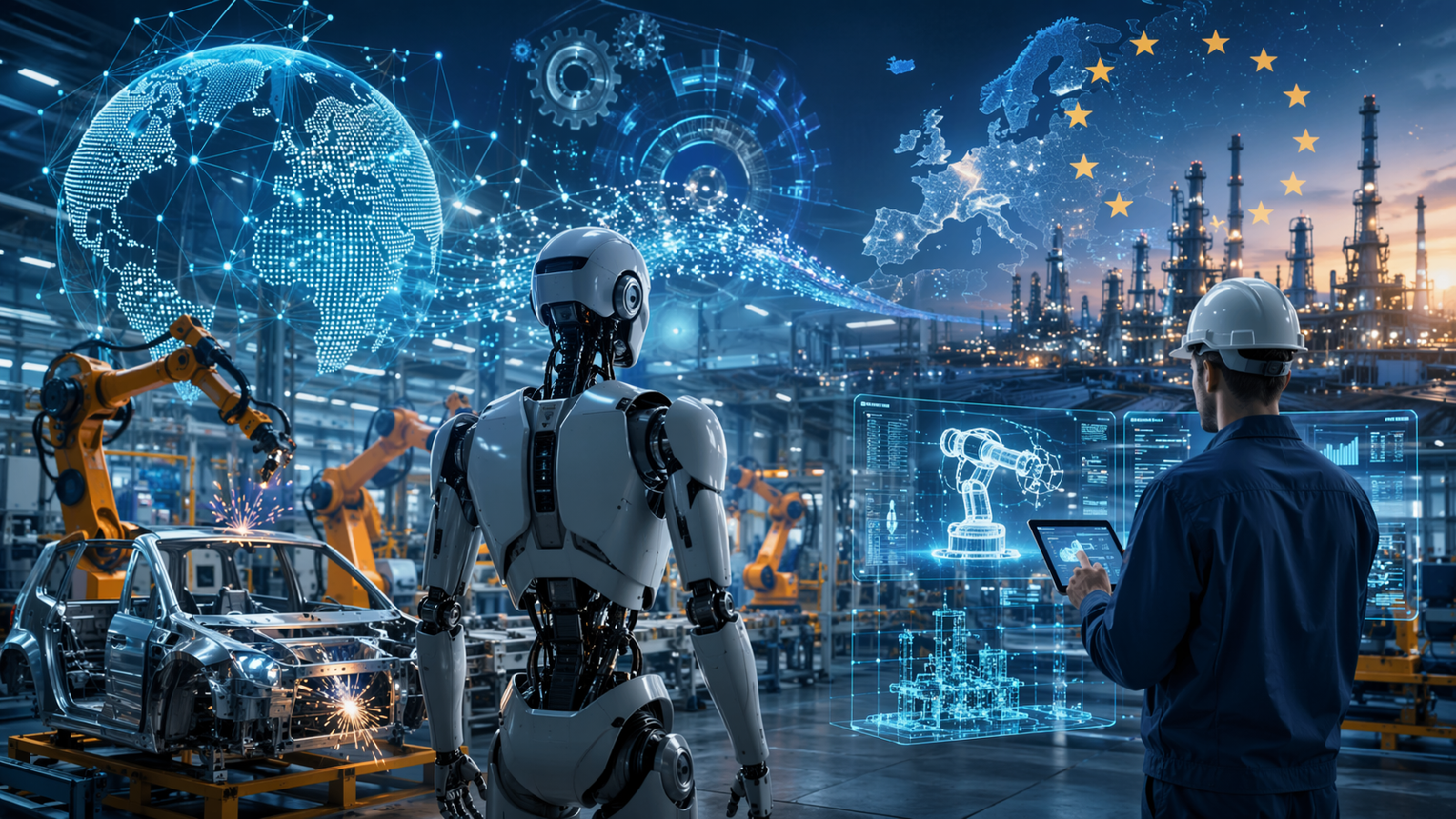
Laying the Groundwork for Industrial AI Leadership in Europe
Artificial Intelligence (AI) can become a key driver for productivity, new business models, and technological sovereignty in the mechanical and plant engineering sector. Based on industrial domain knowledge, interoperable data ecosystems, and shop-floor applications, industry has the opportunity to achieve more efficient and new industrial value creation – as underscored by the VDMA’s new position paper on Industrial AI.
The key now is to establish the right framework conditions. These include a scalable digital single market, a more integrated European capital market, and a clear political prioritization of industry-driven innovation ecosystems. The VDMA is therefore advocating for an innovation-friendly implementation of the EU AI Act as well as a coordinated national and European robotics strategy, as humanoid robotics is becoming a key technology.
What is crucial for future market dominance
“Germany and Europe have an exceptionally strong industrial base”, says Hartmut Rauen, Deputy Executive Director of the VDMA. “Our machinery and equipment manufacturing industry is a technological leader – from automation technology to sensor technology and image processing to production excellence. We also have hundreds of high-performing software companies in our ecosystem. This industrial domain knowledge is the real key to market dominance in the age of Industrial AI. Those who understand the processes will also successfully deploy AI.”
The position paper makes it clear: Industrial AI only realizes its full potential when it is systematically integrated into industrial processes, established architectures, and entire value chains. Standards such as OPC UA and the associated industry-specific companion specifications, digital twins, and industry-driven data spaces, for example, within the framework of Manufacturing-X, create the prerequisites for this. They enable data to be used securely, interoperably, and scalably—even across companies and allow AI applications to be transitioned from the pilot phase to continuous industrial operation.
Humanoid Robotics as the Premier Class of Industrial AI
The VDMA sees humanoid robotics as a particularly promising field for the future. It is considered the premier class of Industrial AI, featuring learning, spatially agile systems that directly link perception and action. “Humanoid robots will establish a new class of machines,” explains Rauen. “They will find applications in industry, logistics, healthcare, the home, and agriculture. Both quantitatively and qualitatively, a central future field of industrial society is emerging here, one that European industry must occupy.
For more information: www.vdma.eu