Reverse Engineering and 3D Scanning Drive Industrial Design Improvements
For years, industrial metrology was primarily associated with inspection and quality control. Today, however, it is increasingly becoming a driver of engineering innovation—particularly in applications where geometry is complex, operating conditions are harsh, and manufacturing variability presents significant challenges.
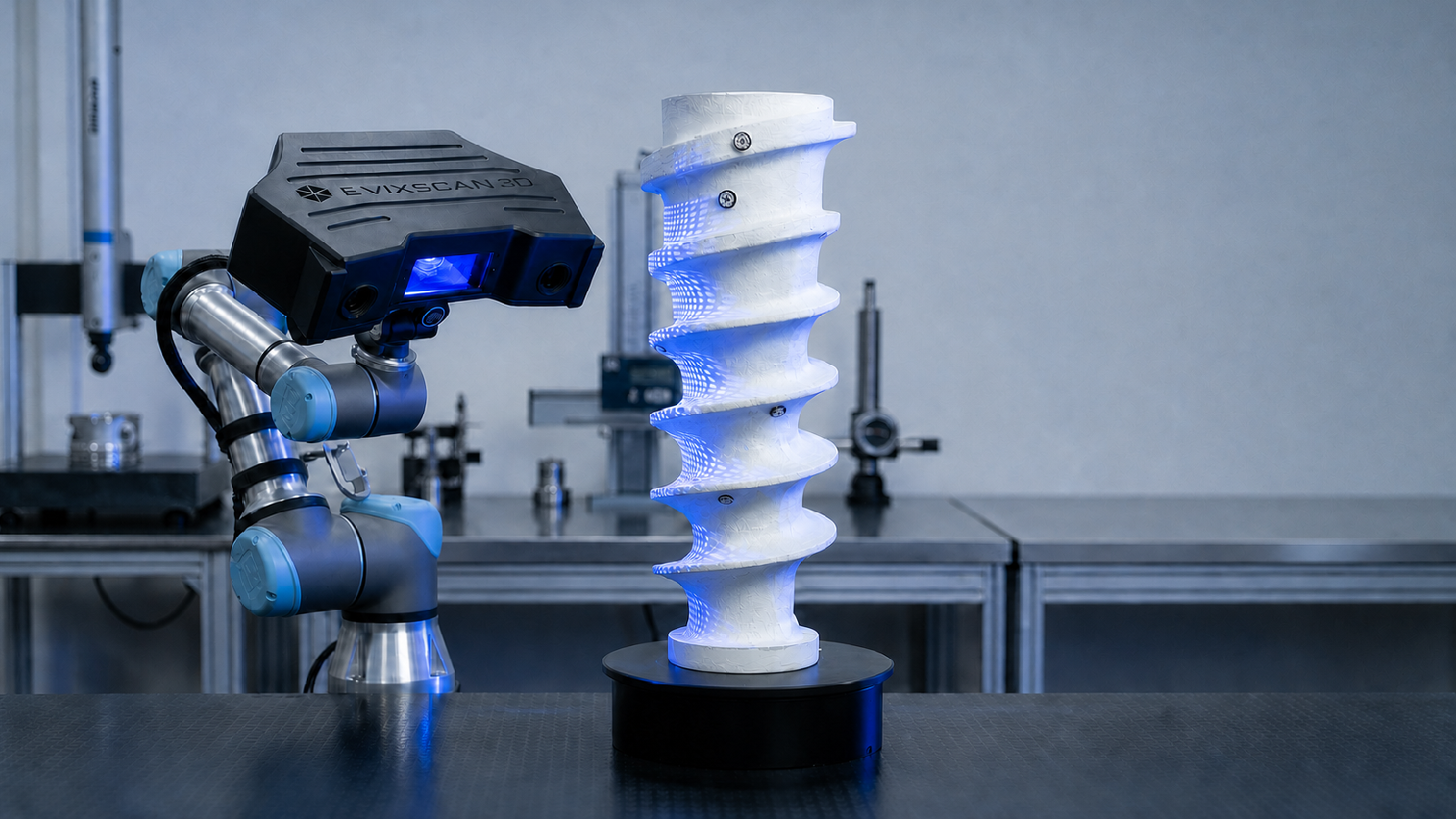
A compelling example comes from South Africa, where engineering company 3DWORX used 3D scanning and reverse engineering technologies from eviXscan3D to redesign a concrete pumping auger. The objective was not simply to replicate an existing component, but to create an optimized version with improved pumping efficiency, more stable flow characteristics, and greater wear resistance.
The project demonstrates how modern metrology workflows can transform scan data into actionable engineering intelligence and measurable performance improvements.
Why Concrete Augers Present a Metrology Challenge
Concrete augers operate under some of the most demanding conditions found in industrial machinery. Constant exposure to abrasive aggregates and cement slurry subjects components to severe wear, while their geometry directly influences system performance.
Critical factors affected by auger design include:
- Pumping efficiency and material transport rates
- Pressure distribution and flow stability
- Wear patterns and component lifespan
- Energy consumption and overall system efficiency
Compounding these challenges, concrete augers are often produced as sand castings. While economical, the casting process introduces unavoidable variability, including dimensional deviations, surface imperfections, uneven wall thicknesses, and local distortions.
As a result, manually recreating or modifying such geometries using conventional CAD methods can be both time-consuming and error-prone.
Moving Beyond Replication
Rather than creating a digital copy of the original auger, the 3DWORX team adopted a redesign approach. Starting from an imperfect casting, engineers sought to develop a geometry that would outperform the original design.
The goals included:
- Improved flow dynamics through optimized pitch and flight geometry
- More uniform pressure distribution during pumping
- Enhanced wear resistance through strategic thickness variations
- Faster design iterations enabled by digital workflows
This distinction is significant. In advanced reverse engineering projects, the scan serves not as a template for duplication but as a highly accurate representation of reality—a foundation for engineering optimization.
Capturing the Physical Geometry
The initial digitization phase utilized the eviXscan3D Quadro+ scanner together with eviXscan3D Suite software. Magnetic geodesic markers, a rotary table, and automated scanning routines enabled efficient acquisition of the auger’s complex geometry.
From a metrology perspective, several factors were particularly important.
Reliable Alignment of Complex Helical Geometry
Helical components can be challenging to scan because their repetitive features may confuse alignment algorithms. Geodesic markers provided stable reference points throughout the acquisition process, reducing the risk of registration errors and cumulative alignment drift.
Automated and Repeatable Data Capture
The use of a rotary table ensured consistent positioning and viewing angles throughout the scanning process. This not only accelerated acquisition but also improved repeatability and data quality.
Creating a High-Quality Engineering Mesh
In reverse engineering workflows, the quality of the mesh directly affects every subsequent stage, from deviation analysis to surface reconstruction and CAD modeling. Producing a clean, accurate mesh early in the process enabled a streamlined engineering workflow.
Turning Metrology Data into Design Intelligence
Once digitized, the geometry was transferred into Geomagic Design X for analysis and reconstruction.
This phase highlights a growing role for metrology: identifying which geometric characteristics matter from a functional perspective.
Deviation analysis allowed engineers to distinguish between:
- Manufacturing-related variations that had little impact on performance
- Critical geometric deviations affecting flow, wear, strength, or assembly
Such differentiation is essential in industrial reverse engineering projects. The objective is not merely to create a visually accurate CAD model but to develop an engineering model that supports measurable improvements in real-world performance.
Engineering a Variable Helix
Perhaps the most technically demanding aspect of the project involved reconstructing and modifying the auger’s helical geometry.
The redesigned auger incorporated variable pitch and changing flight thickness—features that can be difficult to model using traditional CAD workflows.
Geomagic Design X’s unroll-and-reroll functionality proved particularly valuable. By temporarily flattening the helical geometry into a more manageable form, engineers could introduce controlled design changes before reconstructing the three-dimensional shape.
This approach enabled:
- Progressive pitch adjustments
- Variable flight thickness
- Localized profile refinements
- Greater control over conveying performance
The resulting design featured a gradual increase in thickness along the auger’s length, helping improve both pumping efficiency and resistance to abrasive wear.
Closing the Digital Thread
The project extended beyond digital design into manufacturing validation.
To prepare the optimized auger for casting, the team produced a full-scale PLA pattern using additive manufacturing. The pattern was designed as a two-piece sacrificial mold, which was subsequently burned out before molten steel was poured into the cavity.
Compared with conventional wooden patterns, the additive manufacturing approach offered:
- Higher geometric accuracy
- Faster design-to-foundry workflows
- More efficient validation of design changes
From a metrology perspective, this creates a continuous digital thread:
Scan → Parametric Model → Printed Pattern → Casting
Because each stage remains digitally connected, engineers can rapidly evaluate results and implement further refinements when necessary.
Key Lessons for Metrology Professionals:
3D Scanning Enables Optimization, Not Just Replication
The greatest value of scanning often lies not in reproducing existing parts, but in providing an accurate digital baseline for engineering improvements.
Deviation Analysis Can Guide Design Decisions
In this project, deviation analysis was used not only to assess manufacturing quality but also to identify opportunities for improving flow performance and wear characteristics.
Automated Data Acquisition Accelerates Iteration
Marker-based referencing, rotary-table automation, and streamlined processing workflows significantly reduce the time required to move from physical part to engineering model.
Additive Manufacturing Strengthens Casting Workflows
3D-printed sacrificial patterns offer a faster and more precise route from CAD design to foundry production, helping reduce risk before committing to final tooling and castings.
Metrology as an Engineering Enabler
The 3DWORX project illustrates a broader trend within industrial metrology. As scanning technologies, reverse engineering software, and additive manufacturing become increasingly integrated, metrology is evolving from a verification tool into a core element of the engineering process.
Rather than simply measuring what already exists, metrology is helping engineers create what comes next—faster, more efficiently, and with performance improvements that can be directly measured in the field.
For more information: www.evixscan3d.com