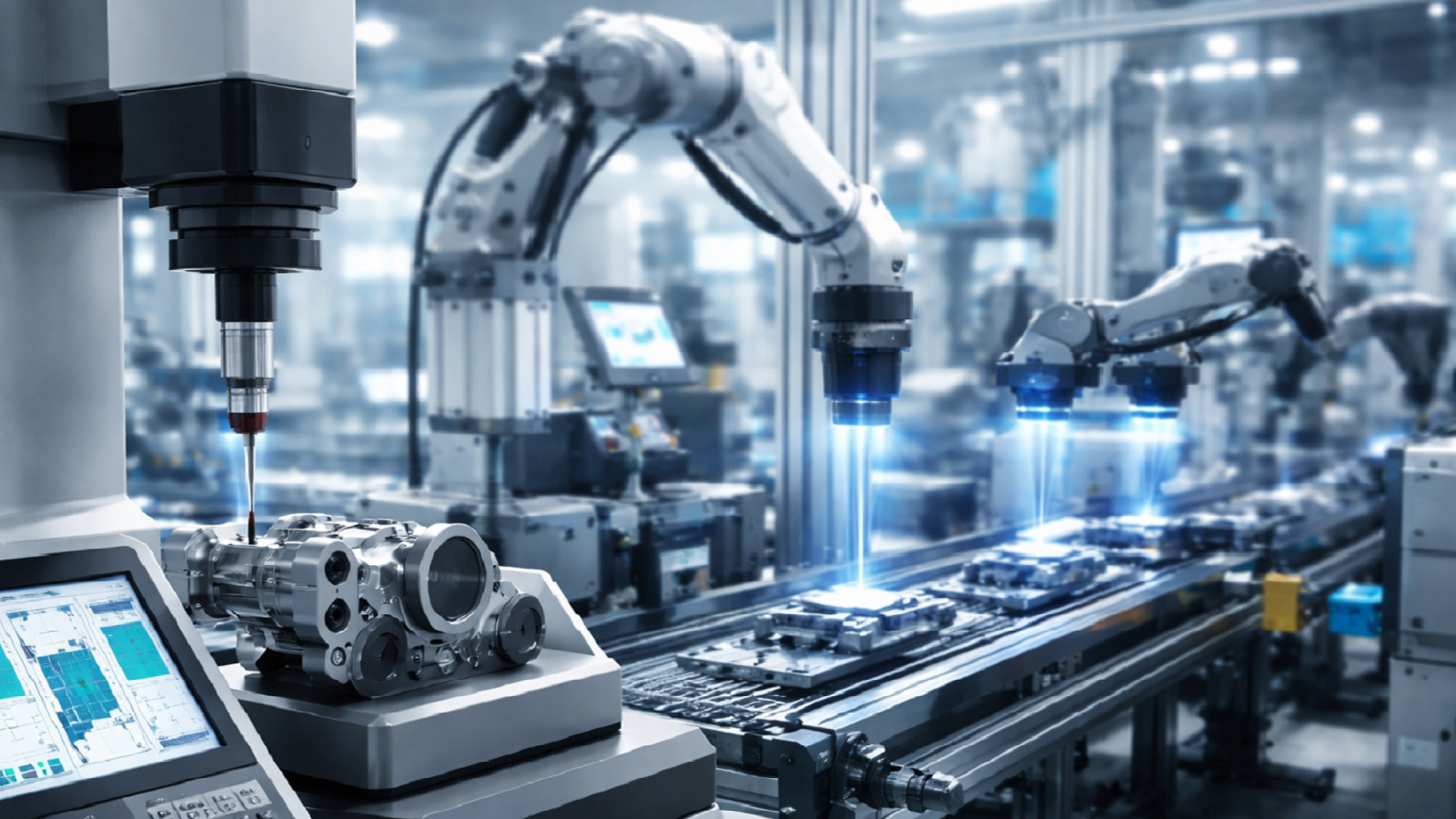
Metrology Moves to the Point of Manufacture
For decades, industrial metrology has largely existed as a downstream function – an essential but separate step used to validate quality after production. Parts were manufactured, transferred to inspection environments, measured, and either approved or rejected. While this model ensured precision, it also introduced delays, bottlenecks, and missed opportunities for real-time process control.
Today, that paradigm is rapidly changing.
A new generation of production-integrated metrology systems is redefining the role of measurement within manufacturing. Rather than operating as a gatekeeper at the end of the process, metrology is increasingly embedded directly into production environments – on the shop floor, in-line, and even within machines themselves. This shift marks a fundamental transformation: from metrology as verification to metrology as control.
From Inspection to Intervention
At the heart of this transformation is the growing demand for real-time decision-making. High-mix, low-volume production, tighter tolerances, and increased product complexity, particularly in sectors such as aerospace, automotive, semiconductors, and medical devices, are pushing traditional inspection models to their limits.
Production-integrated metrology addresses these challenges by enabling immediate feedback. Instead of identifying defects after the fact, manufacturers can now detect deviations as they occur and adjust processes dynamically. This capability significantly reduces scrap, minimizes rework, and shortens production cycles.
The shift is not merely technological – it is philosophical. Measurement is no longer about answering the question, “Did we make this part correctly?” It is about continuously ensuring that the process remains correct.
The Shop Floor Becomes the Metrology Lab
One of the most visible aspects of this evolution is the migration of high-precision measurement systems from controlled metrology labs to the shop floor.
Today’s Coordinate Measuring Machines (CMMs) are increasingly designed for production environments. Enhanced thermal compensation, vibration resistance, and robust mechanical architectures allow these systems to maintain accuracy even in less controlled conditions. As a result, manufacturers can perform high-precision measurements closer to the point of manufacture, eliminating delays associated with part transportation and queuing.
This transition also reflects broader trends in manufacturing digitization. Shop-floor metrology systems are no longer standalone instruments; they are connected nodes within a larger digital ecosystem, feeding data into manufacturing execution systems (MES), quality management systems (QMS), and digital twins.
Inline and In-Process Measurement: Closing the Loop
Beyond near-line inspection, the most transformative developments are occurring in inline and in-process metrology.
Inline systems, integrated directly into production lines, enable continuous measurement without interrupting throughput. Using technologies such as optical scanning, laser triangulation, and structured light, these systems capture dimensional and surface data in real time. More importantly, they enable closed-loop control: measurement results are fed back into machines or control systems to automatically adjust parameters.
This closed-loop capability represents a critical step toward autonomous manufacturing. By linking measurement directly to process control, manufacturers can maintain optimal conditions without human intervention, ensuring consistent quality even in complex or variable production scenarios.
Emerging solutions are also leveraging low-cost sensor technologies combined with advanced algorithms. These systems may not match the absolute accuracy of high-end lab equipment, but their strength lies in speed, scalability, and the ability to provide continuous process insight.
Expanding Measurement Modalities
As metrology moves into production, the range of measurement technologies being deployed is expanding significantly.
Industrial computed tomography (CT), once confined to laboratory environments, is increasingly being used for production decision-making. Its ability to inspect internal geometries non-destructively makes it invaluable for additive manufacturing, castings, and complex assemblies. Advances in speed, automation, and data processing are making CT more viable for near-line and even inline applications.
Similarly, LiDAR and large-volume scanning technologies are becoming more accessible, enabling rapid capture of spatial data across larger components and assemblies. These tools are particularly relevant for industries such as aerospace and energy, where traditional measurement methods struggle to scale.
At the same time, high-precision encoder systems and multi-degree-of-freedom measurement technologies are enhancing the accuracy and performance of machine tools and robotic systems. By providing real-time positional feedback across multiple axes, these systems support advanced compensation strategies and improve overall process stability.
Software as the Enabler
While hardware innovation is critical, the true enabler of production-integrated metrology is software.
New generation metrology platforms are increasingly cloud-connected, allowing data to be aggregated, analyzed, and shared across the enterprise. Artificial intelligence and machine learning are being applied to detect patterns, predict deviations, and optimize processes.
Digital twins play a particularly important role. By comparing real-time measurement data against virtual models, manufacturers can identify discrepancies instantly and simulate corrective actions before implementing them on the shop floor.
This convergence of measurement, data analytics, and simulation is transforming metrology into a central component of the digital thread—linking design, manufacturing, and quality in a continuous feedback loop.
Lowering Barriers, Expanding Adoption
Another defining characteristic of this new generation of systems is accessibility. Advances in sensor technology, computing power, and software have significantly reduced the cost and complexity of deploying metrology solutions.
Portable systems, user-friendly interfaces, and automated workflows are enabling a broader range of users, including operators and production engineers, to engage directly with measurement processes. This democratization of metrology is accelerating adoption across industries and applications.
As a result, measurement is no longer the exclusive domain of specialists. It is becoming an integral part of everyday manufacturing operations.
Toward Autonomous Quality
The convergence of inline measurement, closed-loop control, and advanced analytics points toward a future of autonomous quality systems.
In this vision, manufacturing processes continuously monitor themselves, detect deviations, and self-correct in real time. Human intervention is reserved for exception handling and strategic decision-making, rather than routine inspection.
While fully autonomous manufacturing remains an aspirational goal, the building blocks are already in place. Production-integrated metrology is a key component of this evolution, enabling the transition from reactive quality assurance to proactive quality control.
Production-Integrated Metrology
Metrology is no longer confined to the lab or positioned at the end of the production line. It is moving to the point of manufacture – embedded within processes, integrated into systems, and central to decision-making.
This shift is redefining the role of measurement in manufacturing. By enabling real-time insight, closed-loop control, and seamless integration with digital systems, production-integrated metrology is transforming quality from a checkpoint into a continuous, dynamic capability.
As manufacturers continue to pursue greater efficiency, flexibility, and precision, the integration of metrology into production will not be optional – it will be essential.
The future of manufacturing is not just measured. It is measured in motion.
Author: Guest Writer William Jones II