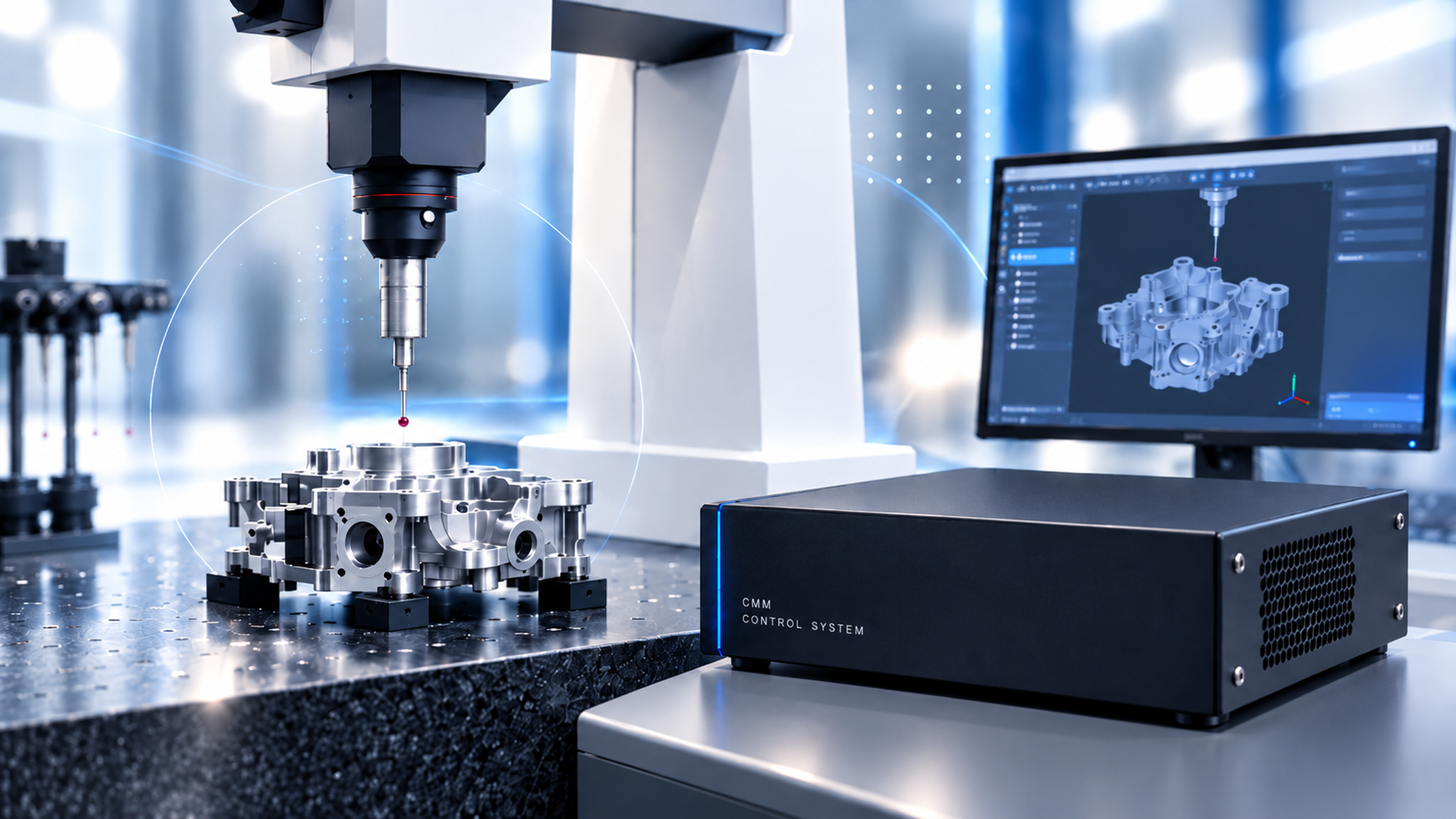
Keeping CMMs Current Through Flexible Controller Technology
The coordinate measuring machine (CMM) has remained a fundamental technology in dimensional metrology for more than five decades, but the role of its controller has changed significantly. As manufacturers look to extend the life of existing CMMs while demanding greater flexibility, software compatibility and connectivity, controller technology is increasingly important in keeping mechanically sound machines productive. In this interview, Simon Moruzzi, Technical Director at independent CMM controller developer Deva Electronics, discusses the evolution of CMM control, the growing opportunity for retrofits and the challenges of modernising established machines without disrupting the way they are used.
Q: The coordinate measuring machine has been a cornerstone of dimensional metrology for over 50 years. How has the role of the CMM controller evolved?
A: Years ago, the controller was basically tied to the machine. You bought the machine, controller and software as one package, and there was very little flexibility outside of that.
PC-based control changed things quite a lot because it allowed the real-time machine control to be separated from the software running above it. You still need very reliable, predictable control at machine level, but users now expect much more choice around software, probes and upgrades.
For me, the controller should be something you can move forward with as requirements change, rather than the reason you have to replace a mechanically good CMM.
Q: Deva Electronics has long operated as an invisible partner;. How has this shaped your innovation strategy?
A: We’ve spent a lot of years supplying control technology that sits inside other companies’ systems, so the Deva name has not always been the part the end user sees.
That has probably made us quite practical in the way we design things. The technology has to work with different machines, probes and software, and it has to be supportable for a long time.
We tend to think about compatibility first, rather than expecting the customer to change everything around our hardware.
Q: How do you assess the current and future market opportunity for CMM retrofits?
A: There are still a lot of CMMs in use where mechanically there is absolutely nothing wrong with the machine. We still see systems using Deva electronics that have been running for 20 or even 30 years.
That isn’t always the case across the market, where older hardware can become unsupported or obsolete.
So if the machine itself is still good, a retrofit lets you modernise the control system and extend its useful life without the cost and disruption of replacing the whole CMM.
Q: What are the key requirements when upgrading a CMM controller?
A: The biggest concern is usually downtime. If that CMM is being used every day, the customer does not want it out of production for weeks while a retrofit is being carried out.
Compatibility is a big part of it as well. Wherever possible, they want to keep their existing software, inspection programs, probes and the way their operators already work.
Performance and price obviously matter, but making the installation straightforward and reducing the risk around the change are just as important.
Q: How is Deva working with independent service organisations?
A: Independent service companies are a really important part of the CMM market, particularly when it comes to supporting and upgrading the installed base.
We try to make the control side as straightforward to integrate as possible – less separate hardware, less wiring and more repeatable connections. That helps service engineers on retrofit work, but the same thinking applies to OEMs building it into a new machine.
Whether it’s a new build or a retrofit, the aim is the same: make installation simpler, keep the system flexible and reduce the amount of engineering needed around it.
Q: How does Deva ensure interoperability and preserve legacy programs?
A: The customer shouldn’t have to start again just because the controller has changed. In many cases they have years of inspection programs and a software package they already know well.
Standards such as I++ are important, but real-world compatibility with the main metrology software platforms matters just as much. Any new controller needs widespread software support.
The aim is to modernise the control system while changing as little as possible for the operator, but still giving them a pathway to adopt new features and working practices over time.
Q: How do you envision the next generation of controller architecture?
A: Integrated CMM controllers are already well established, so I don’t think the next step is simply putting more functions into one box.
For me, it is about how well the whole system works in the field, whether it is going into a new machine or a retrofit. Can you reduce the wiring? Can you make installation and support easier? Can the customer keep the software and sensors they want to use, and can the system be upgraded later rather than replaced?
There will also be more connectivity for things like diagnostics and support, but underneath all of that the basic requirement does not change. The real-time machine control still has to be solid and predictable, because the accuracy of the measurement depends on it.
And really, that’s what we’ve always tried to do at Deva – keep the control solid and reliable, but make everything around it as flexible and straightforward as possible.
For more information: www.deva.co.uk