Patented Pulseboard Technology Enables Faster Robotic Weld Inspection
As manufacturers continue to pursue higher throughput, greater automation, and zero-defect production, weld inspection remains a critical but often time-consuming stage of the manufacturing process. Traditional robotic inspection systems frequently struggle to balance speed and accuracy, particularly when inspecting complex weld geometries, curved surfaces, and large production volumes. Kawasaki Robotics and automation specialist Fives DyAG are addressing these challenges with an advanced robotic weld inspection solution that leverages Kawasaki’s patented Pulseboard technology.
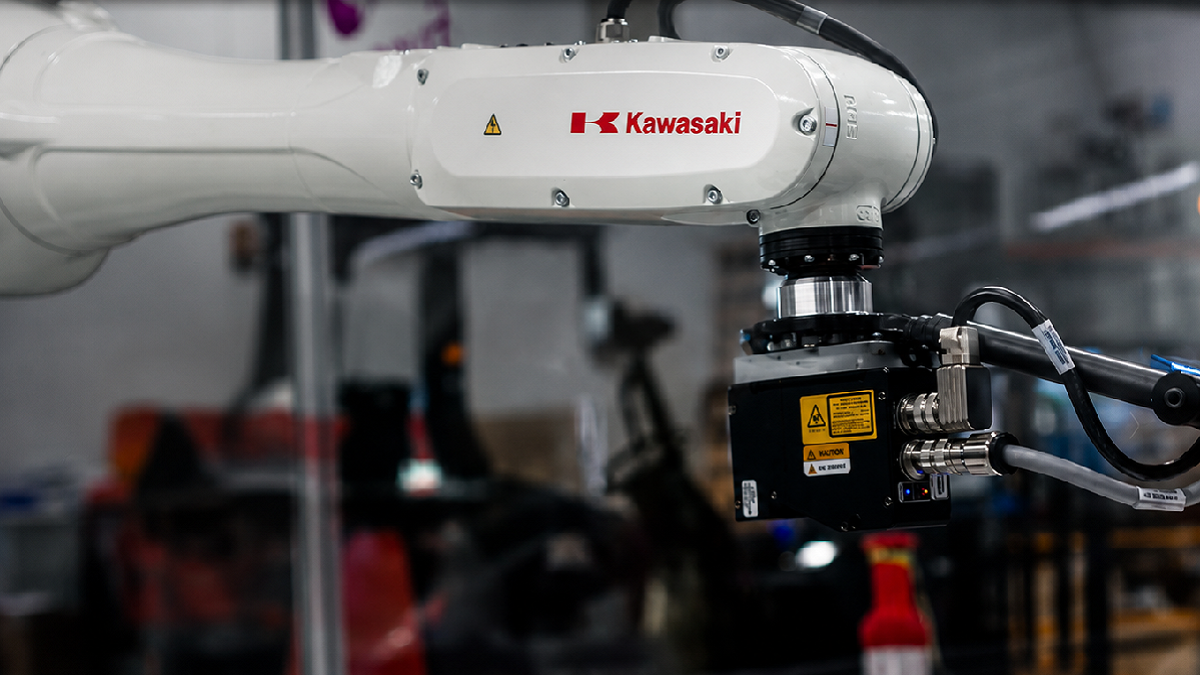
The collaborative system combines a Kawasaki RS013N industrial robot, a high-resolution laser 3D profile camera, and Kawasaki’s proprietary Tool Tip Displacement Output Function, known as Pulseboard, to significantly accelerate weld inspection while maintaining measurement precision.
Eliminating the Stop-and-Inspect Bottleneck
Conventional robotic weld inspection systems typically require the robot to pause repeatedly during an inspection cycle to capture images or measurement data. These frequent stops are necessary to ensure image quality and positional accuracy but introduce substantial cycle-time penalties. The challenge becomes even more pronounced when inspecting intricate weld paths, complex geometries, or curved components where numerous image captures are required.
Kawasaki’s Pulseboard technology fundamentally changes this approach by enabling continuous synchronization between robot motion and image acquisition. Rather than relying on fixed timing intervals or stopping points, Pulseboard outputs highly accurate tool-tip displacement data in real time, allowing the vision system to trigger image capture based on the robot’s actual movement along the inspection path.
This synchronization enables the laser 3D profile camera to acquire high-resolution inspection data continuously, even while the robot is accelerating, decelerating, or traversing challenging weld contours.
High-Speed Inspection Without Compromising Accuracy
The ability to maintain image acquisition during all phases of robot motion delivers a significant productivity advantage. According to Kawasaki Robotics, the integrated solution can achieve weld inspection speeds up to ten times faster than conventional robotic inspection methods.
By eliminating unnecessary stops and reducing the need for complex motion programming, manufacturers can dramatically shorten inspection cycles while preserving the measurement fidelity required for quality-critical welding applications.
The system is particularly well suited for industries where weld quality is paramount, including automotive, heavy equipment, energy, aerospace, and metal fabrication. In these sectors, manufacturers are increasingly seeking inspection technologies that can keep pace with automated production lines without creating downstream bottlenecks.
Improved Defect Detection and Localization
Beyond speed improvements, the synchronized inspection approach provides enhanced defect detection capabilities. Continuous high-resolution scanning allows for more comprehensive coverage of weld seams, reducing the risk of missed defects that can occur when inspection data is collected only at discrete points.
The integration of 3D laser profiling technology enables precise characterization of weld features, including bead geometry, undercut, porosity indicators, surface irregularities, and dimensional deviations. Because image acquisition is tied directly to tool-tip displacement, defect locations can be mapped with greater positional accuracy, simplifying downstream analysis and corrective actions.
This capability is particularly valuable in automated manufacturing environments where rapid identification and localization of defects can reduce rework costs and improve overall process control.
Simplified System Integration
Another benefit of the Pulseboard-enabled approach is reduced setup complexity. Traditional inspection systems often require extensive calibration and programming to coordinate robot motion with camera triggering. Pulseboard’s direct synchronization mechanism simplifies this process by providing real-time positional feedback that can be used to coordinate inspection activities more efficiently.
The result is a more flexible inspection platform capable of adapting to varying part geometries and production requirements while minimizing commissioning time.
Partnership Delivers Production-Ready Solution
The inspection system has been developed through a partnership between Kawasaki Robotics and Fives DyAG, combining Kawasaki’s robotic motion expertise with Fives DyAG’s experience in industrial automation and inspection technologies.
“The solution developed in partnership with Kawasaki using the Pulseboard delivers real value to our customers,” said Wade Rickard, CEO of Fives DyAG Corp. “It accelerates inspections, identifies defects, and maintains the highest level of quality without slowing or sacrificing production time. Together with Kawasaki, we deliver an innovative high-speed inspection solution that redefines efficiency, enhances reliability, and enables smarter operations.”
Advancing Automated Quality Assurance
As manufacturers increasingly adopt smart factory strategies and data-driven quality control, inspection technologies must evolve to keep pace with production demands. The integration of Kawasaki’s patented Pulseboard technology with advanced 3D laser inspection demonstrates how closer synchronization between robotics and metrology systems can unlock substantial gains in both productivity and quality assurance.
By enabling continuous, high-speed data acquisition during robot motion, the solution offers a compelling example of how modern robotic inspection systems are moving beyond traditional stop-and-measure approaches. The result is faster inspection, more precise defect localization, and improved manufacturing efficiency—without compromising the accuracy required for critical weld quality applications.
For more information: www.kawasakirobotics.com