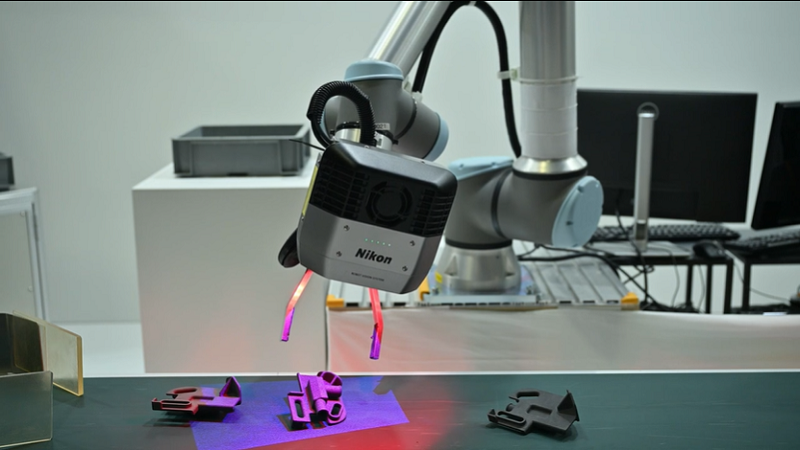
Nikon Adds 3D Vision Tracking for Flexible Robotic Automation
Nikon Corporation has expanded its robot vision system with a new 3D vision tracking capability designed to enable robots to respond rapidly to workpieces moving through production lines in changing positions and orientations.
The technology uses 3D cameras to measure workpieces moving on conveyors and other transport equipment, capturing not only their position and velocity but also their inclination, attitude and orientation. This allows robotic arms to adjust their position and angle dynamically for automated handling and assembly operations that can be difficult to achieve with conventional 2D vision systems.
The system does not require additional equipment such as conveyor encoders to determine workpiece movement, simplifying implementation and expanding the range of production environments in which the technology can be deployed.
From 2D Tracking to 3D Understanding
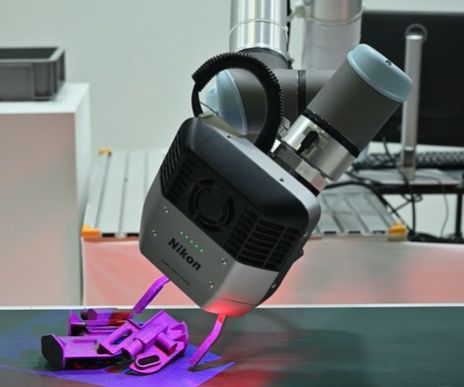 Conventional vision tracking based on 2D cameras can determine the position and velocity of a workpiece within a planar field of view. However, it provides limited information when an object is tilted, rotated or otherwise presented in an unpredictable orientation.
Nikon’s new 3D vision tracking capability extends this approach by measuring the workpiece in three dimensions. The system determines its inclination, attitude and orientation and uses this information to calculate the appropriate position and angle for the robot.
This effectively makes 3D measurement part of the robot’s real-time control process. Rather than simply identifying where a workpiece is located, the vision system provides information about how it is positioned in three-dimensional space.
The capability is particularly relevant where parts arrive in random orientations or where vibration and movement can change their position or attitude.
Supporting Flexible Production
Automotive and other industries are increasingly moving toward multi-product, variable-volume production, while labor shortages are increasing the pressure to automate operations traditionally requiring manual intervention.
Conveyors, automated guided vehicles (AGVs) and autonomous mobile robots (AMRs) provide flexible material movement, but this variability can make robotic automation difficult. A robot must be able to locate individual workpieces and determine their orientation before reliably performing a picking or assembly operation.
Nikon’s 3D vision tracking addresses this challenge by combining three-dimensional sensing with high-speed image processing. The robot can respond to changes in workpiece position and orientation without requiring the production line to precisely control how each part arrives.
The system can also register multiple process positions, allowing robots to perform defined operations on a workpiece while it continues to move through production.
3D Measurement for Random-Orientation Picking
One application is robotic picking of parts arriving on a conveyor in different orientations. By determining the three-dimensional orientation of each workpiece, the system can calculate an appropriate approach position and angle for the robot.
The same principle can be applied to assembly operations. Nikon identifies applications including inserting grommets into automobile bodies, applying plug-hole seals and tightening bolts while tracking a moving workpiece.
Here, the camera is not simply determining whether a part is present or identifying its location. Its 3D measurement data is being used directly to determine how the robot should interact with the part.
Eliminating Conveyor Synchronization
Nikon’s robot vision system can determine workpiece movement without requiring synchronization with the conveyor or other transport equipment.
The system combines a camera sensor with an engine based on a control PC. Nikon says its high-speed image processing, developed through its experience in camera technologies, allows the system to determine the status of a moving workpiece and respond accordingly.
Eliminating the need for an encoder can simplify the integration of vision-guided robotics, particularly where existing conveyors or transport systems were not designed for robotic tracking.
Metrology Moves Into the Robot Control Loop
The development illustrates the continuing convergence of industrial metrology, machine vision and robotics.
Traditional robotic vision has often focused on identifying objects and determining their location. Increasingly, however, three-dimensional measurement is providing robots with geometric information that can be used directly in production.
Measurement therefore becomes an active component of the manufacturing process rather than a separate inspection operation. 3D sensing provides the positional and geometric information required for the robot to make real-time decisions.
Nikon’s 3D vision tracking represents this shift, moving metrology closer to the production process and into the robot control loop. The combination of measurement, computation and motion control can make automated production more tolerant of variation in how parts are presented.
For more information: ngpd.nikon.com