Intrinsic Unveils AI-Powered Modular Manufacturing Vision
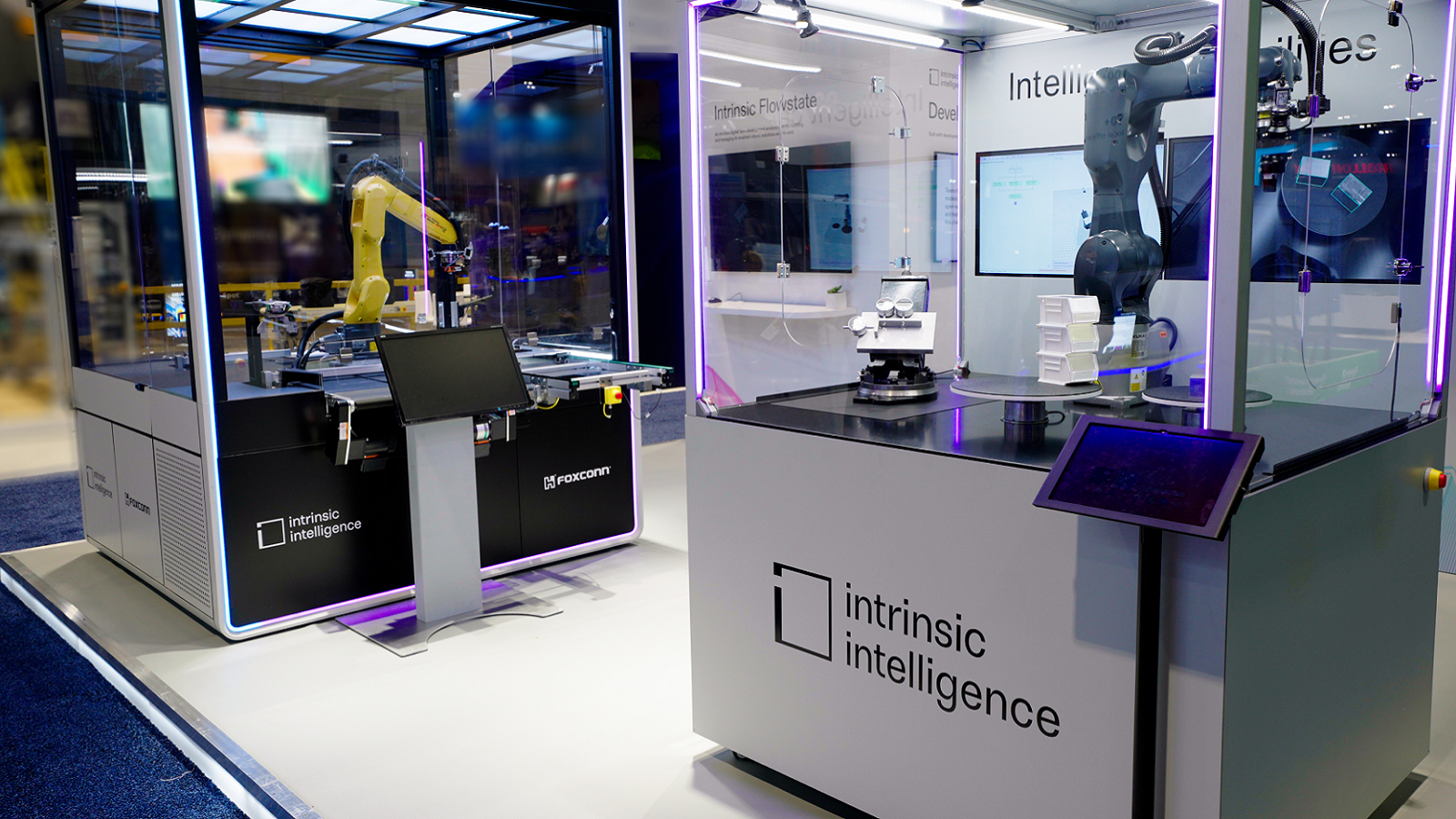
Industrial robotics software company Intrinsic has unveiled an early look at its new Intrinsic Intelligence Cell, a modular robot workcell designed to demonstrate how artificial intelligence can transform manufacturing flexibility, productivity, and accessibility.
Showcased at the recent Automate 2026 expo, the new system highlights Intrinsic’s vision for the next generation of intelligent manufacturing, where AI-enabled robotics can adapt rapidly to changing production requirements while reducing the complexity traditionally associated with industrial automation.
AI-Driven Manufacturing Takes Center Stage
At the heart of the demonstration was the Intrinsic Intelligence Cell, a modular, software-defined workcell architecture built on IntrinsicOS. Designed for complex assembly applications, the system enables rapid process reconfiguration, supports a wide range of hardware and software platforms, and integrates AI capabilities that allow robots to adapt intelligently to dynamic production environments.
The workcell serves as a reference design that provides automation providers and system integrators with a practical framework for incorporating AI-powered robotics into their own solutions. By combining modular hardware with skill-based automation, manufacturers can more easily deploy and scale intelligent robotic systems.
“The intersection of AI with modular production is going to unlock new value and operating models across the industry,” said Wendy Tan White, CEO of Intrinsic. “When both physical workcells and software-defined robotics enable more flexibility, it allows manufacturers of all sizes to build in new ways, and fundamentally shifts the economics of production.”
Supporting the Factory and Machine Shop of the Future
The move toward modular manufacturing cells is gaining momentum across industries as manufacturers seek greater agility in response to product changes and market demands. Intrinsic’s approach is attracting interest from organizations ranging from small machine shops to global manufacturing leaders.
A customized version of the Intrinsic Intelligence Cell developed for electronics assembly is scheduled to be piloted later this year at production facilities operated by Foxconn. At Automate, witnessed a demonstration system equipped with a FANUC robot performing electronics assembly tasks, highlighting the importance of hardware interoperability within modern automation ecosystems.
The company is also collaborating with CNC automation specialists Trinity Automation and Martin Systems to integrate AI-powered skills into next-generation machine tending applications. These systems are designed to simplify robot deployment and operation, enabling machine operators to benefit from advanced robotics without requiring specialist programming expertise.
Capabilities such as machine vision, automated motion planning, intelligent grasping, and precision part insertion are expected to help machine shops improve throughput while supporting high-mix, low-volume production environments.
Accelerating the Path to Physical AI
Intrinsic believes AI is fundamentally reshaping the economics of industrial automation by reducing the time, expertise, and cost required to develop and deploy sophisticated robotic systems.
The company is targeting a broad ecosystem that includes more than 1.3 million ROS developers, systems integrators, machine tool builders, and automation providers seeking practical pathways from prototype development to production deployment.
As AI capabilities continue to mature, Intrinsic argues that advanced robotics will become increasingly accessible to organizations of all sizes, from regional machine shops to multinational OEMs. The result could be a manufacturing landscape where access to intelligent automation is determined less by company size and more by the ability to leverage modular, software-defined production systems.
At Automate 2026, the Intrinsic Intelligence Cell provided a glimpse of that future – one where AI-enabled robotics are not only more capable, but also more flexible, interoperable, and accessible than ever before.
For more information: www.intrinsic.ai