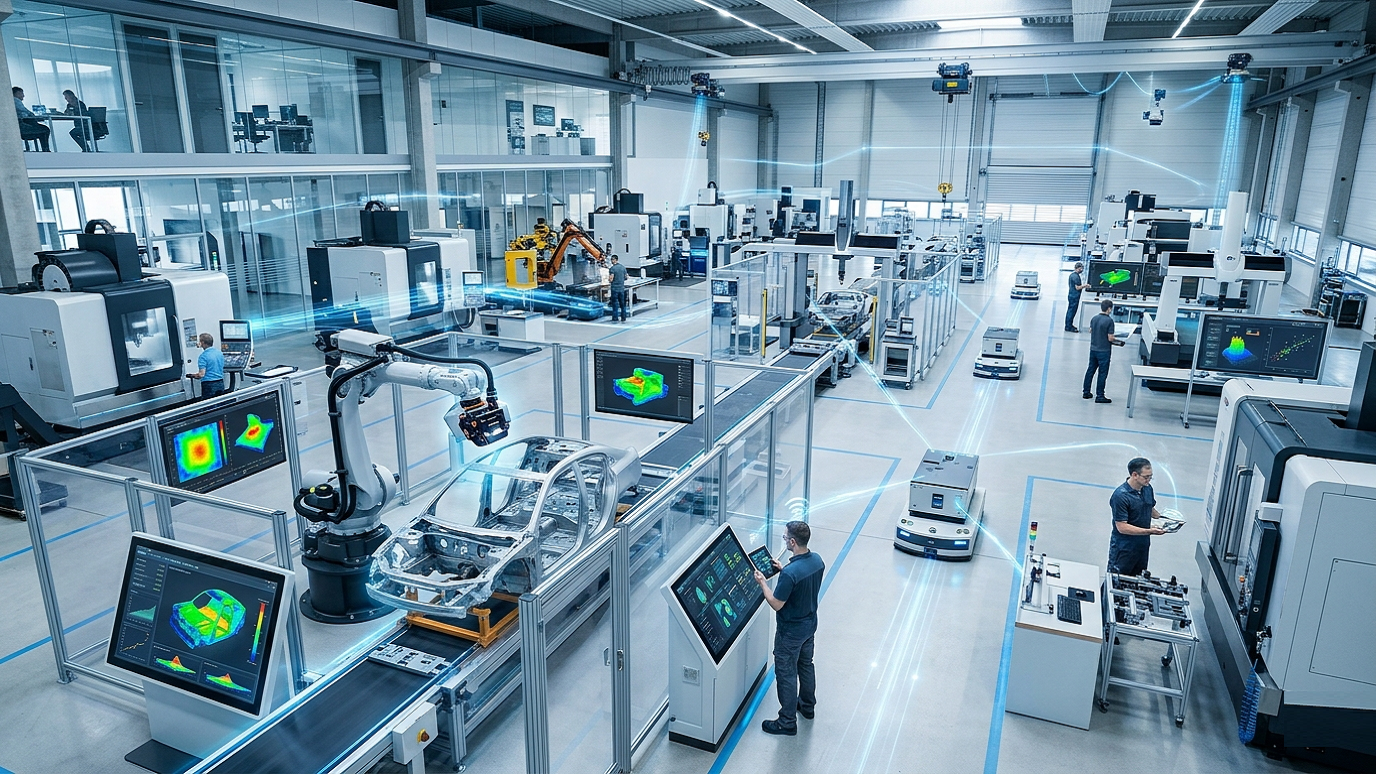
Driving Quality Through Manufacturing Intelligence
Quality control in manufacturing is no longer confined to inspection rooms or end-of-line checks. It has evolved into a dynamic, data-driven discipline that operates continuously across the production lifecycle. This transformation is being powered by manufacturing intelligence – the integration of metrology data, advanced analytics, connectivity, and software-driven decision-making into a unified ecosystem.
Historically, quality control was largely reactive. Parts were measured after production, defects were identified, and corrective actions were taken retrospectively. While effective to a degree, this approach often resulted in wasted materials, production delays, and missed opportunities for process optimisation. Today, the increasing complexity of products, tighter tolerances, and global competitive pressures are pushing manufacturers to adopt a more proactive stance. Measurement alone is no longer sufficient; the real value lies in understanding what the data reveals and acting on it in real time.
Manufacturing intelligence enables this shift by transforming raw measurement data into actionable insight. Today’s metrology systems generate vast quantities of digital information, capturing not only dimensional characteristics but also contextual data related to machines, processes, and environmental conditions. When this information is connected across the production environment, through IIoT frameworks and integrated software platforms, it becomes possible to see quality as a continuous, measurable flow rather than a series of isolated checkpoints.
Real-Time Insight and Predictive Quality
This real-time visibility is fundamentally changing how manufacturers approach quality control. Inline and near-line measurement systems now provide continuous feedback during production, allowing deviations to be detected as they occur rather than after the fact. The impact is immediate: processes can be adjusted on the fly, scrap rates are reduced, and consistency improves. More importantly, this approach lays the foundation for predictive quality control, where potential issues are identified before they manifest as defects.
Predictive analytics plays a central role in this evolution. By analysing historical and live data streams, manufacturers can identify patterns that signal emerging problems – tool wear leading to dimensional drift, thermal fluctuations affecting measurement accuracy, or subtle machine behaviour changes that precede defects. These insights allow for timely intervention, shifting quality control from a process of detection to one of prevention. In advanced implementations, this capability extends into closed-loop manufacturing, where measurement data feeds directly back into production systems, enabling automatic process adjustments without human intervention.
Software sits at the core of manufacturing intelligence, acting as the bridge between data acquisition and decision-making. Today’s metrology platforms are designed to aggregate and harmonise data from a wide range of sources, including coordinate measuring machines, laser scanners, and vision systems. This integration provides a comprehensive view of quality across the entire manufacturing process, breaking down traditional data silos that have long limited analysis.
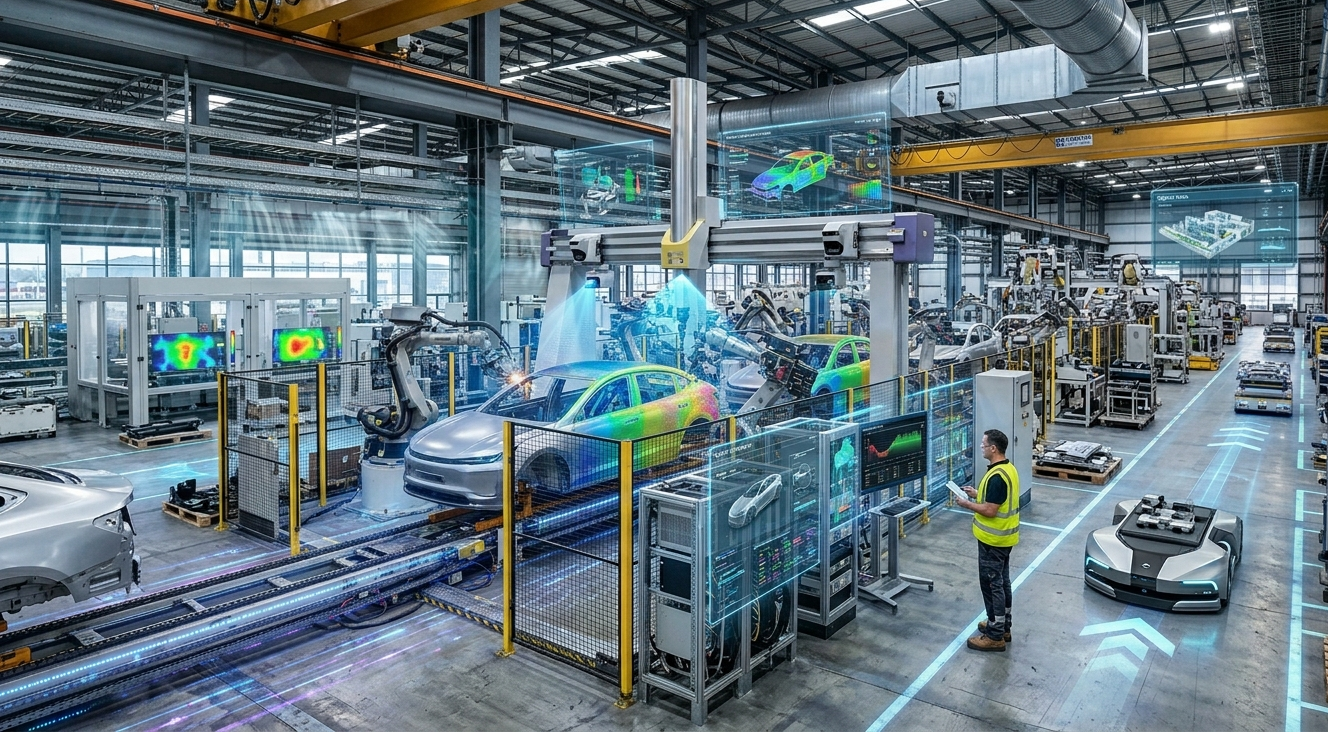
Equally important is the way this data is presented. Advanced visualisation tools such as 3D deviation maps and statistical dashboards make complex datasets accessible and meaningful to both engineers and shop floor production personal. The ability to quickly interpret and act on data is critical in fast-paced production environments, where delays in decision-making can translate directly into increased costs.
AI, Automation and the Future of Quality Control
Automation further enhances the effectiveness of manufacturing intelligence. Inspection routines, data analysis, and reporting can now be standardised and executed with minimal manual input, reducing variability and improving efficiency. Intelligent workflows can prioritise critical measurements, adapt inspection strategies in response to changing conditions, and ensure that quality processes remain aligned with production demands.
Artificial intelligence is accelerating these capabilities, introducing a new level of sophistication to quality control. Machine learning algorithms can uncover relationships within data that would be impossible to detect using traditional statistical methods. They excel at recognising patterns, identifying anomalies, and continuously improving as more data becomes available. In high-volume or highly complex manufacturing environments, this ability to process and learn from vast datasets is becoming indispensable.
Despite these advances, the transition to manufacturing intelligence is not without its challenges. Data quality remains a critical concern; inaccurate or inconsistent measurements can undermine even the most advanced analytics. Integration is another hurdle, particularly in environments where legacy equipment and proprietary systems are still in use. Beyond the technical aspects, there is also a human dimension to consider. Successfully leveraging manufacturing intelligence requires a shift in mindset, with greater emphasis on data literacy, cross-functional collaboration, and trust in automated systems.
Paradigm Shift is Redefining the Role of Metrology
Looking forward, the trajectory of manufacturing intelligence points towards increasingly autonomous and interconnected systems. The concept of the digital twin is gaining traction, enabling manufacturers to simulate and optimise quality outcomes before physical production begins. At the same time, edge computing is bringing data processing closer to the source, reducing latency and enabling faster decision-making on the shop floor. These developments are contributing to a more tightly integrated digital thread, where design, manufacturing, and inspection data are seamlessly linked.
In this emerging landscape, quality control is no longer a standalone function. It is becoming an intelligent, embedded layer that permeates every stage of manufacturing. The organisations that succeed will be those that recognise manufacturing intelligence not simply as a technological upgrade, but as a strategic capability. By harnessing data effectively, they can move beyond defect detection towards continuous optimisation—ensuring not only better products, but more resilient and efficient manufacturing operations overall.
Author: Gerald Jones Editorial Assistant