Dragonfly 3D World 2027 Adds AI Segmentation and Advanced CT Measurement Tools
Computed tomography (CT) is increasingly being used to inspect complex automotive components, including lightweight structures, castings and battery systems. As component geometries become more complicated, CT analysis must provide more than internal visualization, with engineers requiring quantitative tools to identify defects, measure features and document results.
The forthcoming Dragonfly 3D World 2027 software release from Comet Technologies adds a range of tools intended to support these requirements. The release combines AI-assisted segmentation, subvoxel multi-mesh analysis, mesh and CAD tools, integrated reporting and additional visualization and measurement capabilities.
One of the main additions is an AI-powered instance segmentation workflow based on Meta AI’s Segment Anything Model (SAM). The tool can identify and separate objects in a 2D view with a single click, creating individual labels for detected objects.
For CT inspection, this can be applied to features such as pores, inclusions, weld defects and particles within battery components. Individual objects can subsequently be measured and analyzed without first manually outlining each feature or training a dedicated segmentation model.
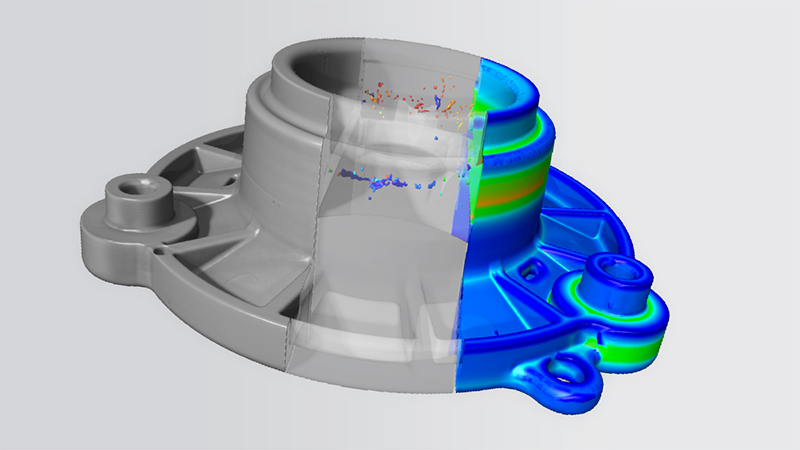
Subvoxel Multi-Mesh for Porosity Analysis
The new Subvoxel Multi-Mesh capability is designed for quantitative analysis of internal structures such as porosity and voids.
Rather than treating a connected structure as a single mesh, the software can separate individual components into independently labelled meshes. Individual pores, voids, phases or other features can then be measured separately.
The approach uses mesh surfaces to represent curved geometries rather than relying solely on voxel-based regions of interest. According to Comet Technologies, this allows more detailed geometric characterization of features and supports repeatable analysis across CT datasets.
Potential applications include casting porosity analysis, defect characterization, phase analysis and inspection of battery components.
Expanded Mesh and CAD Interoperability
Dragonfly 3D World 2027 also adds several tools for working with meshes and CAD data.
These include Boolean mesh operations, covering union, intersection, difference and XOR; automatic mesh registration for scan-to-CAD alignment; STEP CAD import; support for additional mesh file formats; and faster remeshing and mesh optimization.
The tools are intended to reduce manual preparation when performing applications such as reverse engineering, dimensional inspection and scan-to-CAD comparison.
Integrated Reporting
A new Report Builder brings reporting functions into the Dragonfly environment rather than requiring users to transfer measurements and images to separate software.
Reports can incorporate interactive images and visualizations, measurements and statistics, histograms, profiles and object properties. Reports can be exported in PDF and HTML formats.
Full License users will also have access to editable Microsoft Word export, customizable headers and footers, and embedded 3D surface meshes.
The integrated approach is intended to provide a more direct link between CT analysis and the documentation of inspection results.
Faster Separation of Connected Objects
The new Fast Split tool uses Dragonfly’s GPGPU framework to accelerate the separation of touching objects.
Connected features are separated using a one-click workflow intended as a faster alternative to traditional watershed segmentation. The tool can be used alongside Smart Erode to separate objects while maintaining relevant boundaries.
This could be useful when analyzing large CT datasets containing closely spaced pores, inclusions, weld defects or particles.
Rotational Views for Complex Geometries
Rotational Views provides an alternative method for examining cylindrical and other rotational structures.
Instead of manually repositioning a dataset to generate multiple slice orientations, the tool allows an XZ view to be re-sliced continuously around an object’s axis. This can assist inspection of structures such as batteries, pipes and fibers, particularly where defects may only become apparent from specific orientations.
Additional Measurement and Visualization Tools
The release also adds several tools for annotation and measurement.
A Caliper tool measures perpendicular distances between surfaces, while Scalar Arrow annotations display measurement values directly within 2D and 3D views. Other additions include automatic rulers along paths, radial basis function (RBF) surfaces generated from point annotations, and referential coordinate systems for positioning and comparison.
Visualization improvements include additional mesh rendering modes, camera bookmarks that preserve scene settings, and minimal and oriented bounding-box clip tools.
These functions are intended to make measurements and visual results more consistent between inspection projects and easier to communicate.
Surface Roughness from CT Data
One of the more notable additions for metrology applications is Surface Roughness Analysis, which enables surface texture measurements to be performed on CT-derived meshes.
The capability supports both one-dimensional profile and two-dimensional areal surface roughness measurements. This provides a non-contact method for examining surfaces that may be difficult or impossible to access using conventional stylus profilometers, including internal geometries.
Potential applications include additive manufacturing inspection, machined component measurement, tribology studies, surface-finish evaluation and internal surface analysis.
The associated Surface Determination tool has also been redesigned, incorporating histogram-guided thresholding and mesh generation intended for roughness analysis. Macro compatibility supports the automation of repeatable workflows.
Full License and Session Viewer
Several of the new capabilities will be restricted to Full Licenses. These include Subvoxel Multi-Mesh, Surface Roughness Analysis and additional Report Builder functions.
The release will also introduce the ability to export ORSObject and ORSSession files that can be opened using a free Project Viewer.
A separate Session Viewer application is planned for later in 2026. It will allow customers and colleagues without the full 3D World software to open and interact with shared session and object files.
For automotive and manufacturing applications, the combination of CT visualization, AI-assisted segmentation, quantitative measurement, CAD interoperability and reporting points toward a broader role for CT software in inspection workflows. Rather than using CT primarily to locate internal defects, the expanded tools allow the same dataset to be used for segmentation, dimensional analysis, surface characterization and inspection reporting.
For more information: dragonfly.comet.tech