Beyond Monitoring: Why Metal AM Needs Build Intelligence
Metal Additive Manufacturing (AM) has never lacked ambition. It can produce geometries that conventional manufacturing cannot, consolidate assemblies, reduce weight, enable new thermal and fluidic performance, and support more resilient supply chains. In sectors such as aerospace, defence, energy, medical, and advanced engineering, the argument for metal AM is already well understood.
But there remains a difficult truth. Being able to print a part is not the same as being able to trust it, repeat it, prove it, and scale it.
This is where much of the industry conversation around AM quality in our view has become too narrow. Over recent years, ‘in-situ monitoring’ has become a common phrase. It is useful as far as it goes, but it does not go far enough. Monitoring describes the act of observing, it does not necessarily describe understanding, prediction, and proof. And it certainly does not, on its own, describe learning.
That distinction matters.
Quality & the Physics of the Process
 In metal AM, quality is not determined only by whether a camera sees an anomaly during the build, instead it is shaped by the physics of the process (thermal history, cooling rates, reheating cycles, localised energy input, scan strategy, geometry, material response, and machine-specific behaviour). Every new geometry can change the thermal reality of the build, every new material can require a different process window, and every new application can introduce a different evidential burden.
This is why the industry remains caught in a costly loop. Develop a process, build a part, test it extensively, interpret the data, adjust the parameters, build again, and repeat. The most capable AM teams can do this well, but it is often slow, expensive, specialist-dependent, and difficult to scale.
The answer is not simply to add more monitoring. In many cases, AM already generates huge volumes of process data. The challenge is that much of this data is disconnected, difficult to interpret, or not directly useful in making better build decisions.
Additive Build Intelligence
More data is not the same as more confidence. The industry needs a different category of solution. It needs Additive Build Intelligence.
Additive Build Intelligence starts from the customer outcome, not the sensor. The aim is not to say, “we can watch the process.” The aim is to help manufacturers answer the questions that actually determine whether AM can move from development to production.
Can we predict where this build may go wrong before we start? Can we understand what happened during the build? Can we generate evidence that supports build verification? Can we use what we have learned to improve the next build? This is a fundamentally different proposition from conventional monitoring.
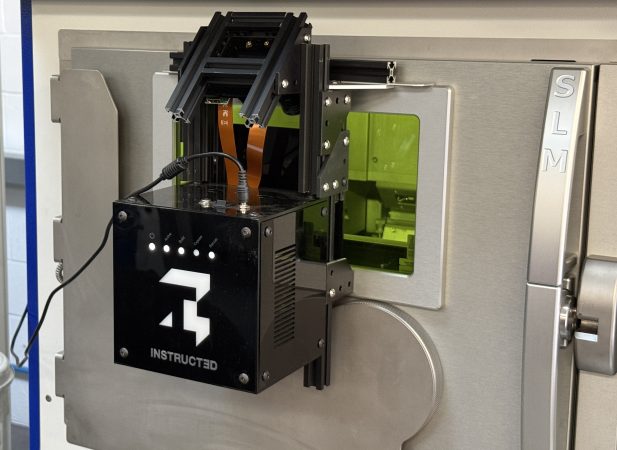
At Instruct3D, our approach is built around the idea that AM quality must become connected. Prediction, process measurement, analysis, verification, and learning should not sit in separate silos. They should inform each other. This is why our platform combines VertX, our camera-based process data acquisition system, with AdditiveOS, our software environment for data storage, analysis, and optimisation.
VertX matters because it gives us the visibility needed to understand the build. It captures multi-spectral process data in a way that is designed to be affordable, deployable, and scalable across AM environments. But the hardware is not the endpoint. The cameras are there to provide enough meaningful data to build intelligently.
AdditiveOS is where that data becomes useful. The software is designed to turn process information into actionable insight, helping users understand defects, optimise build files, support process qualification, and preserve build knowledge across projects and machines.
This is the important separation. Instruct3D is a build intelligence platform that uses in-process data as one necessary input into a larger workflow, and that workflow can be summarised simply – Predict. Build. Prove. Learn.
Predict means using physics-based understanding to identify risk before the build begins. Build means capturing relevant process evidence as the part is made. Prove means linking that evidence to build confidence, verification, and eventual qualification needs. Learn means ensuring that each build improves the next prediction, rather than disappearing into another isolated data archive.
Building with Confidence
This is where the market needs to move. The future of AM quality is not passive observation, it’s the creation of a self-learning feedback loop in which measured build behaviour informs prediction, prediction informs strategy, and strategy improves outcomes.
For high-value AM applications, this has very practical consequences. If build intelligence can reduce parameter development time, shorten iteration loops, identify scrap risk earlier, provide better evidence, and help engineers understand the thermal behaviour of a part, it changes the economics of AM. It also changes the level of confidence that can be given to customers, primes, regulators, and internal quality teams.
It is important to say that this is not about replacing engineering expertise. The best AM engineers already understand that metal AM is highly sensitive to geometry, material, and process conditions. The issue is that too much of their time is spent manually interpreting disconnected evidence and repeating expensive empirical loops. Build intelligence should make expert teams more productive, not less important.
Nor is this an R&D vision searching for a future application. The technology is moving into real commercial environments because the need is already here. Manufacturers do not want another dashboard filled with unexplained anomalies. They want a way to make better decisions, reduce uncertainty, and build with greater confidence.
Category Language
That is why category language matters. If all quality technologies are described as in-situ monitoring systems, the market will naturally compare them by cameras, sensors, frame rates, dashboards, and anomaly detection. These may be relevant technical details, but they are not the full value proposition.
The real question is not, “What can the system see?” it’s “What can the manufacturer now do?” Can they build faster? Can they reduce waste? Can they understand why a defect occurred? Can they compare build-to-build behaviour? Can they support supply-chain evidence without exposing sensitive geometry or parameters? Can they move closer to right-first-time production?
This is the space Instruct3D is defining. Additive Build Intelligence is not another name for monitoring. It is a more complete way of thinking about AM quality. It recognises that the value of data lies not in its existence, but in its ability to create confidence.
Metal AM will continue to grow because the engineering logic is compelling. But its full industrial potential will only be unlocked when manufacturers can build, understand, prove and improve with far greater confidence than is possible through fragmented tools and manual iteration.
The next phase of AM quality will not be defined by who captures the most data, it will be defined by who turns that data into better builds.
For more information: www.instruct3d.io
Authors: Henry Saunders, CEO & Co-Founder, and Ben Thomas, Co-Founder & CTO, Instruct3D