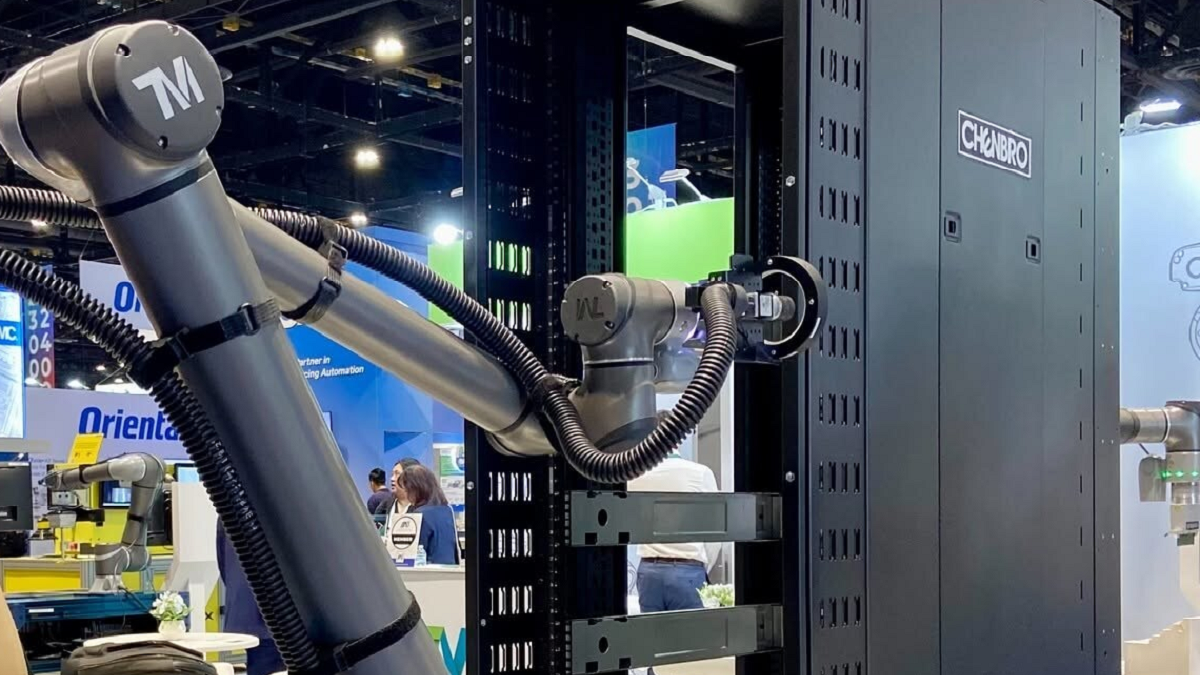
Robot Solution Targets Zero-Downtime Quality Inspection with High-Speed AI Vision Technology
At Automate 2026, Techman Robot highlighted a new generation of AI-powered inspection technologies designed to help manufacturers rapidly establish and scale production operations. While much of the company’s presentation focused on reducing integration costs and simplifying deployment, the most significant development for quality and metrology professionals was the introduction of its High-Speed AI Flying Trigger Inspection system.
Eliminating Inspection Bottlenecks
As manufacturers increasingly reshore production and build new facilities across the United States, quality assurance systems are under pressure to deliver faster inspection cycles without compromising throughput. Traditional machine vision inspection often requires products to stop or slow down for image capture, creating bottlenecks that directly impact productivity.
Techman Robot’s latest approach seeks to eliminate this constraint by performing AI-driven defect detection while parts remain in motion. The company’s High-Speed AI Flying Trigger Inspection technology combines synchronized image acquisition with real-time AI analysis, enabling inspection tasks to occur without interrupting production flow.
Virtual Planning Simplifies Deployment
The technology builds on Techman Robot’s TMscene software environment, a codeless programming platform that allows users to define and optimize inspection points through a drag-and-drop interface. Within the virtual environment, engineers can simulate inspection paths, identify potential blind spots, and validate camera coverage before deployment. According to the company, this reduces commissioning time while helping manufacturers achieve more consistent inspection performance.
From Discrete Inspection to Continuous Quality Control
For metrology and quality professionals, the significance lies in the potential to move inspection from a discrete production step to a continuous inline process. By capturing images and evaluating product quality while workpieces are moving, manufacturers can avoid the latency traditionally associated with vision-based inspection systems.
Techman Robot reports that the technology delivers inspection cycle time reductions of between 40% and 50% compared with conventional inspection methods. The company describes the result as “zero-latency inspection” capable of supporting true zero-downtime production environments.
Growing Demand for Inline AI Inspection
The development reflects a broader trend across advanced manufacturing, where AI-enabled machine vision systems are increasingly being integrated directly into production processes rather than operating as standalone quality stations. As labor shortages, throughput demands, and quality requirements continue to intensify, technologies that combine automated inspection with uninterrupted production flow are attracting growing interest across sectors including electronics, automotive, precision engineering, and industrial manufacturing.
For manufacturers evaluating new automation investments, the ability to deploy AI inspection systems that operate continuously without stopping production could represent a significant advancement in both operational efficiency and quality control—particularly as North American facilities seek to balance higher labor costs with increasingly stringent quality expectations.
For more information: www.tm-robot.com