Preserving America’s Symbol of Freedom – Precision Metrology Creates Digital Twin of Liberty Bell
As Americans celebrated Independence Day on 4 July, few national symbols carry greater historical significance than the Liberty Bell. The Bell has become an enduring emblem of American liberty, democracy and independence. For nearly two centuries it has represented the ideals upon which the United States was founded, attracting millions of visitors to Philadelphia every year.
Now, as the nation approaches the 250th anniversary of independance, one of its most treasured artifacts is benefiting from the latest advances in precision metrology. Researchers from VAR Lab: The Emerging Technologies Hub at Penn State have completed an ambitious preservation project to create what is expected to become the first freely accessible, high-resolution digital twin of the Liberty Bell.
 The project illustrates how measurement technologies are expanding beyond manufacturing and industrial inspection into the preservation of cultural heritage. Using an integrated suite of high-precision laser scanning, structured-light scanning, LiDAR, photogrammetry and immersive imaging technologies, the team has created an exceptionally detailed digital archive of the Bell’s geometry, inscriptions, surface texture and its famous crack. The resulting digital twin is intended to provide a permanent record of the artifact while making it accessible to researchers, educators and the public worldwide.
According to the project team, while a high-resolution scan of the Liberty Bell already exists, it remains privately held and is not freely available. Their objective is to make a research-grade digital model publicly accessible for the first time, extending access to one of America’s most important historical artifacts while supporting long-term preservation.
Precision Metrology Under Challenging Conditions
Capturing one of the world’s most recognised historical objects presented significant metrology challenges.
 The Liberty Bell remains on public display inside the Liberty Bell Center at Independence National Historical Park in Philadelphia. Rather than working in a controlled laboratory environment, the team operated within an active museum, where every stage of the measurement process had to be carefully coordinated around public opening hours.
Access was limited to three tightly scheduled capture windows before and after the museum opened, providing just eleven hours across two days to complete the entire field deployment. Within those narrow windows, the team had to acquire, review and validate the measurement data before leaving the site.
Because opportunities to return were extremely limited, verification of data quality during acquisition became an essential part of the workflow. Any significant omissions discovered after leaving Philadelphia could have proved difficult, or impossible, to correct.
The project also maintained strict conservation standards. Throughout the deployment, the Liberty Bell was never touched, moved or altered. All measurements were obtained using completely non-contact methods.
Combining Complementary Measurement Technologies
No single measurement system could capture every aspect of the Liberty Bell with the required level of accuracy and completeness. Instead, the project combined multiple complementary technologies, each contributing different strengths to the overall digital preservation workflow.
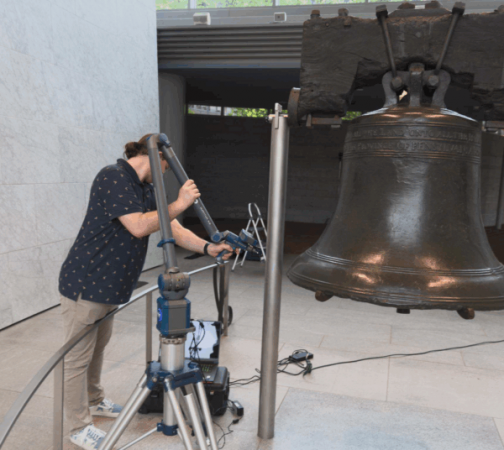 At the heart of the project was the FARO Quantum X FaroArm equipped with xS and xR laser-line probes. Delivering measurement accuracy in the range of 10–25 microns. The articulated arm captured the Bell’s fine geometry, surface detail and crack morphology with exceptional precision.
The laser scanning data was complemented by Artec Space Spider and Artec Eva structured-light scanners, providing additional high-resolution surface coverage while enabling rapid acquisition of complex geometry from different viewpoints.
To preserve the Bell within its architectural setting, the team employed a Matterport Pro3 LiDAR system to digitally capture the surrounding Liberty Bell Center. This room-scale documentation will enable visitors to explore both the artifact and its environment through future virtual experiences.
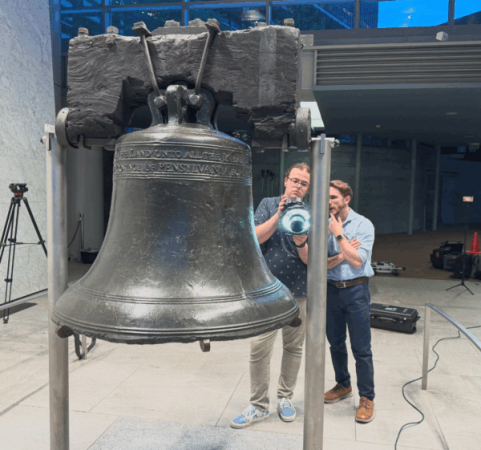 Colour, texture and documentary imagery were recorded using a Canon EOS R5 Mark II, supporting photogrammetric reconstruction alongside high-resolution photography and video documentation. Additional immersive content—including VR180, stereoscopic 3D/360 and conventional 360-degree video—was also captured for future educational releases.
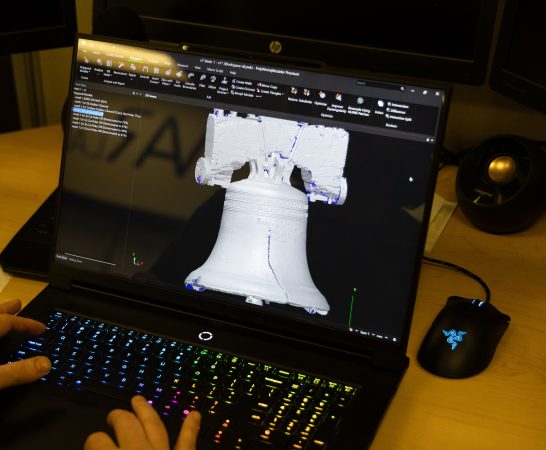
On-site processing and validation were performed using PolyWorks, Artec Studio and Lenovo high-performance mobile workstations. This enabled engineers to review measurement quality immediately, ensuring adequate coverage before equipment was packed and the limited access period ended.
Creating a Permanent Digital Archive
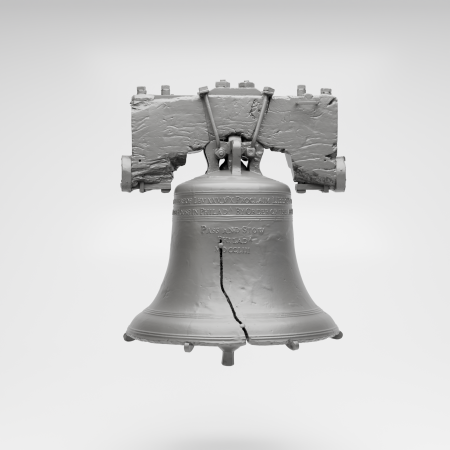 For metrology professionals, projects such as this demonstrate that precision measurement is no longer confined to manufacturing quality control. High-resolution digital twins are increasingly becoming valuable archival assets, preserving the geometry and condition of culturally significant objects for future generations. They also provide baseline datasets that can support conservation planning, condition monitoring and future restoration work.
The Liberty Bell presents a particularly compelling case. The famous crack that defines the Bell, its inscriptions and its weathered bronze surface all represent a specific moment in the artifact’s history. By capturing these features at research-grade resolution, the project creates an enduring record of the Bell’s present condition.
Unlike photographs alone, a digital twin allows researchers to examine geometry, dimensions and surface characteristics from virtually any perspective while preserving measurement data that can be revisited long after the fieldwork has been completed.
Collaboration Across Industry and Academia
The project was led by Christopher R. Shelton, Ph.D., Founder and Director of VAR Lab: The Emerging Technologies Hub, working alongside Technical Lead Remington M. Orange and Creative Lead and Project Manager Alexander C. Fisher.
The deployment also demonstrated the importance of collaboration between academia and industry.
FARO supplied the Quantum X FaroArm together with technical support and pre-deployment training. PolyWorks provided the software platform for precision scan processing and validation, while Lenovo supplied high-performance mobile computing for field review and post-processing. Matterport technology enabled the spatial documentation of the Liberty Bell Center, and National Park Service staff coordinated the carefully managed access windows required to complete the project without interrupting public operations.
Looking Beyond the Digital Twin
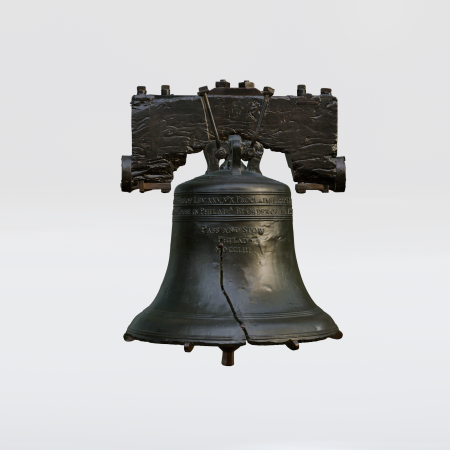 The Liberty Bell digital twin represents only the first phase of the preservation initiative.
The team plans to release immersive VR180 and stereoscopic experiences alongside the public digital model, allowing audiences around the world to explore both the Bell and the project itself. Longer-term plans include producing a full-scale 3D-printed replica for education, museum outreach and accessibility, together with a research-informed interpretation of the Bell’s historic sound.
As metrology technologies continue to evolve, projects such as this demonstrate the growing contribution that precision measurement can make beyond traditional industrial applications. Increasingly, the same technologies used to inspect aircraft components, automotive assemblies and precision manufactured parts are being employed to preserve humanity’s cultural heritage.
Ahead of this year’s Fourth of July celebrations, the Liberty Bell stands not only as a symbol of American independence, but also as an example of how advances in metrology are ensuring that irreplaceable historical artifacts can be documented, studied and shared with future generations in unprecedented detail.
For more information: var.psu.edu