The End of Programming? Natural Language Interfaces in Industrial Robotics
Researchers from Huawei Noah’s Ark Lab, the Technical University of Darmstadt, and ETH Zurich have introduced a novel framework that brings large language models (LLMs) into direct collaboration with the Robot Operating System (ROS). This development marks a significant step toward more intuitive, flexible, and intelligent robotic systems capable of understanding and executing natural language instructions in real-world environments.
From Code to Conversation
Traditionally, programming industrial robots has required structured code, predefined workflows, and highly controlled environments. While effective, this approach limits adaptability and creates barriers for non-expert users. The integration of LLMs changes this paradigm by enabling robots to interpret human instructions expressed in everyday language.
The newly developed framework acts as a bridge between high-level linguistic reasoning and low-level robotic control. LLMs process user commands – such as “pick up the red object on the table and place it in the box” – and translate them into structured task sequences. These sequences are then executed through ROS, which manages perception, planning, and actuation.
Architecture and Functionality
At its core, the framework combines three essential layers:
Language Understanding Layer: Powered by LLMs, this layer interprets intent, context, and ambiguity in human instructions.
Task Planning Layer: Converts interpreted commands into actionable steps, often involving decomposition into sub-tasks.
Execution Layer (ROS): Interfaces with sensors, actuators, and control systems to perform physical actions in the environment.
What distinguishes this framework is its ability to dynamically adapt to changing conditions. If a task cannot be completed as instructed—due to obstacles, missing objects, or environmental changes—the system can reassess and propose alternative actions, maintaining a level of autonomy previously difficult to achieve.
Implications for Metrology and Smart Manufacturing
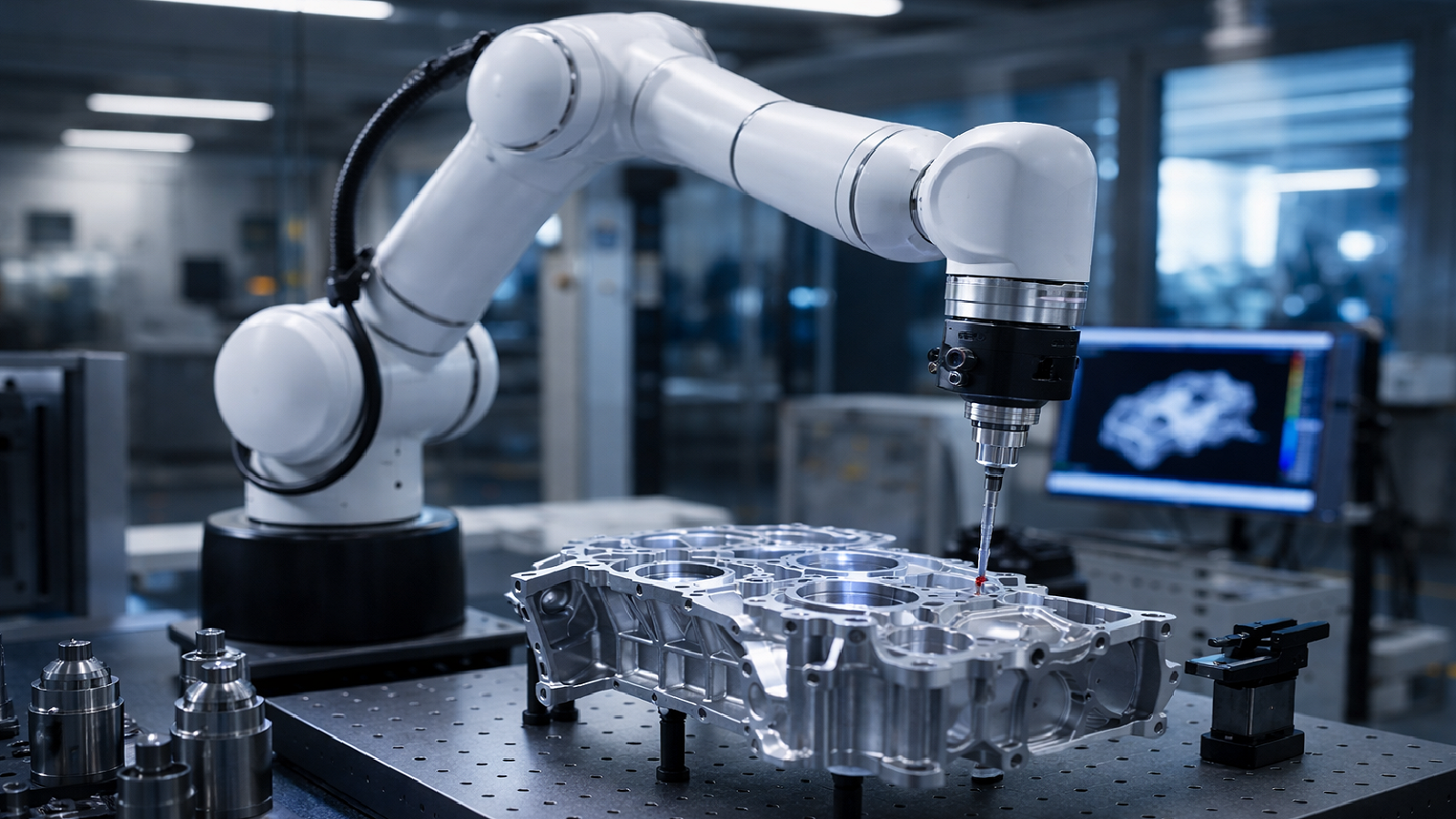
For the metrology sector, this advancement holds particular relevance. Inspection processes often involve complex sequences, multiple measurement devices, and varying part geometries. Integrating natural language interfaces into robotic systems could simplify interaction with automated inspection cells and coordinate measuring machines (CMMs).
Potential applications include:
Voice-Driven Inspection Routines: Operators could instruct systems to “measure all critical dimensions on this component and generate a report,” reducing reliance on pre-programmed routines.
Adaptive Inspection Workflows: Systems could adjust measurement strategies in real time based on part variation or environmental factors.
Training and Accessibility: Less experienced personnel could interact with advanced metrology systems without deep programming knowledge.
This aligns closely with broader trends in digital metrology, where software intelligence increasingly complements hardware precision. By embedding LLM-driven reasoning into robotic platforms, the boundary between human intent and machine execution becomes significantly thinner.
Challenges and Considerations
Despite its promise, the integration of LLMs with ROS is not without challenges:
Reliability and Safety: Natural language is inherently ambiguous. Ensuring consistent, safe execution in industrial environments remains critical.
Real-time Constraints: LLM inference must be optimized to meet the timing requirements of robotic control systems.
Validation and Traceability: In metrology applications, every action must be traceable and verifiable—something that probabilistic models like LLMs must accommodate.
Addressing these issues will be essential before widespread deployment in production environments.
A Step Toward Cognitive Robotics
This framework represents more than just a technical integration – it signals a shift toward cognitive robotics, where machines not only execute commands but also understand context, reason about tasks, and interact naturally with human operators.
For manufacturing industries reliant on precision, the ability to seamlessly translate human intent into accurate physical action could unlock new levels of efficiency, flexibility, and responsiveness.
As LLM capabilities continue to evolve and their integration with robotic systems matures, the prospect of truly intelligent, language-driven automation is moving rapidly from research to reality.