Eka Robotics Secures $150 Million to Advance Physical AI
The development of artificial intelligence for industrial robotics has received a significant boost following the announcement that US-based Eka Robotics has raised $150 million in Series A funding to accelerate its development of general-purpose robots capable of performing complex physical tasks.
The investment reportedly values Eka Robotics at approximately $1.45 billion, highlighting growing investor confidence in the emerging field of physical AI – artificial intelligence systems designed to understand, interact with and operate in the physical world.
Founded by MIT researcher Pulkit Agrawal and former Google DeepMind researcher Tuomas Haarnoja, Eka Robotics is addressing one of the longstanding challenges in industrial automation: enabling robots to perform a wide variety of tasks with the speed, accuracy and adaptability required for commercial production environments.
Moving Beyond Conventional Robot Programming
Traditional industrial robots have achieved impressive levels of speed and repeatability, but typically depend on carefully programmed movements and controlled operating environments. Changing a task, introducing different components or dealing with variations in object position can require additional programming, integration and adjustment.
Conversely, newer AI-driven robotic systems are increasingly capable of adapting to unfamiliar objects and environments, but often lack the speed and consistency needed for demanding industrial applications.
Eka believes that bridging this gap between general-purpose intelligence and production performance is essential to making the next generation of robotics commercially viable.
Its approach centres on a technology it calls Vision-Force-Action (VFA), which combines visual perception with force sensing and robotic control. Rather than relying primarily on cameras and learned visual patterns, the system also interprets the physical forces experienced by a robotic hand as it interacts with objects.
This is particularly important when handling delicate or irregularly shaped components, where visual information alone may not be sufficient to determine whether an object has been securely grasped, is slipping or is at risk of being damaged.
By combining visual information with force feedback, Eka aims to give robots a more sophisticated understanding of physical interactions.
Learning Through Simulation and Reinforcement Learning
A key element of Eka’s development strategy is the use of large-scale simulation and reinforcement learning.
Rather than depending exclusively on demonstrations of humans performing tasks, the company trains its robotic systems within simulated environments, allowing them to experience thousands of hours of virtual operations in a relatively short period.
The simulations introduce variations in objects, positioning, environmental conditions and physical interactions. Through reinforcement learning, the robot develops strategies for completing tasks, learning from successful and unsuccessful attempts.
The resulting intelligence is then transferred to physical robotic systems.
This approach is intended to overcome one of the major limitations of AI-driven robotics: the difficulty of collecting sufficient real-world data to train systems for the enormous variety of physical situations encountered in manufacturing.
Eka acknowledges that transferring skills developed in simulation into real-world applications remains a significant technical challenge, particularly for tasks involving physical contact, where small differences in friction, material properties and positioning can influence the outcome. However, the company believes its approach is demonstrating that this simulation-to-reality gap can be significantly reduced.
Performance Beyond Human Benchmarks
Eka reports that its robotic systems can currently perform approximately 1,500 picking operations per hour, compared with a human benchmark of around 600 operations per hour.
Importantly, the company says its robots can handle a wide variety of objects that were not included in their original training data, suggesting that the underlying AI model is capable of adapting to unfamiliar situations.
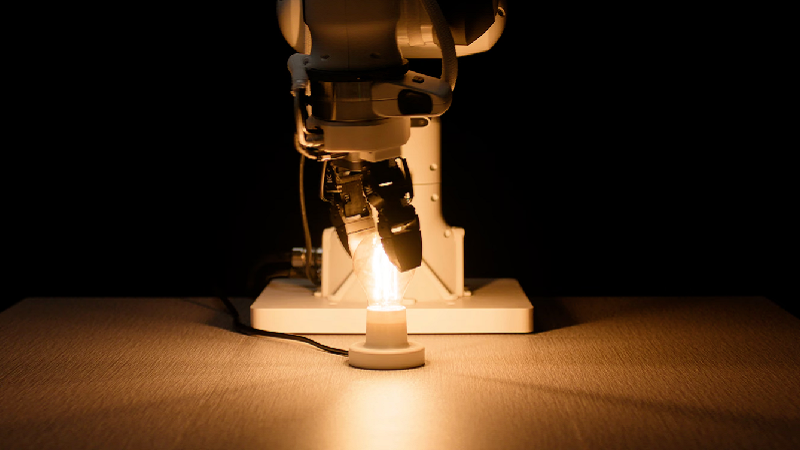
Demonstrated tasks include picking and handling objects, inserting wires and screwing a light bulb into a socket.
According to reporting by TechCrunch, the company has also demonstrated picking success rates exceeding 95 per cent, handling objects weighing up to one kilogram.
The robotic gripper itself incorporates additional force-sensing capabilities and has been designed to provide greater flexibility than conventional rigid gripping systems. Eka reports that its current gripper is rated for five million operating cycles, with a longer-term target of 20 million cycles to meet the durability expectations of industrial applications.
Implications for Intelligent Manufacturing
The potential implications extend well beyond conventional pick-and-place automation.
Manufacturing operations involving component assembly, cable insertion, handling of delicate materials and the manipulation of irregularly shaped parts could benefit from robotic systems capable of adapting to variations without requiring extensive reprogramming.
For metrology and quality control, the wider development of physical AI is also significant. As robotic systems become increasingly capable of interpreting both visual information and physical interactions, there is potential for closer integration between automated handling, inspection and manufacturing processes.
Combining intelligent robotic manipulation with machine vision and dimensional measurement technologies could ultimately enable more adaptive production environments, in which robots not only handle components but also respond to information about their condition, position and conformity.
However, Eka’s current focus is on dexterous manipulation rather than dimensional metrology or automated inspection. The significance for manufacturing measurement lies in the wider direction of travel towards more intelligent and adaptable production systems.
From Lab Demonstrations to Industrial Deployment
Despite the impressive performance figures, Eka recognises that demonstrating robotic capabilities in controlled environments is only the first step towards widespread industrial adoption.
Production applications demand sustained reliability, consistent cycle times and the ability to operate for extended periods without intervention. Robotic systems must also integrate with existing manufacturing equipment and production workflows.
The company is currently working with industrial customers on pilot applications involving pick-and-place operations and wire manipulation. Its latest funding will support expansion into additional tasks, further development of its VFA model and acceleration of commercial deployments.
With a team drawing on research and engineering experience from organisations including MIT, Berkeley, DeepMind and Boston Dynamics, Eka is positioning itself at the forefront of a rapidly developing area of robotics.
The $150 million investment represents a substantial commitment to the belief that the next generation of industrial automation will be defined not simply by robots that can repeat programmed movements, but by machines capable of understanding and responding to the physical world around them.
For manufacturing, the longer-term objective is a new generation of robotic systems combining the speed and repeatability of industrial automation with a level of adaptability traditionally associated with human operators.
For more information: www.ekarobotics.com