Rise of Intelligent Inspection & Predictive Excellence
 Metrology News recently sat down with Robert Wasilesky, President at Kitov AI North America to discuss how artificial intelligence is rapidly reshaping industrial quality control. What was once a futuristic concept is now becoming central to factory operations, enabling real-time data interpretation, automated inspection planning, and increasingly predictive quality systems. As AI begins to influence everything from sensor design to closed-loop manufacturing, we asked Robert Wasilesky to share his perspective on why this shift is accelerating now and what it means for the future of metrology.
Q: Let’s talk specifically about dimensional inspection. Metrology is traditionally a highly deterministic environment. How is AI influencing it?
A: Metrology is necessary to quantify defects, but the real problem is spotting them in the first place, that’s where AI is invaluable. AI does a wonderful job at noticing the slightest change in dimension or surface quality. Then bring AI to the game of quantification and you have a new kind of adaptive metrology. Where inspection planning used to involve manually programmed routines, AI can now analyze CAD models and propose optimal strategies in minutes. It identifies areas that are statistically prone to defect and drift then suggests measurement strategies that match actual process risk.
AI also digs into historical inspection results, comparing them with machine and environmental conditions. It uncovers patterns – perhaps a specific feature begins to deviate when a spindle reaches a particular wear stage, or a datum consistently shifts under thermal load. These correlations would be difficult for humans to detect at scale.
Most importantly, AI doesn’t treat dimensional deviations as isolated outcomes. It tries to understand their origins by correlating measurement data with process parameters. This turns dimensional inspection into a predictive quality tool rather than an after-the-fact verification activity.
Q: Inline quality inspection is another area evolving rapidly. Has AI finally unlocked reliable inline quality control?
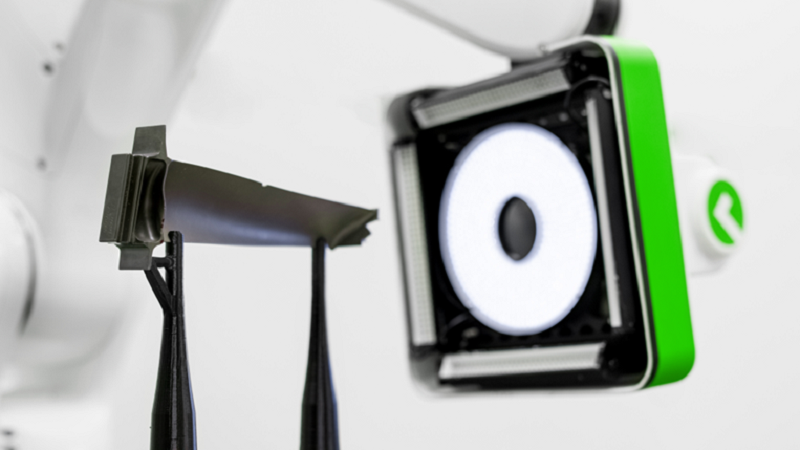
A: Yes, AI is the breakthrough inline and at-line systems have been waiting for. Early inline inspection struggled with inconsistent lighting, reflective surfaces, and the complexity of real industrial environments. AI-based vision systems handle these variations gracefully easily finding the proper pose, lighting intensity and lighting angle (dark field illumination vs the standard bright field illumination) to find defects and dimensional flaws. They can detect extremely subtle defects and adapt to changes in angle, reflection, or surface texture.
Inline 3D inspection has also advanced significantly. AI-enhanced scanners can process high-density point clouds at production-line speeds, enabling true real-time geometry checks. The predictive element is where things get exciting. AI links what sensors see with how processes behave. A slight thermal anomaly in a weld seam, a faint acoustic deviation from a stamping press—AI can interpret these as early warnings of future defects. Inline inspection becomes not just fast, but preventive. Choosing the right sensor is paramount and Kitov AI can interface any sensor into the inspection and measurement system.
Q: Some people worry that AI will replace metrologists or quality engineers. What’s your view?
A: AI will not replace them; it will enhance and elevate them. Most measurement is a statistical process covering problem areas only and a very small percentage of the part or of the population of parts. And all these tasks that consume time – inspection programming, first-level defect classification, sorting through large volumes of data – are perfect for AI. But engineering judgment, root cause analysis, regulatory interpretation, and strategic decision-making remain fundamentally human.
AI acts as a force multiplier. Quality professionals will spend less time on repetitive tasks and more time solving problems, improving processes, and shaping the future of manufacturing systems. Instead of checking products, they will be designing intelligent processes. Guaranteeing defects never make it to the customer and rework is at a minimum. This saves money and reputation. Also reduces overall cost of warranty while having the opportunity to extend warranties beyond the typical year of service.
Q: Closed-loop manufacturing has long been an aspiration. How does AI help manufacturers achieve it?
A: AI enables closed-loop control to become truly intelligent. Traditional closed-loop systems are deterministic: if a measurement is out of tolerance, adjust an offset. But these systems don’t understand why variation occurs.
AI does. It considers tool wear evolution, machine temperature cycles, vibration patterns, and multi-sensor data to understand the full context. Instead of merely correcting errors, AI predicts when they will occur and adjusts upstream parameters to prevent them.
Picture a machining center that tunes itself autonomously because AI anticipates wear-related drift, or a molding press that adjusts cooling times because AI foresees warpage. That’s the future of closed-loop control, and AI is what makes it achievable!
Q: Data management and the digital thread are becoming crucial themes. What role does AI play here?
A: AI is becoming the interpreter, validator, and accelerator of the digital thread. Manufacturing data comes in countless formats and from diverse systems. AI can harmonize these streams, making connections that humans would struggle to assemble manually.
It also distills massive data sets into actionable insights – patterns of deviation, correlations between machine behavior and quality, early indicators of drift.
AI is exceptional at identifying inconsistencies as well. It recognizes when sensors drift, when timestamps misalign, or when calibration offsets are incorrect. On top of that, AI captures institutional expertise. When experienced engineers retire, their knowledge often goes with them. AI can learn from their past decisions and preserve this intelligence for future operations.
High value parts can have a digital twin with all relative changes, rework and measurement following the part for it’s extended lifetime. This can be 50 years with some aerospace parts.
Q: Which industries will see the most dramatic impact from AI-enabled quality control?
A: Aerospace, Medical, semiconductor and Automotive will lead the way due to volume and speed pressures. Battery manufacturing, welding verification, semiconductor fab, polishing (for optics and medical) and PCB inspection are already experiencing major AI-driven breakthroughs.
Aerospace is adopting AI carefully but quicker than you would imagine because the benefits out way the risk like in AI-assisted conformity assessments and advanced composite inspection. Medical device manufacturing will see huge value in traceable, AI-assisted documentation and inspection. Heavy industries will rely on AI for predictive casting analysis, advanced welding quality, and adaptive machining of large parts.
Q: AI isn’t perfect. What limitations or risks should manufacturers keep in mind?
A: Data quality remains the biggest dependency. Poorly calibrated sensors will lead to poor AI guidance. Explainability is another challenge; some AI systems don’t offer transparent reasoning, which is essential in regulated industries. Early training data can bias AI models if the process is unstable, and organizational adoption requires thoughtful change management. AI not only controls the process, but self-monitors the instruments and sensors used to control the process. This is absolutly brilliant, human operators do not have incentive to find their own errors, AI does!
The best approach is hybrid decision-making – AI provides the analysis, but human experts remain the gatekeepers for critical decisions. That balance delivers both speed and reliability.
Q: Looking ahead to 2035, what do you expect industrial quality control to look like?
A: By 2035, many factories will function as self-monitoring ecosystems. Equipment will inspect itself, inline sensing will be fundamental, and closed-loop control will be embedded in most production systems. CMMs will operate as autonomous, intelligent metrology platforms. Digital twins will update continuously using live sensor and inspection data.
Quality engineers will evolve into process intelligence leaders, steering strategy while AI manages scale and speed. It will be a transformation comparable to the shift from manual machining to CNC.
Q: One final question. If you had to summarize AI’s impact on industrial quality control in a single sentence, what would it be?
A: AI turns product quality from a statistical uncertainty to an absolute, no more gambling on customer quality because it’s guaranteed.
For more information: www.kitov.ai