





Latest Metrology News View All Posts

Featured Stories View All Posts



General Announcements View All Posts

Sponsored Video

API Integrated Laser Tracker iLT
API has launched its 6th generation Laser Tracker: the Integrated Laser Tracker (iLT). iLT represents the pinnacle of Laser Tracker technology refinement, engineered to be the most portable, user-friendly Laser Tracker ever designed and featuring several improvements over the previous generation. iLT is the smallest Laser Tracker ever made, as robust as the Radian Laser Tracker, and available at the lowest price API has ever offered.
Editors Choice View All Posts
Coordinate Measuring Machines View All Posts

Smart Manufacturing View All Posts


Automated Robotic Metrology View All Posts


Sponsored Video
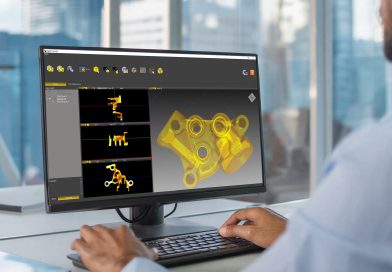
Verisurf 2026 Precision Meets Innovation
Built on a legacy of innovation and customer-focused development, Verisurf 2026 introduces new features and workflow improvements designed to help manufacturers reduce costs, save time, and enhance repeatable process control across all stages of digital manufacturing.
Portable Metrology View All Posts


Optical & Video Metrology View All Posts
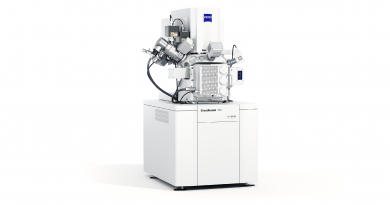
ZEISS Gemini 4 Electron Optics offer Superior Resolution and Signal-to-Noise Ratio
ZEISS has unveiled the new ZEISS Crossbeam 750 focused ion beam-scanning electron microscope (FIB-SEM) that is optimized for demanding sample preparation. It provides a live, high-resolution “see while you mill” view at any imaging and milling condition to enable immediate feedback and eliminate milling interruptions for uniform first-pass transmission electron microscopy (TEM) lamellae and precise FIB cross sections.


Computed Tomography View All Posts
Software View All Posts
Nikon Boosts Throughput and Automation with Next-Generation NEXIV Software
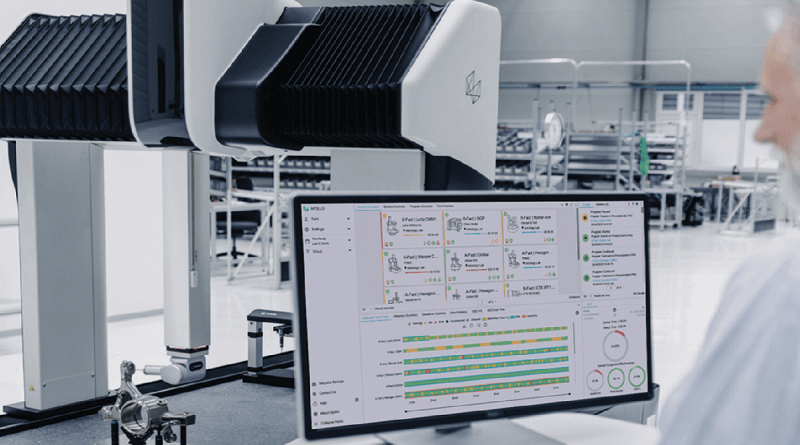
Nikon Corporation has announced major advancements across its NEXIV software lineup with the release of the newest versions of AutoMeasure and Advanced Measure, designed to significantly simplify program creation, automate operator tasks, and accelerate high‑volume measurement workflows.


Sensors View All Posts
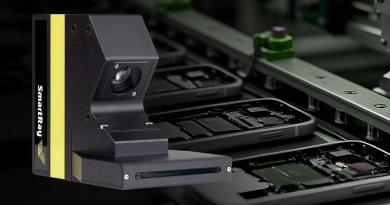
SmartRay Expands ECCO X Range with 3D Sensor for Reflective and Glass Surfaces
The ECCO X 050G incorporates SmartRay’s G-series glass-scanning designation, bringing the full benefits of fast, high-resolution, high-precision automated optical inspection and superior 3D data quality to an even wider range of processes.

Machine Vision View All Posts
Artificial Intelligence View All Posts
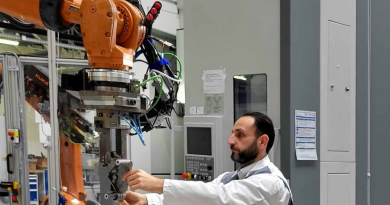
From Sensors to Smarts: Fraunhofer’s AI-Driven Approach to Human–Robot Teamwork
How can we achieve intelligent teamwork between humans and robots in production? The Fraunhofer NeurOSmart technology platform combines sensor technology with AI-supported data processing and energy-efficient chips that mimic the way the human brain works.



Additive Manufacturing View All Posts

Application Stories View All Posts
Precision Measurement at the Heart of Advanced Optoelectronics
Crytur specializes in the design, production, and delivery of integrated optoelectronic and optomechanical assemblies. The foundation of these products lies in synthetic crystals, which Crytur produces in-house. Because the company’s products demand exceptional dimensional and shape accuracy, Crytur relies on high-end measuring machines and gauges from Mitutoyo to ensure every component meets stringent specifications.
Fluorescence-Based Metrology Drives Condition-Based Cleaning
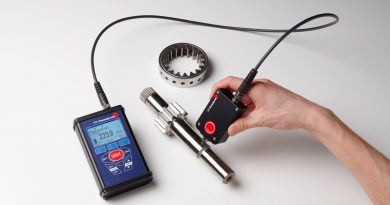
Working with Dyne Testing, Burnside trialed the SITA Cleanospector. The device utilizes UV fluorescence spectroscopy to detect residual organic contaminants. By illuminating metal surfaces with UV light, the sensor measures the intensity of the resulting fluorescence from oils, greases, and cooling lubricants.
Comprehensive Reverse Engineering and Metallurgy Services Meet Aerospace Challenges
When a leading FAA-certified repair station faced the challenge of replicating critical components without original design documentation, it turned to NVision, Inc. NVision provides complete reverse engineering, encompassing 3D scanning, 3D CAD modeling, 2D drawings, and materials analysis.
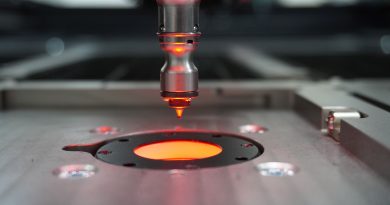
Optical Vision Systems Transform Microchip Handling Accuracy
In the high-precision world of the semiconductor industry, every micrometer counts. To ensure the exact, contactless positioning of even the smallest components, esmo AG, a leading provider of special machine engineering, automation technology, and semiconductor handling, relies on optical inspection technology from senswork in its Talos system series.

High-Speed Medical Device Assembly Meets Real-Time Metrology
Combining advanced sensor technology from Kistler with a patented digital motion system from ATS LSS, Symphoni platform delivers real-time in-line quality assurance for medical devices, up to 320 parts per minute with 90 percent less tooling and full traceability.
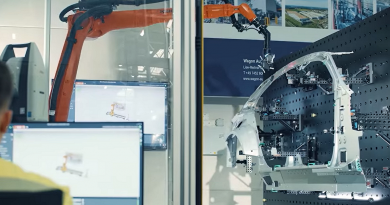
Wagon Automotive Implements Inline Metrology Cell for Complex Chassis Components
Wagon Automotive’s production environment involves highly complex parts with varied geometries that must be inspected with tight tolerances. Ensuring consistent measurement accuracy while maintaining production speed presented a significant challenge.
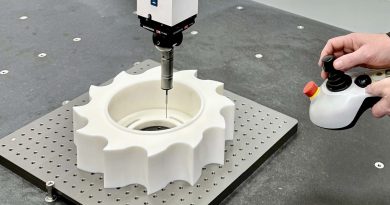
ActionPlas Invests in Advanced CMM to Meet Demanding F1 Tolerances
Design and contract manufacturing firm ActionPlas Group, specialising in machining and fabricating plastic, metal components and assemblies for a wide variety of industries including automotive, food and drink, pharmaceutical and power generation, has upgraded its quality control department with the purchase of an Altera M 20.12.10 coordinate measuring machine (CMM) from LK Metrology.
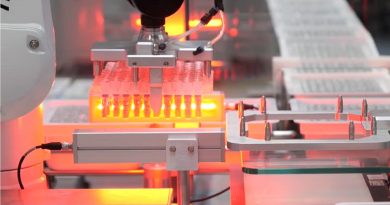
Automated Inspection and Packaging of 36,000 Syringes per Hour
In pharmaceutical manufacturing, the integrity of the final product depends not only on how it is produced but also on how it is inspected, labelled and packaged. At high production volumes, these end-of-line processes must deliver both speed and absolute reliability while meeting stringent regulatory standards.
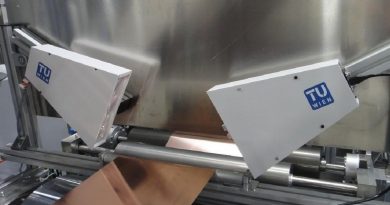
Inline Imaging-Ellipsometer Resets Speed Barrier for Thin-Film Quality Control in Roll-to-Roll Manufacturing
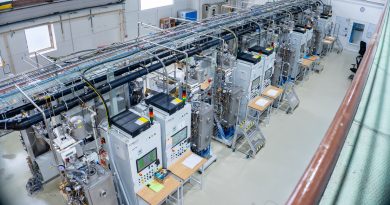
Researchers at TU Wien University have unveiled an inline imaging-ellipsometer purpose-built for roll-to-roll (R2R) production, with an Allied Vision EXO250ZU3 polarized camera at its core. The system delivers real-time, full-area optical thickness measurement of functional coatings directly on moving foils, eliminating the sampling delays and blind spots that have long plagued R2R quality assurance.
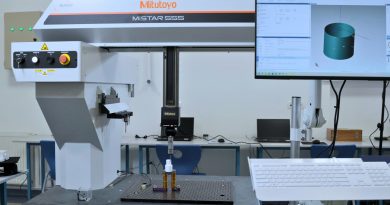
UBB Reșița Elevates Metrology Training with Cutting-Edge Mitutoyo CMM
The Mitutoyo MiSTAR 555 is a 3D CNC CMM designed for precision, reliability, and durability – essential for frequent student use. Equipped with real-time temperature compensation technology, it maintains accuracy across a wide range of environmental conditions.
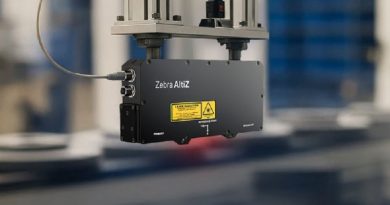
AI-Enhanced 3D Profilometry Delivers Eightfold Measurement Precision in Lumber Inspection
Zebra Technologies, a leader in digitizing and automating workflows to deliver intelligent operations, has announced that EBI Electric, an innovative wood scanning solutions provider, is using Zebra’s AltiZ 3D sensors to power its new AI-enriched lumber scanning solution, Inspector T.
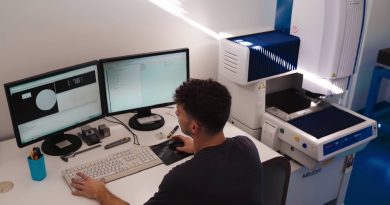
Multisensor Metrology Automating Micron-Level Inspection in Micro Waterjet Cutting
WatAJet, an Italian excellence in micro waterjet cutting, has transformed an academia-developed technology into a unique production process. Thanks to Mitutoyo’s Quick Vision Apex, the company has revolutionised its quality control, taking precision, automation and reliability to the next level.
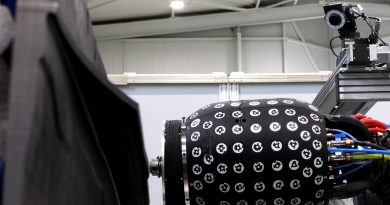
High-Precision Robotics Gains Ground in Aero-Structure Manufacturing
Composite aero-structures, primarily based on carbon fibre and epoxy resins, are essential in today’s aerospace to reduce weight, increase strength, and improve fuel efficiency. Their use in fuselages, wings, and stabilizers provides longer service life and greater corrosion resistance compared to conventional metals.
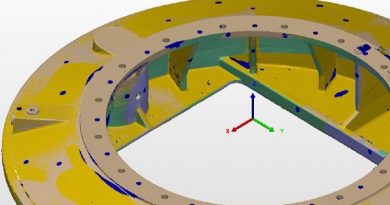
Large-Scale 3D Metrology Enables Reconstruction of Critical Agitation Component
By integrating portable 3D scanning technology with robust inspection workflows and CAD reconstruction, Buffalo Metrology delivered a comprehensive reverse engineering solution – transforming a fractured clarifier cover into a fully engineered pathway toward new fabrication.