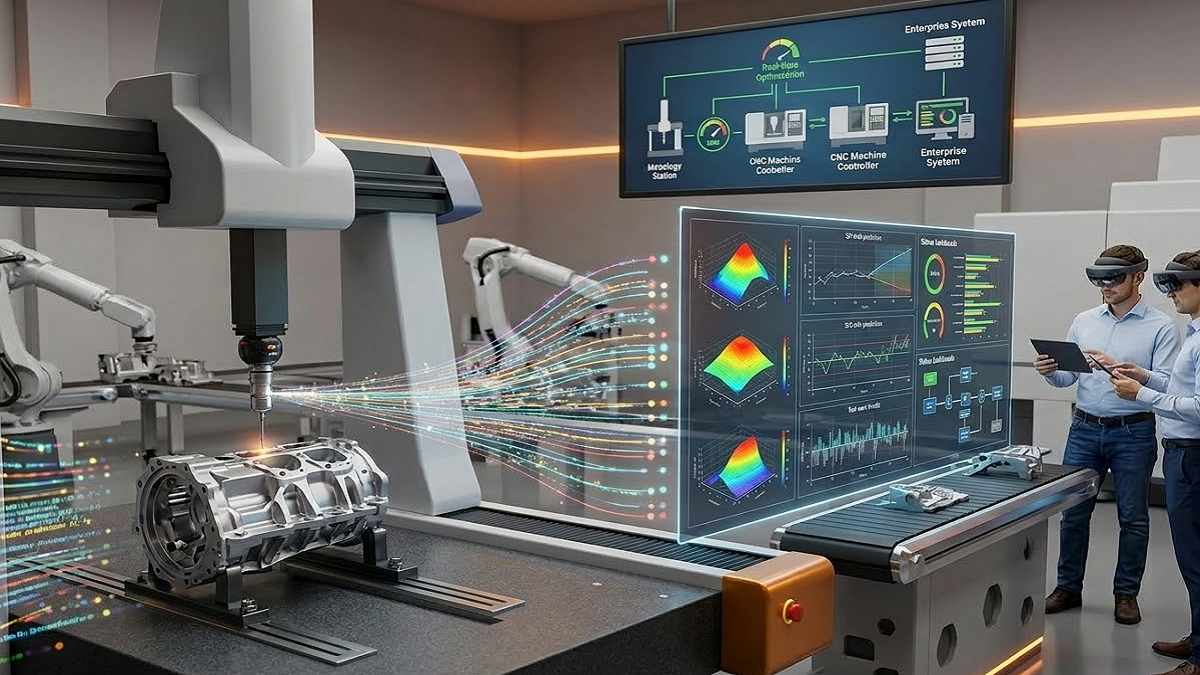
Turning Measurement Data into Real-Time Production Intelligence
For decades, manufacturing has generated enormous volumes of data, yet much of it has lived a quiet life in databases, reports, and archived quality records. Measurement results were stored for traceability. Machines logged process parameters. ERP and MES platforms tracked orders and output. But these streams rarely converged in a way that allowed production to adapt in real time.
That paradigm is shifting. Manufacturers are no longer satisfied with collecting data; they are working to operationalize it. The move toward data-driven manufacturing represents a structural change in how production systems are controlled, optimized, and continuously improved. At the heart of this evolution is metrology.
This transition is not about increasing data volume. It is about closing the loop between measurement, process control, and day-to-day production decisions.
From Measurement Records to Manufacturing Intelligence
Dimensional inspection has traditionally functioned as a verification step. Parts were measured to confirm conformance, and results were used primarily for audits, certification, and customer assurance. While essential, this approach positioned metrology downstream, as a checkpoint that validated outcomes rather than influenced them.
In data-driven manufacturing, measurement data takes on a fundamentally different role. It becomes a real-time indicator of process health, a source of predictive insight, a trigger for automated adjustments, and a foundation for digital simulation environments. Instead of simply determining whether a part meets tolerance, manufacturers increasingly use dimensional results to understand what the data reveals about tool wear, machine drift, thermal behavior, fixture stability, and process variation.
Dimensional data effectively becomes an early-warning system, often identifying instability long before scrap rates increase or machine alarms are triggered.
The Convergence of Metrology and Production Systems
Rolling out data-driven manufacturing requires dissolving the historical boundaries between quality systems and production systems. Advanced implementations link inline and nearline metrology with Manufacturing Execution System (MES) platforms, scheduling systems, SPC environments, machine tool controllers, and digital twin frameworks. The result is a production ecosystem in which measurement outcomes influence operations in the moment rather than hours or days later.
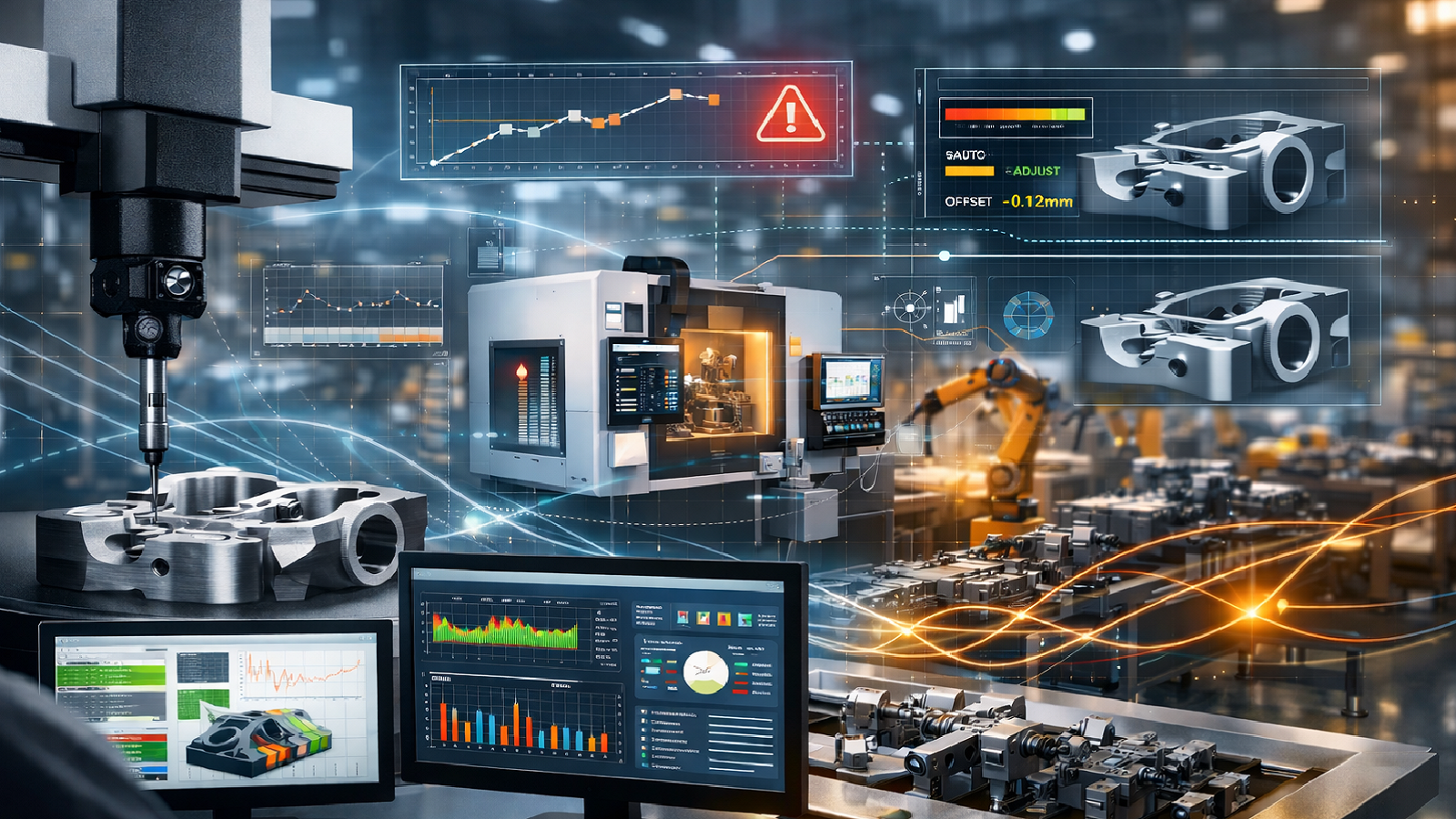
In such environments, measured deviations can drive automatic tool offset adjustments in CNC machines. Real-time statistical monitoring can prompt intervention before trends evolve into defects. Patterns in dimensional drift can guide tool life management, and fixture stability metrics can signal when correction or requalification is needed. The inspection cell ceases to be an endpoint; it becomes a sensing node within a cyber-physical production network.
The Backbone of Data-Driven Manufacturing
Technology itself is rarely the primary obstacle. The real challenge lies in building the infrastructure and architecture required to support continuous data use.
Data standardization is foundational. Measurement information must be structured and consistent, with unified naming conventions, traceable measurement strategies, stable coordinate systems, and harmonized reporting formats. Without this discipline, advanced analytics only magnify inconsistency.
Connectivity is equally critical. Data must move automatically from CMMs, scanners, vision systems, sensors, inline stations, and portable devices into broader manufacturing systems. Manual transfers and spreadsheet-based workflows break the real-time chain that data-driven manufacturing depends on.
Raw dimensional values also need context. Measurements gain meaning when linked to machine identity, tool condition, operator or shift, environmental factors, and material batches. Context transforms isolated numbers into actionable intelligence.
Finally, scalable analytics capabilities are required. Static SPC charts are no longer sufficient on their own. Manufacturers increasingly rely on multivariate analysis, drift modeling, trend prediction, and AI-assisted anomaly detection. The objective is not simply to visualize data but to support decisions and, in some cases, automate them.
Organizational Shift – From Inspection Department to Data Partner
The rollout of data-driven manufacturing is as much cultural as technical. Metrology organizations are evolving from inspection service providers into process intelligence partners. Their work becomes tightly linked to production engineering, with shared performance indicators focused on throughput, scrap reduction, and process capability.
Metrology teams are also engaged earlier in product and process design, where measurement strategies influence manufacturability and control concepts. Skills in data analysis, digital systems, and cross-functional collaboration increasingly complement traditional expertise in measurement science. Quality data becomes part of the operational language of manufacturing rather than a separate discipline consulted after problems arise.
Despite the scale of the vision, most successful journeys begin with targeted, high-impact initiatives rather than sweeping plant-wide transformations. Closed-loop machining applications are common early steps, where CMM or in-process probing data feeds automatic tool offset corrections. Other projects focus on monitoring high-value features that correlate strongly with product performance or scrap risk. Historical dimensional data is often used to model predictable process drift, such as thermal effects or tool wear, enabling earlier and more controlled intervention.
Inline inspection cells are frequently introduced at process bottlenecks or in operations known for high variation. These focused efforts generate measurable gains, build organizational confidence, and help define the architecture needed for broader deployment.
The Role of Digital Twins
As digital twin technologies mature, metrology data assumes an even more strategic function. Measurement results validate simulation accuracy, refine process models, and help adjust tolerance strategies. They support virtual commissioning and ensure that the virtual representation of production remains aligned with physical reality.
In this context, metrology is not reactive. It becomes an essential layer in a predictive production ecosystem where models and machines evolve together.
Evidence-Based Control
Manufacturers that successfully roll out data-driven approaches report tangible operational benefits. Scrap and rework decline as instability is detected earlier. Root-cause analysis accelerates because richer data provides clearer signals. Production ramp-up times shorten, and process capability improves. These gains also increase confidence in lights-out and highly automated production environments.
Perhaps the most significant shift, however, is in decision-making. Instead of relying heavily on intuition or reactive troubleshooting, organizations move toward evidence-based control, where data continuously informs action.
The Strategic Reality
Data-driven manufacturing is not a single software deployment or an isolated metrology upgrade. It is an operational strategy that demands system integration, process redefinition, data governance, and cross-functional alignment.
Metrology delivers one of the most precise and information-rich data streams in manufacturing. The competitive advantage emerges when that data is no longer archived for reports but activated to guide machines, inform engineers, and steer production in real time.
In the factories of the future, inspection results will not wait at the end of a workflow. They will shape the workflow itself. That is what it truly means to roll out data-driven manufacturing.
Author: Guest writer William Jones II