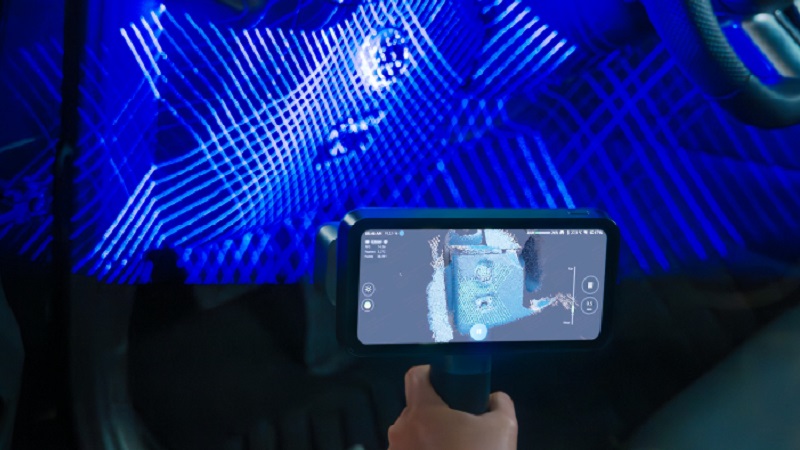
SHINING 3D Introduces EinScan Rigil Lite Expanding All-in-One Scanning Portfolio
With more than two decades of experience in high-precision 3D scanning, SHINING 3D has introduced the EinScan Rigil Lite, further strengthening its all-in-one scanning portfolio for professional users. The latest addition to the Rigil Series combines performance, flexibility, and accessibility in a compact, integrated platform.
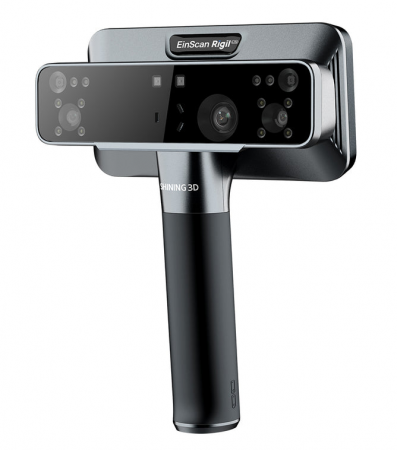 Rigil Lite incorporates a hybrid light-source architecture, including 17+17 crossed blue laser lines, 7 parallel blue laser lines, and infrared VCSEL technology. This configuration enables reliable capture of challenging surfaces, such as reflective metals and dark plastics, across a range of lighting environments. With a resolution of up to 0.05 mm, the system is designed to support applications spanning small, intricate components to larger-scale objects.
Building on All-in-One Concept
The Rigil Lite builds on the foundation established by the original EinScan Rigil, introduced in 2025 as the first Tri-Mode all-in-one 3D scanner. The Rigil Series reflects SHINING 3D’s vision of a fully integrated system, combining scanning hardware, onboard computing, display, storage, and power supply within a single device.
This architecture enables both standalone operation and wired or wireless PC connectivity. Integrated software allows users to complete the full workflow—from data acquisition to processing and export—directly on the device, reducing system complexity while maintaining high-performance output.
Following continued development, the platform was enhanced with V1.2 firmware and recently released software updates, delivering improvements in tracking stability, workflow efficiency, and overall system responsiveness. Within this evolving ecosystem, Rigil Lite provides a more cost-effective option while retaining the core capabilities of the series.
Adaptive Scanning with Hybrid Light Sources
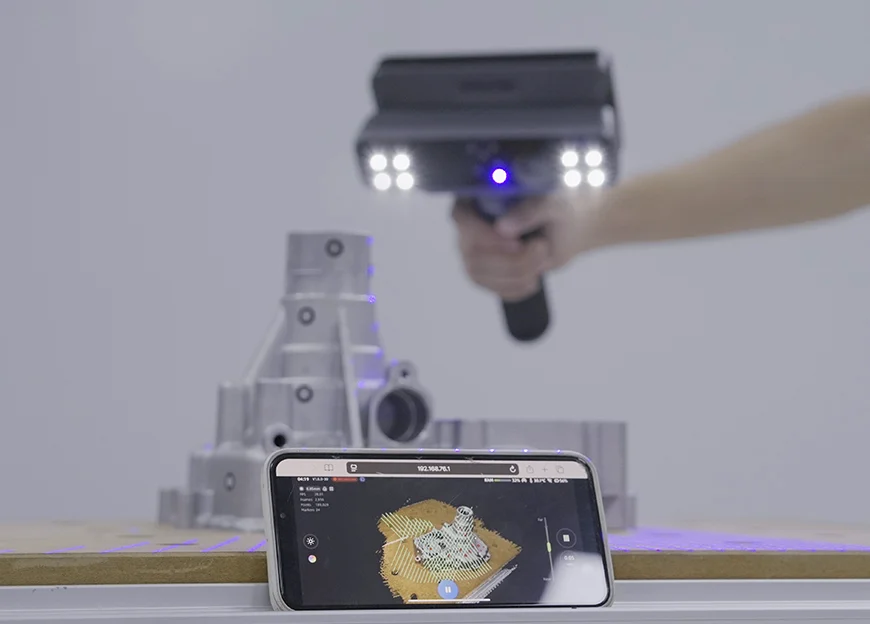 Rigil Lite integrates multiple scanning modes to address diverse measurement requirements. The crossed laser lines enable high-speed data acquisition, while parallel lines enhance fine-detail capture and edge definition. Dual-laser switching allows users to balance speed and resolution depending on the task.
The addition of near-infrared VCSEL technology supports rapid scanning of larger objects in both indoor and outdoor environments, while also enabling safe and efficient human scanning applications.
A notable feature is marker-free laser scanning, which allows feature-rich objects to be captured without extensive target placement. This reduces preparation time and simplifies operation, particularly for new users, while maintaining reliable results.
Multi-Tracking Technology for Improved Efficiency
To enhance scanning continuity, Rigil Lite employs hybrid alignment technology that combines geometric features, markers, and texture data. This multi-tracking approach improves robustness under varying conditions and enables smoother transitions between scanning modes, contributing to higher overall efficiency.
Integrated Hardware for Mobile Performance
Maintaining the hardware philosophy of the Rigil Series, Rigil Lite is designed as a fully self-contained system. It operates without the need for an external PC, supported by 24 GB of onboard processing power and Wi-Fi 6 connectivity for wireless workflows.
The system includes 512 GB of storage alongside 64 GB eMMC memory, enabling users to manage complete project datasets directly on the device. A 6.4-inch touchscreen provides intuitive control and real-time visual feedback, while replaceable batteries support continuous mobile operation.
Its ergonomic, monolithic design is engineered for stability and reliability during extended single-hand use, supporting field and on-site applications.
Software Ecosystem Supporting End-to-End Workflows
Rigil Lite is supported by an integrated software suite enabling a complete workflow: scan, process, and export.
The dedicated PC software, EXScan Rigil, offers expanded functionality through a unified interface designed to streamline operations and reduce system load. This contributes to faster processing, improved mobility, and lower operating costs.
For reverse engineering applications, EXModel provides a comprehensive toolset for converting mesh data into CAD-ready solid models, enabling efficient transition from scanning to manufacturing.
Ensuring Accuracy Through Standards and Verification
In an increasingly competitive 3D scanning market, accuracy claims can vary significantly. SHINING 3D emphasizes traceability and verification through adherence to established international standards, including VDI/VDE 2634 and ISO 10360-13.
Calibration and testing are conducted in controlled environments with stable temperature and humidity, minimizing variability. Reference artifacts used for accuracy validation are certified using high-precision coordinate measuring machines (CMMs) and are regularly recalibrated by accredited laboratories.
Each EinScan Rigil unit undergoes a rigorous two-stage testing process, including production-line validation and final quality inspection. For professional-grade systems, accuracy is verified through repeated measurements using a 1000 mm sphere rod, with the maximum deviation, rather than the average, reported as the final accuracy value. This approach ensures performance consistency under real-world conditions.
Expanding Access to Professional 3D Scanning
With the introduction of Rigil Lite, SHINING 3D broadens access to its all-in-one scanning technology, offering a lighter and more cost-effective solution without compromising core performance.
Leveraging its integrated design, robust accuracy framework, and continued software development, the Rigil Series demonstrates the growing maturity of standalone 3D scanning systems. The addition of Rigil Lite further positions SHINING 3D in the professional segment, supporting applications across engineering, manufacturing, digital content creation, and research.
For more information: www.einstar.com