Robot-Assisted 3D Laser Scanning Redefines Inline Quality Inspection
Traditional, human-dependent measurement methods are increasingly reaching their limits in high-speed, high-precision production environments. In response, AT Sensors, in collaboration with LASS Technology and EVT Eye Vision Technology, has enabled fully automated, 100% inline inspection of industrial components – delivering stable, operator-independent measurement results directly on the production line. The key advantage: reproducible, human-independent measurements that maintain accuracy under any production condition.
Robotics Meets 3D Sensor Technology
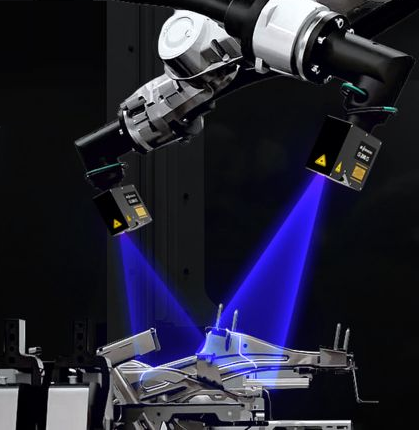 With 0.05 mm accuracy, 43 kHz profile speed, and fully automated inline inspection, robot-assisted 3D scanning has set a new benchmark in industrial quality control. As production lines accelerate while demanding ever-higher precision, reliance on manual measurement or ‘gut feeling’ is no longer sufficient. Across industries, from automotive to aerospace and defense, manufacturers increasingly require measurement results that are reproducible, real-time, and impervious to operator variability or environmental factors. This shift has made robot-assisted, fully automated inline measurement systems a strategic necessity.
The Evolution of Inline Inspection
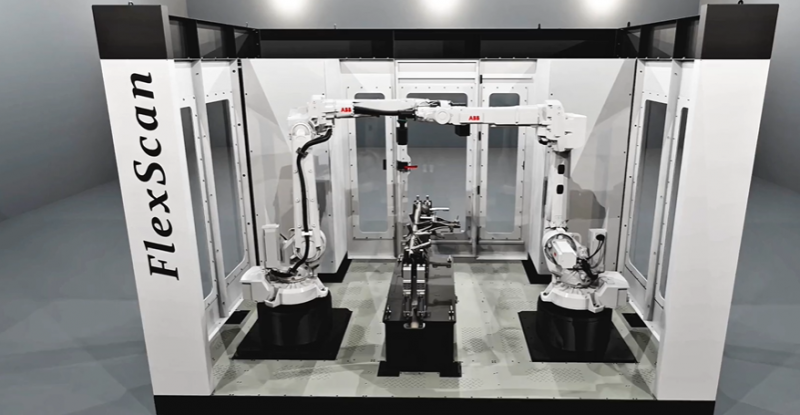
Responding to these market demands, LASS Technology developed the FlexScan system. Originally focused on dimensional measurement, FlexScan has evolved into a fully integrated solution capable of geometry inspection, weld seam analysis, and optical component evaluation directly on the production line. Its standout feature is the combination of multiple inspection tasks in a single, fully automated process—operating continuously without human intervention.
“Our goal was to create a measurement system that works independently of humans and still delivers the highest accuracy even under harsh production conditions,” says Hüseyin Bozan, CTO of LASS Technology. “FlexScan is our answer to the need for true 100% inspection in mass production lines.”
The result is a customizable, robot-assisted 3D laser scanning system capable of inspecting individual components or complete car bodies quickly, reliably, and in a fully validatable manner inline.
A Collaborative Technology Trio
The development of FlexScan relied on the complementary expertise of three industry leaders: LASS Technology for system integration, AT Sensors for high-precision 3D sensors, and EVT Eye Vision Technology for flexible, high-performance image processing software. Together, they created a seamless system that bridges robotics, sensor technology, and data analysis.
Overcoming Variability and Ensuring Reliability
One of the major challenges in developing FlexScan was managing the enormous variety of component geometries, inspection tasks, and individual customer requirements. The system had to be flexible enough to accommodate this diversity while remaining robust and reliable over long-term operation.
“A fully automated system must function reliably in every situation—without downtime, without readjustment, without room for interpretation,” explains Bozan. Three years of prototyping, one year of application optimization, and over eight years of continuous development underscore the team’s commitment to stable, repeatable performance.
High-Precision Sensors from AT Sensors
 FlexScan leverages two compact 3D sensors from AT Sensors’ 2040 line. The 2040CS, with a 63 mm field of view, offers 31 µm resolution in X and 0.9 µm in Z, paired with a 43 kHz profile speed and a blue laser for fast, clear inline measurements of geometry and weld seams. For larger components and multi-sensor calibration, the 2040CS with a 100 mm field of view provides 49 µm X and 3 µm Z resolution.
“The image quality of the sensors is decisive,” notes Dr.-Ing. Athinodoros Klipfel, Head of Sales at AT Sensors. “Low-noise, stable signals are essential for reducing measurement uncertainties in complex robot-assisted applications and achieving reproducible results.”
Bozan adds, “The better the raw signal, the more stable and efficient the evaluation software can work. High-quality profiles significantly reduce our development effort.”
User-Friendly Evaluation with EVT EyeVision
Data evaluation is handled by EVT’s EyeVision software, which combines standard modules with customizable commands. Weld seam inspection, for example, utilizes a specialized command, while surface and geometry inspection relies on standard functions.
“Our goal is to make powerful image processing as easy to use as possible,” says Michael Beising, CEO of EVT. “Once a setup is configured, it can be reproduced worldwide and operated reliably over the long term.”
Depending on configuration, FlexScan achieves accuracies from 0.05 to 0.15 mm, with repeatability between 0.04 and 0.12 mm, reflecting both sensor resolution and robotic stability.
Flexible, Fast, and Fully Integrated
FlexScan demonstrates how modern 3D sensor technology, sophisticated image processing, and advanced system integration can combine to enable true 100% inline inspection without affecting production flow. Its modular, customer-specific design allows adaptation to various component geometries, cycle times, and production environments, making integration into existing production lines seamless.
“Automated inspection is no longer a trend; it is a prerequisite for sustainable production quality,” concludes Dr.-Ing. Athinodoros Klipfel.
LASS Technology’s Hüseyin Bozan emphasizes the importance of high-quality components:
“All hardware in the FlexScan system must come from world-leading brands. AT Sensors provides the resolution, sensitivity, and minimal noise we need. Capturing the correct image is critical for accurate measurement results.”
FlexScan and its collaborative technology trio exemplify the shift in industrial quality inspection—from human-dependent processes to fully automated, reliable, and reproducible systems that deliver measurable improvements in production quality.
For more information: www.at-sensors.com